The Value of Your Time Calculator
To know what your time is truly worth, you’ll need to do some math—but don’t worry, we’ll walk you through it! Grab a calculator and get ready to crunch some numbers.

At the end of this article, you’ll be able to identify how much your time is worth and how much more revenue you could be generating if you optimized your time.
Find Your Hourly Rate
A. First, we’ll calculate the amount of revenue you bring into your business for the year. How much revenue did you generate last year?
B. Let’s estimate the total time you spent working last year. How many total hours did you work?
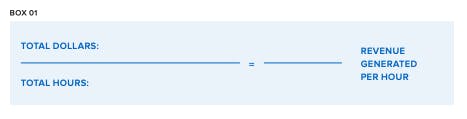
C. Determine how much money you’re making every hour. Divide the total dollars by the total hours worked to find your revenue generated per hour with the box below.
Understand Your Billable Hours
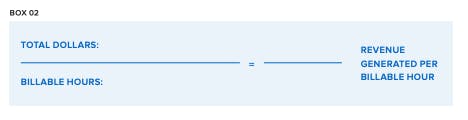
It’s good to know your revenue per hour, but it doesn’t quite tell you what your time is worth. Chances are some of the hours you worked were sucked up by administrative tasks or other typical office duties—things that others who do not have your home remodeling and design expertise could be doing. A more accurate way to determine what your time is worth is to look at your revenue generated per “billable hour”.
A. Billable hour is the time you spent doing the things only you can do—like working with clients, creating renderings, choosing furniture or materials, etc.
D. Look through work logs and invoices to see how much time you spent doing tasks only you could do (or estimate if you didn’t keep track.) How many hours did you spend on those tasks?
E. Now take the total amount of revenue you generated (B) and divide it by number of billable hours
Identify Opportunity For Delegating
Chances are your revenue generated per billable hour (Box 2) is higher than your revenue generated per hour (Box 1). This is because you’re spending time doing tasks that you’re not getting paid for, like working on your website or making sure the books are balanced.
The next step is find out just how much time you’re spending on tasks that could be delegated.
F. Take the total amount of hours you worked last year (B)
G. Subtract your total billable hours (D)

Optimized Income
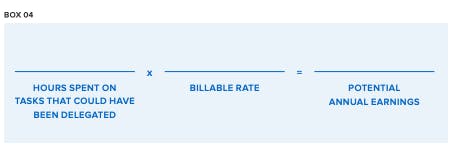
The number of hours you spent working on things that could have been delegated represents time you could be using to generate more revenue if you were to spend that time on tasks only you could do. Let’s find out how much:
H. Take the total number of hours you spent working on tasks that could be delegated (Box 3)
I. Multiply that by your revenue generated per billable hour (Box 2)
Action Items
Is the amount of money you’re leaving on the table because you’re doing tasks that anyone else could do enough to think about delegating some of those jobs?
Here are a few steps you can take immediately to get the most value out of your time as a skilled professional:
01 Identify the tasks you can delegate
02 Find services or tools to handle those tasks
03 Use the extra time to take on more projects
Action Items
While delegating tasks certainly frees up your schedule, keep in mind that this worksheet is simply an exercise to help you visualize what’s possible in terms of revenue. Before you outsource a task to a service or employee, ask yourself the following questions:
01 Will I be able to work as many hours as I delegate, or will I need to account for time training or managing?
02 If I outsource the task, will the cost of the service or employee to do the task be worth it?
03 Would I realistically be able to take on more work with my freed up hours?


Want advice delivered to your inbox?
Unlock industry insights and updates for contractors and design pros
By signing up, I agree to the Houzz Terms of Use and Privacy Policy and that Houzz may use my information to contact me about relevant content, products, and services.