How to Start a Homebuilder Company: All Your Questions Answered
Get your building business off the ground with this comprehensive guide
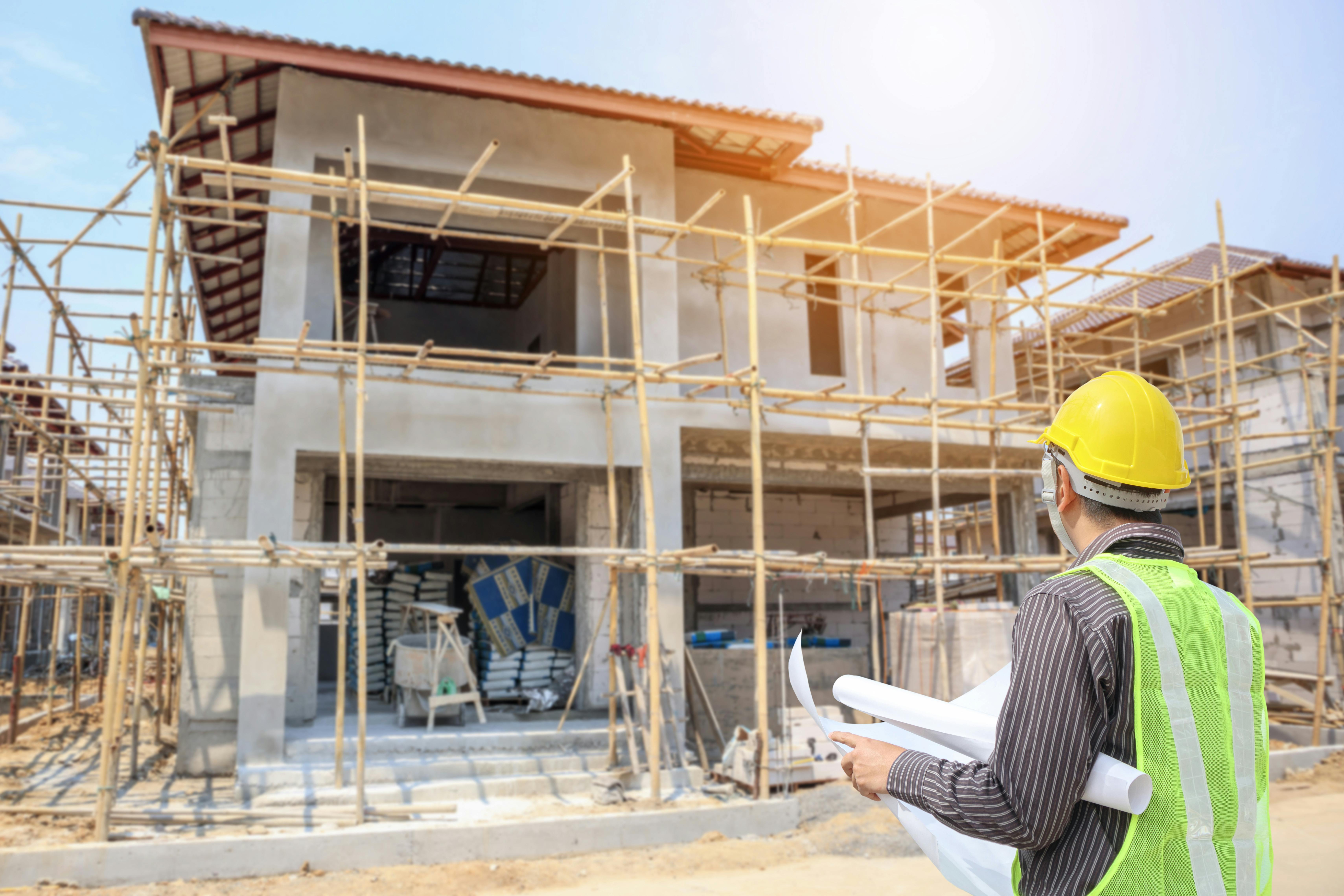
If you’re considering how to start your own homebuilding company, look no further. Here we share 14 steps to do just that, explaining each in detail. Whether you want to learn how to start a custom homebuilding business or you want to work with more typical designs, this guide will give you a solid foundation for success.
Click one of the links below to jump to the section you’re most interested in:
- Identify your niche
- Conduct market research
- Write a builder business plan
- Name your building company
- Decide on a business entity type
- Register your business
- Get building licenses and permits
- Get builder insurance
- Set up your business to receive and send funds
- Get funding
- Set up your office
- Build your team
- Choose homebuilder business software
- Find your first client
How to identify your home building niche
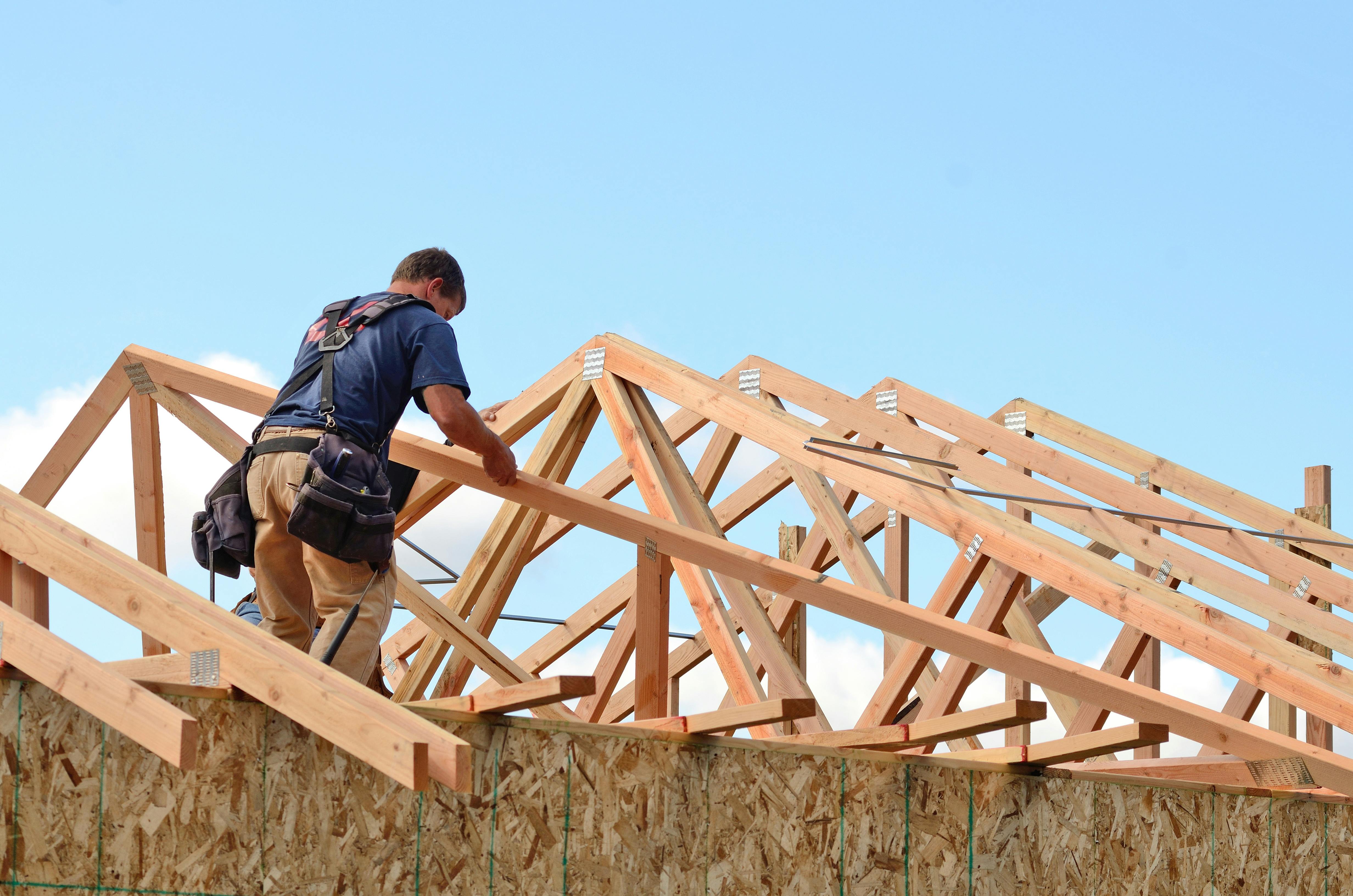
The first step in figuring out how to start a housebuilding business is to decide which niche to pursue. This way you can select the types of projects that best suit your skillset and your new business’ goals. There are four main niches:
- Tract/production: This involves building clusters of homes (dozens to hundreds) in a single neighborhood, typically with a set number of floor plans and design features for buyers to choose from. A model home is often shown to potential buyers, and price is often the deciding factor for buyers.
- Speculation (aka spec): This involves buying a parcel of land and building a house or houses before finding a buyer. The builder determines the floor plan before breaking ground, but if clients buy in before the work is finished, they might be able to choose finishes and appliances.
- Custom: This involves working with the client to build a unique home based on his or her wishes and local regulations, with complete flexibility regarding the architecture and features. Custom builders also can do renovations and add-ons.
- Luxury: In this sector, the homes are generally custom, given the higher budget. But whether the home is custom or not, the architecture is generally more distinctive than for the typical home, and the finishes, appliances and other elements are high end. Artisans might even be brought in to create show stopping components, such as artful gates, stairway railings and tilework.
Consider also the possible specialties within any of the above categories. “Green” or sustainable construction is popular, as is the kitchen-and-bath niche.
How to conduct builder market research
When you’re learning how to start a homebuilding company, it’s imperative to conduct research in certain areas so you’re not just guessing at what clients want and what the local economy and region will support. To make it easier, focus on each area individually. For example:
- Your intended market (both geographical and in terms of specialty)
- Competitors
- The local client base
- Local building trends
It’s not hard to do this research on your own, thanks to all the resources out there. All you need is a computer and the knowledge of where to look. For instance:
- The U.S. Small Business Administration (SBA) offers lots of information on conducting market research and doing competitive analyses and much more in its Business Guide for general businesses.
- The National Association of Home Builders (NAHB) offers many resources including info on industry news, economic analyses, and more.
- The U.S. Bureau of Labor Statistics (BLS) lets you search typical salary ranges and other economic info
- Put out questionnaires and surveys on social media or mailing lists. This is a great way to find out what people really want. You can also join relevant social media groups and get plenty of info without even posting.
- Do an internet search for “residential construction companies + [your area]” to find competitors. Once you’ve identified them, you can check out their websites and social media to see what types of homes and projects are locally popular and what the typical price ranges are.
Attend industry events and/or search their websites as well as other industry websites for published findings. For instance, Houzz offers a number of regularly updated research reports and IBISWorld offers data on industry trends.
How to write a homebuilder business plan
A solid builder business plan is essential for long-term success. Not only will it help you shape your goals and make sure you have enough capital to realize them, but bank lenders and investors will want to see it as part of their research. It doesn’t have to be long and complex to be effective, either. And while charts and graphs can be helpful and in conveying info and giving your plan a professional appearance, they aren’t strictly necessary. But your homebuilder business plan should include the following at a minimum:
- Executive summary: Summarize your business through a bio, goals, and mission statement. Include the niche you chose earlier. This can be just one or two pages.
- Company overview: Describe the founder(s), share your values statement and what makes your company different, and specify the type of business entity (we’ll explain that later).
- Market analysis: Use the research you did in the previous step to show a clear demand and how your company can satisfy it.
- Business structure: More detail about the type of business entity, including whether there are shareholders, what the organizational layout looks like, and the current or planned number of employees.
- Products and services descriptions. Will you offer eco-friendly solutions, for example? Will you focus on a certain style of home, such as modern or traditional? You can also include how you’ll charge for your services (lump sum, unit price, or cost plus) and if you have any existing relationships with developers, subcontractors or suppliers.
- Marketing and sales plan: Include what types of platforms you’ll have a presence on (Houzz is a great one, of course), advertising you’ll be using, any existing email lists, any other ways you’re planning to reach potential clients, and how you’re planning to turn leads into clients.
- Financial plan: Included projected income and expenses, cash flow forecasts, and any debt obligations (investments, loans, and so on).
Note that the components above are the same whether you’re creating a custom homebuilder business plan or a business plan for a building company that works only with fixed designs.
How to name a homebuilding business
This is actually often the first thing people wonder when they’re figuring out how to start a homebuilding company. And it’s worth some serious thought, given that a name is important in terms of conveying your identity as well as in branding, creating a memorable customer impression and maximizing your firm’s appearance in internet search results. Your market research will help you come up with a name that will draw clients, and you can either get creative or take a more straightforward approach using just your name and/or the types of projects you’ll be focusing on (for example, Custom Traditional Homes by Carl). Ideally the name should indicate what your business is, but your own full name alone might be fine if you’ve already built a reputation.
Important: Do a trademark search and also a general internet search to make sure you’re not infringing on someone else’s name either legally or informally. Even if a business doesn’t hold official rights to a name, it can cause confusion among customers if you have the same or a similar name.
Feeling stuck or uninspired? Do an internet search for “building business name generator” for ideas.
What is the best business entity for a homebuilding company?
It’s helpful to consult a tax professional for this, because each entity type has its own tax implications and reporting requirements. However, a sole proprietorship is not recommended, as it exposes you to personal risk (see below).
- Sole proprietorship: This is the simplest type of business entity, but it offers little protection and no special tax benefits. Your business is under your own name and social security number. If you get sued or owe any debt, your personal assets (home, car, and the like) will be on the line.
- LLC (limited liability company): You get certain asset protections and can choose to be taxed as a partnership or a corporation. Reporting requirements and tax calculations are generally not too onerous. Note, however, that not all states recognize LLCs.
- C Corp: The business is a separate taxable entity, and the owners and shareholders have limited liability because of that. It involves several reporting requirements as well as holding regular meetings. One plus is that you can sell stock in the entity to raise capital.
- S Corp: This is technically a tax status rather than an entity type. So, for instance, your business can be an LLC that’s taxed as an S Corp. It can result in tax savings depending on profit amounts, but also has reporting and other requirements — for example, there must be fewer than 100 shareholders.
As mentioned above, you’ll include the chosen entity type on your builder business plan.
How to register a homebuilding company
If your company is a sole proprietorship in your own name, this might not be technically necessary, but it’s still important as you’re working out how to start a housebuilding business to register it as a legal entity to get certain liability protections, legal benefits and tax deductions. The registration requirements for a homebuilding company are the same as or similar to the requirements for other types of businesses; for most small businesses, you just need to register your business name with the local and state governments.
First get a federal tax ID number (TIN) or employer tax ID number (EIN) through the IRS. You’ll need it for paying taxes, hiring staff, opening bank accounts, getting loans and applying for business licenses.
LLCs registration is handled at the state level, but corporations need to file with the federal government, again through the IRS (see Form 2553). Then you also need to register with state and possibly local governments; consult the SBA and local government websites to find out your locale’s requirements.
How to get builder licenses and permits
If you’re just beginning your research on how to start a homebuilding business, you might not be aware that you need licenses and permits. But they’re 100% necessary! Without them, your business could be subject to fines or other penalties and even closure. Every state has different requirements, so it's important that you check in with your state’s agency as well as know all the building codes for your state and city.
What are permits? Permits are evidence of permission granted at the state and/or local level for, among other things, hauling certain types or sizes of materials, or if your vehicle is overweight or oversize.
What are licenses? Licenses are granted for operating the business itself. In most states, you’ll need at least a general contractor’s license. If you’ll be doing a specialty service such as carpentry, painting, electrical, roofing or HVAC work, you might need a specific license for that as well.
You can check what licenses and permits are needed and apply for them on the SBA website as well on other government websites.
What insurance does a builder need?
You might be wondering, do builders need insurance? Definitely! Taking out a few kinds of insurance policies not only is often required by the project agreement, but it will help you protect your business in the event of accidents, lawsuits and more. There are four main types to consider:
- General liability. This covers work-related bodily injury (to subcontractors, clients, vendors etc.) and property damage; the specifics of what’s covered are unique to the particular insurance policy. Note that it does not cover the cost of repairing defective work.
- Professional liability. This insurance is often taken out by homebuilders who are also architects or engineers, as it protects businesses from financial liability for design issues.
- Builder’s risk. This is for anyone with a financial interest in the home being built, and it typically covers the property on the jobsite in the event that it is damaged or completely ruined by fire, wind, vandalism, vehicle collisions or other accidents. Some builder’s risk policies also cover construction materials stored at another location.
- Commercial auto. This is coverage for company-owned vehicles used for work-related purposes, and is similar to what many people carry for their personal autos. It can protect light, medium, and heavy-duty vehicles, and you can take out a policy for just one vehicle or several, as well as add on vehicles personally owned by employees that they use for work.
You might also be required to purchase worker’s compensation insurance, which is helpful to have even if it’s not required; it pays workers in the event that they are injured on the job. Consider also inland marine (aka equipment) insurance, which covers any property that might be moved, including tools and equipment.
Set up your business to receive and send funds
Think about not just how clients will pay you but how you’ll pay vendors, subcontractors and any employees. First you’ll need a dedicated business bank account, which requires a TIN or EIN (see above). Be sure to check any fees that will be charged; most business bank accounts have a minimum monthly service charge, and some charge for every check deposited or financial transfer as well. If you’ll be taking credit card payments, you’ll also need to get set up with a payment processor (tip: Houzz Pro allows you to take both credit card and ACH payments online).
In addition, decide which billing method(s) your business will use and study up on how to price your construction jobs so you turn a healthy profit.
How to get funding for a homebuilder business
Funding sources should be included in your builder business plan, and it’s essential to make sure you always have enough working capital to cover the amounts you’ll need to lay out for materials and supplies, office overhead, and payments due until the client pays you. Luckily, there are a number of sources to possibly tap as you figure out how to start a homebuilding company.
SBA and other small business loans. While they can be hard to get and require lots of paperwork, SBA loans are a great option to try for due to their low interest rates and generous terms. Three of the most common are:
- 7(a) loan program: Up to $5 million, and can be used for a variety of business-related purposes.
- Microloans: Up to $50,000 and can be repaid over as many as six years.
- CDC/504 loans: Up to $5.5 million for purchasing fixed assets such as heavy machinery. Can be repaid over 10 or 20 years.
Many lenders both locally and nationwide offer small business loans as well. You can find out about these via internet search; be aware that terms can vary widely.
- Working capital loans: To cover day-to-day expenses such as office rent and payroll. These include lines of credit through a financial institution.
- Vendor financing: Individual vendors may offer short-term financing/payment plans at varying interest rates, generally between 1% and 6%; be sure to read the fine print on the terms of repayment.
- Equipment loans: For purchasing machinery; the amount loaned must go directly to the cost of the machinery. The equipment’s value serves as collateral, so this is a good option if you have no other collateral or a not-ideal credit score.
Tip: Networking can be a great way to get advice about financing from those who have “been there, done that.” Check out our handy guide to networking in construction for ideas.
How to set up an office for your homebuilding company
While it might be tempting to save money by working from home, a dedicated office confers an air of legitimacy and acts as a place where you can easily meet clients, investors and others involved in your business. You can also set aside a portion of it for holding material samples, project models and other bulk items.
- Pick the best geographical location. Ideally it will be convenient for both you and anyone who visits. Consider your commute time, local traffic and the parking situation.
- Consider office style. Remember that everything the client sees creates an impression. And if your company focuses on modern housing, for example, setting up in an old Victorian mansion might send mixed messages. Make sure the setting is professional-looking and creates a trustworthy image as well as fits your brand.
- Research costs. You should account for rent or leasing costs in your builder business plan, and make sure that you can afford them. You might have to trade a favorable location for something that works with your budget.
- Ensure security. If you’re not in a building with a guard and/or an alarm system, set up your own security system. Keep in mind that while your files might not be worth dollars to a thief, you’ll be working with clients’ sensitive financial information, and it’s worth protecting.
- Furnish it. At a minimum, you’ll need a desk and chair for you and somewhere else for others to sit, plus a filing cabinet and some general storage. As you might be working on how to start a homebuilding company on a shoestring, check out secondhand stores and local online resale websites such as Craigslist. Add at least a bit of decor too, including any framed certificates of training or printed accolades.
- Equip it. If you work only on a laptop and use your cell phone, you’ll likely still need a printer, some good task lighting for your desk and perhaps a paper shredder for sensitive documents.
How to build your team
1. Decide what roles to fill
Your team might be small to start, but you’ll need at least a project manager to oversee the construction and development of the homes; a home dealer, who will handle pre-project client-related tasks such as selling the homes; and the subcontractors who will do the actual work. Aside from those, you’ll likely need to bring some or all of the following on staff or hire them on a freelance basis:
- Construction foreperson
- Equipment manager
- Inspector
- Superintendent
- Estimator
- Surveyor
- Engineer
- Bookkeeper/accountant
- Assistants
2. Interview candidates
Building the right team requires interviewing people thoroughly to make sure they’re:
- Qualified
- Truly interested
- Trustworthy
- A good fit in terms of personality, values and work ethic
See our articles on common construction titles and how to recruit for your team for more info.
3. Keep your employees happy
Job satisfaction is just as important as good pay for many people, so make sure to keep the lines of communication open and listen to what your employees and contractors need. Be flexible when you can and offer opportunities for advancement. See our article on how to retain construction talent for ideas.
How to choose builder business management software
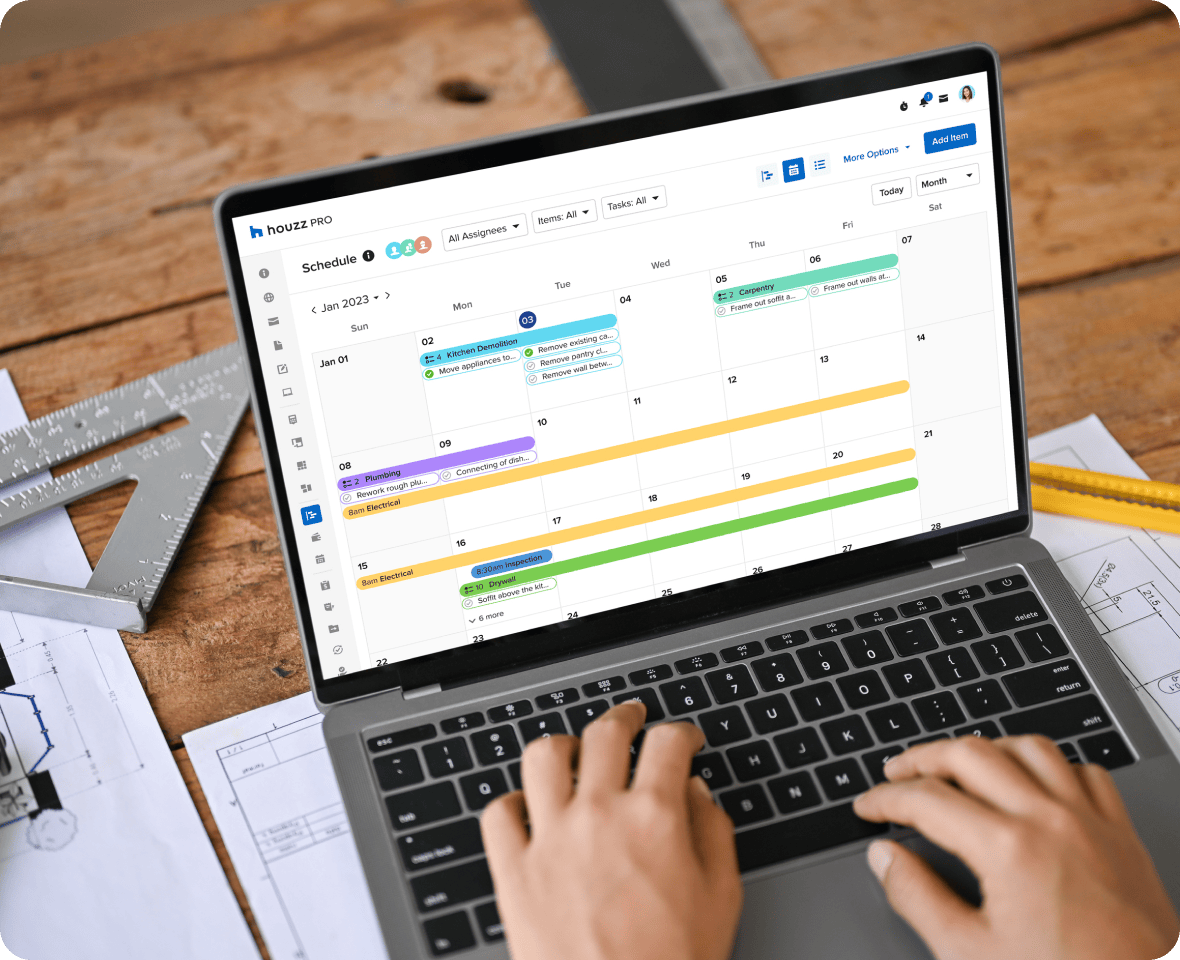
The right software won’t just make your job easier; it’ll help you organize and follow up with leads, increase the accuracy of all of your calculations, let you easily analyze your business’ finances and keep your clients and team members in the loop. So as you’re working out how to start a homebuilding business, consider that investing in software will pay for itself in the long run. Look for something that can help you with everything from organizing to taking payments. It’s especially important that the software is easy to adopt (that is, it has a low learning curve) and that it includes:
- Tools for creating takeoffs and estimates
- Features that promote collaboration
- Cloud-based storage and other features
The ability to use the software on a mobile device also is essential, so you can work whether you’re in the field or at a desk. For home builder software, you can’t beat Houzz Pro, which has all of these features and capabilities and more. Try it free today to put your new construction business on the path to success!

How to find your first builder lead
Getting the word out about your new business is mission critical for the long-term success of your business. And even when you start landing clients, you want to keep focusing on bringing in new clients so you always have a steady stream of work. Our guide to getting leads for a residential construction business is a great place to start; it covers digital marketing, networking, getting referrals and more. Also check out our articles dedicated to:
Conclusion: ‘Should I start a homebuilding company?’
By now you should have a pretty good idea of the answer to that question. Even if you’re excited to get started right away, take some time to think it all through instead of just rushing in. Research all of the next steps involved in the actual work too so that you’re comfortable with what’s required. For instance, learn all about the construction project workflow. And talk with booth new and veteran builders to get their take — there’s no substitute for personal experience!


Want advice delivered to your inbox?
Unlock industry insights and updates for contractors and design pros
By signing up, I agree to the Houzz Terms of Use and Privacy Policy and that Houzz may use my information to contact me about relevant content, products, and services.