Everything You Need To Know About Pricing Your Services
It’s fulfilling to earn a living doing work you love in an industry you’re passionate about, so it’s important to price your services accurately to meet your customers’ budgets while generating a reasonable profit.

Determining how you price can be a challenge, but finding a system that works for you is essential to longterm success.
This article provides advice into four common pricing questions that all business owners face - no matter whether your focus is design or construction.
We’ve gathered best practices and suggestions from architects, builders, contractors and interior design pros across the country. No matter what your experience, if you’ve ever struggled with pricing your services, we hope you’ll find the advice of fellow professionals useful in guiding your pricing decisions.
HOW DO I KNOW WHAT TO CHARGE?
Do the Math
This is one of the most common questions businesses face, whether they are just starting out or facing changes in their costs. While there’s no easy answer, doing a few easy but key calculations can help you begin to estimate how much you need to make in order to sustain your business and earn a reasonable level of income.
General Contractor Steve Greenberg advises:
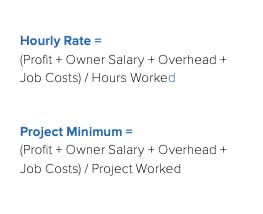
1) First, figure out how much you want to make a year. Consider your profit and growth, and the salary you want to take home. Then, figure out what your overhead costs per year, which includes anything you need to keep the business in operation: insurance, rent, trade groups, utilities, and equipment costs including maintenance.
2) Next find out the job costs like materials, crew salary (including vacation pay or benefits), subcontractors, even gas. Add the profit, salary, overhead, and job costs to find out the total yearly costs of doing business.
3) Once you have that figure in mind, estimate how many jobs you think you’ll get, and what size they’ll be. Be conservative at first.
4) Divide the cost of doing business by the number of hours or projects you or your business will work, and you’ll have a billable rate.
Do Market Research
As a starting point, look for broader research reports that you can use as a benchmark for what you can expect to earn in a year — in revenue and in profit.
The NAHB publishes an annual Cost of Doing Business study reporting financial stats such as gross and net profit, liabilities, and owner equity so business owners can compare their company to industry averages. The Houzz Renovation Barometer is conducted quarterly among a national U.S. panel of architects, interior designers, general contractors, remodelers, design-build firms, and landscape/outdoor specialties, and includes local data on cost trends.
Another source of good information can be your competition and colleagues.
“For comparison, see what other contractors of your quality, experience, and business size are charging. Ask members of any trade organizations you’re in or find some peers that you trust and see if they’re willing to share their numbers. Join a peer review group or start one so that you can safely share and learn from your peers. If most are charging $50 an hour, but you charge $75, you’ll may be staring at the phone a lot if you aren’t able to justify and convince potential customers you’re worth the premium. If you feel you need to charge that $75 to make your numbers work, start looking at how you can cut expenses to be more profitable and charge less. On the other hand, don’t undervalue yourself.” —STEVE GREENBERG, STEVEWORKS LLC
Include Complexity When Determining Pricing
Not all projects are equal, and you can charge a premium for taking on work that others can’t or won’t. Decide how much profit you want to earn to make it worth your time to do the project.
“The difficulty, complexity and time required for each job helps me determine the profit margin for my projects. For example, a simple exterior paint of a ranch home might yield a 10% profit. A room addition on a hillside with rocks to move, electrical and septic lines in the way, and many more details will demand a 30% profit, because you’ll spend a lot more time and the risk is greater. When you spend your time on a higher risk project, you should get a higher return.” —RUSTY BORDERS, K.O.H. CONSTRUCTION CORPORATION

HOW CAN MY PRICING BE MORE STRATEGIC?
Optimize Your Pricing Structure
Everyone wants more revenue, but raising prices can turn off existing or potential customers. Here are five possibilities to increase revenue without simply charging more:
Cross-sell: Sell additional complementary products or services to existing customers that don’t compete with your main offering. For example, a landscape architect could serve as a dealer for spas to gain commission when clients want to incorporate that feature.
Bundle with other pros: Combine your services with another provider. Team up with other designers and builders to sell your services together. You’ll capture leads who are looking for one team to handle everything from start to finish.
Bundle your offerings: To convince a client to take on a project with a larger scope, try offering them a discount compared to if they handled the whole project in smaller phases.
Up-sell: Convince a client to upgrade to higher level of service. If their need would best be met by a larger scope, you can educate them on the benefits of taking on a bigger project or receiving more professional assistance.
Add-on: Include a service that is related to what the customer is buying and amplifies the value of the project. Some add-ons could be photorealistic renderings, more detailed plans or managing permits, beyond the basic requirements for the project.
“Changing the conversation around the way you structure your proposal will help you generate revenue by delivering more value without being overly promotional. There are multiple strategies that will give you a more complex but beneficial pricing model.” —ENOCH SEARS, ARCHITECT
Offer Tiered Pricing
Tiered pricing works by replacing the one-size-fits-all proposal with multiple options. To create your tiers, begin by listing all of the services you could possibly offer, then group your services into three distinct levels. The highest priced package should include everything you have to offer with the lesser packages including fewer services.
Most people will choose the middle package because they do not want to select the least expensive option, but may not feel ready for the most expensive option. However, the lower priced package still needs to have value, so you can still deliver exceptional results no matter which option they choose.
If your business handles design and construction, you could offer tiers related to handling multiple phases of the job. A different option is to sell based on levels of service and how much help the client needs with the project.

The Pros and Cons of Charging a Consultation Fee
Your pricing strategy starts from the initial consultation, and there are different approaches with their own unique benefits and drawbacks. Here are three different takes on this hotly debated question:
“I have always charged a consultation fee because I am a professional and my time is valuable. My initial consults are working meetings and can be standalone, or a jumping off point for larger projects. I try to provide as much information to the client about my process and services prior to meeting so they can determine if my firm is a good fit for them.” —REBECCA WARD, REBECCA WARD DESIGN
“I do not charge for my initial meeting but I do not give specific professional advice. Instead, I discuss my approach to the project and ask general questions about the client’s objectives, preferences, and budget. That meeting is also an opportunity for us to meet one another which I hope will create a comfort level for the client. It also helps me determine whether or not I want the job.” —TERESA BUCHANAN, DESIGNLINE
“For referral work, I offer a free consultation. I started charging a fee for leads that are not from a referral. I want to see if they are serious about their project before I drive to meet them. It’s an effective way of screening leads and my conversion rate of interviews to projects is higher when I charge, simply because there are fewer interviews if I don’t offer a free consultation.” —CINDA LESTER, 12/12 ARCHITECTS AND PLANNERS
The Case For and Against Discounts
Offering a small, targeted discount to people new to your area can be a way to spread awareness of your business. However, some professionals feel that offering discounted services does more harm than good for the business because clients will attribute different values for the same service.
“When I started my business I did targeted direct mail with a postcard that offered a $100 discount. I mailed the postcard to customers who had just purchased a home in my area. It seems when people buy an existing home, they always need something done.” — MARK BURNS, BOERNE KITCHENS AND BATHS
“We occasionally run 10% off for interior painting in November and December. We do it to keep our crews busy in our slower months. We don’t do it every year, but if we don’t have much in the pipeline, we send an email blast to past clients notifying them of the discount.” — JEFF DUPONT, SOUND PAINTING SOLUTIONS
“The issue with discounts is that the client still expects and deserves the same level of product or service. My company stands firm on our pricing for all clients, keeping it competitive and fair.” — JOHN MCCLAIN, JOHN MCCLAIN DESIGN
Business Growth & Management
We hope you’ve enjoyed our eBook about strategic pricing practices. Put your new pricing approach to work with Houzz. From targeted local advertising and enhanced exposure on Houzz to business management software that streamlines proposals and billing, Houzz Pro can help you reach new clients, target different types of projects or geographies and do more with ease.
Contact sales to schedule your interactive, online demo.
“Houzz is the only source of marketing we participate in. The leads we receive are in our target area and it has provided a verified source of customer reviews and displayed work in a professional format. Clients like to see that we have such a robust profile on Houzz - there is value there.” —ZACH MESCHI, MESCHI CONSTRUCTION


Want advice delivered to your inbox?
Unlock industry insights and updates for contractors and design pros
By signing up, I agree to the Houzz Terms of Use and Privacy Policy and that Houzz may use my information to contact me about relevant content, products, and services.