How Do You Know if a Potential Client is a Good Fit?
The relationship between a professional and a client is especially important in highly personal and service based industries like home design and renovation. So how can you, as the service provider, foretell if you and a potential client will likely have a successful working relationship?

One of the best ways to qualify a client is to create a persona of your ideal client, and compare potential clients to that persona. To create that persona, you’ll need to be introspective about what you value in a client and consider similar traits between past clients with whom you really enjoyed working. Use the Ideal Client Worksheet on the next page to guide the process.
In this article, members from our professional community will share how they qualify a client as a good fit, and we’ll share tips on how to handle a potential client who doesn’t meet all of the criteria.
The Goal
Save time, increase your win rate and maximize your return by creating an ideal client profile Knowing what your ideal customer and ideal project looks like will simplify screening inquiries and qualifying leads.
Ideal Client Demographics
Understanding who your ideal client is and where they are located will help you identify promising projects at a glance.
Where is your ideal client located?
What areas do you want to work in? How far do you want to travel?
What is the ideal age range you want to work with?
Do you want to work with clients who are younger or more mature?
Does your ideal client have a family or are they single?
Do you prefer working for clients with individual or multiple decision makers?
Based on your project cost, what would the ideal household income level be?
How much income is needed to afford the type of projects you want to work on?
Project Logistics
Knowing what your ideal project is and at what stage you want to be involved will help you determine if future opportunities are the right fit for your business.
What types of projects do you want to work on most?
Which projects best fit the direction you want to take your business? What kinds of projects do you want to add to your portfolio?
What timeline works best for your projects?
Is there a certain timeline you like to follow for your projects? Are there certain seasons or months that you prefer to work during? What is your current pipeline and how might new projects fit into it?
What is your ideal project budget?
Given your average project costs, do you have a minimum budget you’re willing to work with?

Working Style & Motivations:
Every project requires some level of collaboration. What does your ideal partner look like and what are their motivations for this project?
How engaged is your ideal client?
Do you prefer to work with clients who are hands on or hands off? How involved does your client need to be for a successful project?
What is your ideal client looking to achieve through this project?
Are the reasons behind the project important to you? Do you want to work with clients who are emotionally invested or approach the project from a more practical standpoint?
Is it important to work with clients who already understand your style?
How much time do you want to spend educating a potential client about your work? Would you rather work with someone who has done their research and knows what they want?

The Ideal Client
The Potential Client is Familiar with Your Work
A designer or renovator’s personal style is often a primary consideration for homeowners when selecting which pro they want to hire. It makes sense that your portfolio would draw in clients who want a similar look and feel in their home. Is the homeowner that’s reaching out to you familiar with your work? Have they taken the time to visit your Houzz profile or website? Or did they just call you because you were a referral from someone they know?
If they reference your portfolio, it shows they have taken the time to research your firm and are emotionally invested in working with you specifically because of your unique skill set, accomplishments, and aesthetic. Regardless of if you have a signature style, when a homeowner is familiar with your work, they may have more realistic expectations of what you can deliver and they may be more likely to proceed with your proposed design.
“We have initial dialogue prior to consultation about the scope of work, location and if they have seen our work on Houzz or our website prior to contacting us. If they are familiar with our work, we proceed with a bit more dialogue. If they are not familiar with our work via Houzz or our website, we ask that they spend a bit of time looking at both venues and then call us back if our portfolio is consistent with what they want to accomplish. It might sound a bit ostentatious on our part, but it has been an effective tool prior to a site meeting.” John M. Algozzini, K&D Landscape Management
The Potential Client has a Realistic Budget
Taking on a renovation project is usually a substantial investment for a homeowner, especially when they want to hire a pro instead of taking a DIY approach. If you find out that a potential client’s budget is realistic and in line with your past projects, that’s a clear sign to take action to get their project on your calendar.
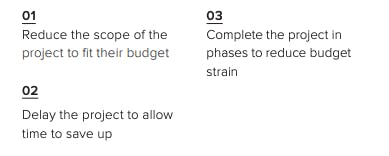
However, if you meet with a potential client who seems like a fit in all areas except for the budget, it’s not automatically a lost opportunity. If their budget number falls a bit short, ask if they would be willing to do some of the following:
If her budget is far below what you estimate the project will cost, use data like budgets from prior projects or the Houzz & Home study to show what others are spending on projects and demonstrate that the client may need to reset her expectations regarding the cost.
“For a project to be successful, we strive for a finished project with a happy client. If a client has lofty dreams but no budget, right off the bat we are already struggling to meet the client’s expectations. Sometimes clients don’t know what their budget is. But they must be willing to be adaptable - for example, listening to the pros to learn what is possible. Maybe it means upping what they expected to spend or adjusting their wish list.” Collin Kayser, Garrison Hullinger Interior Design
The Potential Client Has a Realistic Timeline
Studies have shown that when a person decides upon a time and place to accomplish a certain task before beginning, they are more likely to actually complete said task. This rings true when it comes to clients and setting a timeline for their renovation projects. Many pros tell us that the way they know a client is serious is when he has a timeline for when he wants the project completed.
If a client presents a vague timeline or says they are unsure, ask questions like these to get them thinking about time-bound reasons to move forward with the project:
01 | Do you want to use the space to host any specific upcoming events? (If it’s a kitchen, maybe they want to the host family for the holidays; if it’s a backyard, maybe they want to enjoy it during the next summer.)
02 | Are you anticipating any changes that could impact how you use the space, like retirement or any new household members?
03 | Are you waiting to set a timeline because you foresee possible changes in the scope or budget?
"'What’s your timeline?’ has the most valuable answer of all. Any timeline is fine and a customer can say even three years from now and they will do the project 90% of the time, often much sooner. However, the answer ‘I don’t know’ means that the project will most likely never happen and that the customer should not be pursued.” Paul McAlary, Main Line Kitchen Design
The Potential Client Cares About Design or Aesthetics
When it comes to home design and renovation projects, it would seem obvious that a client cares about design. However, some clients may care about having a professionally renovated home for other reasons, perhaps to improve the home’s resale value, for example. While a valid reason for wanting to take on a project, some pros say they especially enjoy working with clients have an inherent desire for a well-designed home. Beyond just caring about design, some pros verify that a potential client also attributes a financial value to the design phase.
“We watch for people who value aesthetics; they may own some art or enjoy fashion or appreciate beautiful automobiles. These are not necessarily artistic people themselves, but beauty, whether in a mountain landscape or a well-engineered bridge, speaks to them.” Karen Keating, TKP Architects
“I typically will meet with a prospective client for no charge, but I always ask for a retainer before putting pencil to paper (or fingers to a keyboard). Good clients understand that good design costs money. If they balk at paying $1,000 upfront, they will probably balk at paying your fee later.” John Barton, Architect

"If a client owns a good and/ or valuable piece of art, they usually turn out to be a better client overall for me. They ‘get’ me.” Aggie Purvinska, Aggie Designs
The Potential Client Does Not Waver
It’s clear you have a promising project if a potential client presents you with a solid budget, timeline, scope of work, and design style—but it’s also important that they do not waver from those initial factors. A client may say he is willing to spend $100,000, which you know should cover everything on his wishlist; but if after the meeting and before he signs the contract, he says he feels more comfortable spending significantly less, it leaves you in the tough spot of having to reconsider if the project is worthwhile given the new constraints.
Some adjustment to a wishlist, timeline, or budget is appropriate and reasonable. But if a client is very much off the mark from what they initially said, it’s worth taking the time to address their concerns, and perhaps even reconsider moving forward.
“We try to have more than one initial meeting to see if it is a fit. Frequently on a second discussion, you begin to hear changes to the initial discussion. Like, ‘oh yes we said we were going to move out, but now we are going to try to stay living in this major massive remodel,’ and ‘I know you said it would take 9 months but can it be done in 5 months?’ If those red flags appear, it is time for a re-discussion or a time to determine that this is not a good fit.” Kirk Nelson, Design-Intervention

The Potential Client Communicates Freely
Communication is essential from both pro and client to complete a design or renovation project. If a client cannot articulate what they want or need, is not responsive to calls or emails, or if they hold back information you need to move forward on a proposal, it could signify challenges ahead.
Tools to facilitate and set expectations around communication can come in handy:
01 | Houzz Ideabooks can help the client articulate what they want in their space
02 | Develop a questionnaire to collect information from homeowners before scheduling a consultation; some pros use web forms with required fields
03 | Use your contract to define necessary timelines for responses and preferred methods of communication
“We utilize a checklist and follow our instincts. Bad body language and resistance to sharing information usually means a bad fit. Clients that do not share budget parameters are generally ruled out as they are suspicious. If they do not have confidence in our team it is generally a poor use of their time and ours.” Steve, Urbanata
“First impressions are critical. Communication just in the initial phone/ email contacts and the first meeting is a huge indicator. Also, how a potential client treats others in the room (spouse, assistant, contractor, whomever) says a great deal about what it will be like to work with them. Mutual respect and good chemistry are a must.” Leah Ansel, Space Planning Technologies
A positive attitude about the project can be an indication that the homeowners will help make the renovation process smooth. It makes it easier for you to sell a potential client who is ready to get started and who sees all of the benefits of transforming their space.
Sometimes, one member of a couple may be enthusiastic about the project, while another is apathetic or perhaps even downright negative. There are a multitude of reasons why someone could express some negativity about the project, and addressing those can help build trust and impart that you care about their experience and satisfaction with the project.
Here are some tips for how you can address their feelings and hopefully get them feeling more comfortable and excited for the project:
01 | Mention that you’ve noticed they do not seem as enthusiastic as their partner and ensure you want to provide a great experience for all parties involved.
02 | Ask what’s causing these concerns—is it the investment, inconvenience of living in a construction zone, or another factor?
03 | If you have one, share an anecdote of a past client who felt this way and what you did to assuage their concerns.
04 | Depending on what’s causing their lack of excitement, use materials such as past client reviews or before and after photos to sell your skills, or data like the average return on project investment to demonstrate how they will gain from the project.
05 | Ask the enthusiastic partner how they want to use their space after the project is completed, and ask the unenthusiastic partner if they can envision those benefits as well.
"Are they enthusiastic about the project, rather than viewing it as a giant ordeal? I’m 100% onboard.” Hampton Ford Design

Business Growth and Management
Screening clients to determine if a homeowner you’ve recently met would be a good client for a renovation projects involves skills in sales, communication, and even perhaps some psychology. You can make it easier by improving your pool of prospects to include a higher ratio of homeowners who are educated, excited about their project, and ready to get started.
Signing up for our business growth and management program, Houzz Pro, can help. Brand yourself and connect with homeowners who are researching their projects on Houzz, then smoothly manage the project with estimation tools and a client dashboard to provide a seamless experience. Houzz Pro membership comes with features including enhanced exposure, support from a Client Success Manager to update and maintain your profile, a website, Insights, and enhanced lead attribution information.
Whether you’re looking to make each project more profitable, or take on more projects, Houzz Pro can help you work toward your goals by optimizing your operations. To schedule your interactive, online demo, contact sales.
“Houzz is our primary marketing tool as it brings in up to 40% of our business. The leads we get are mostly mid to high end with jobs. We had significant results within the first month of joining, and we use the input from our Client Success Manager to maintain our online presence.” Scott Lankford, Lankford Associates
“Houzz greatly assists in reaching our target demographic market. It is much more effective than other advertising methods as Houzz users are all about the design industry, and the leads are almost always on target.” Michael Gainey, Michael Gainey Signature Designs


Want advice delivered to your inbox?
Unlock industry insights and updates for contractors and design pros
By signing up, I agree to the Houzz Terms of Use and Privacy Policy and that Houzz may use my information to contact me about relevant content, products, and services.