Free Template: How to Write a Builder Construction Contract
Protect the business you've worked hard to build. Download our free builder contract sample and builder agreement template, then read our guide to get started.

This content was originally published Oct. 29, 2023, but was reviewed May 20, 2026, and is up to date.
As a homebuilder, you know there are many moving parts in every construction project and plenty of risks for miscommunication between you and your clients. To reduce the potential bumps during the life of a project, one of the most important documents you will create for your clients is a builder construction contract. In this guide, we lead you through all the steps for writing a professional builder construction contract with tips for making the job as easy and efficient as possible.
We’ve included a free, downloadable and editable builder construction contract template. This can be customized to your business and every project. You can download it to print it or share with your team and clients. Also, included is a builder construction contract example to illustrate how other building professionals organize their contracts.
Click on a link below to jump to the section you’re most interested in:
- Download our free homebuilder contract template
- What is a builder construction contract?
- Why are builder agreement contracts important?
- When do you need a builder contract template?
- Types of builder construction contracts
- 18 clauses to include in a homebuilder contract form
- How to create a homebuilder construction contract step-by-step
- Tips for after you’ve drafted your homebuilder contract
Download Our Free Homebuilder Contract Template
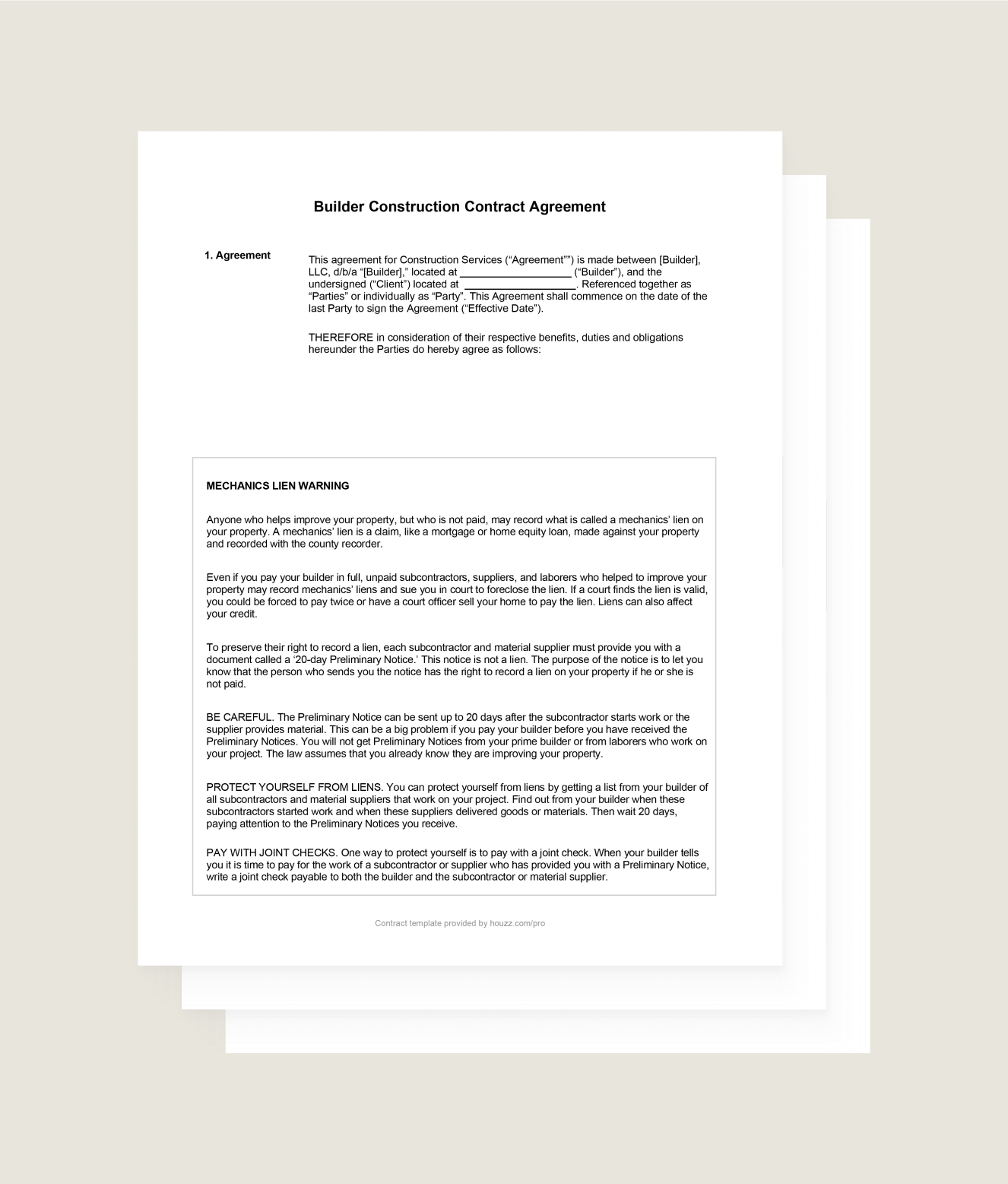
Get Started With This Free Homebuilding Contract Template
Use this Homebuilding Contract Template to protect your business.
The to-do list when starting a homebuilding business can be a long one. Learning how to create comprehensive, professional contracts is likely near the top of your list. We’ve got that one covered. Download our free homebuilder contract template, which will serve as your guide for what to include in the contract.
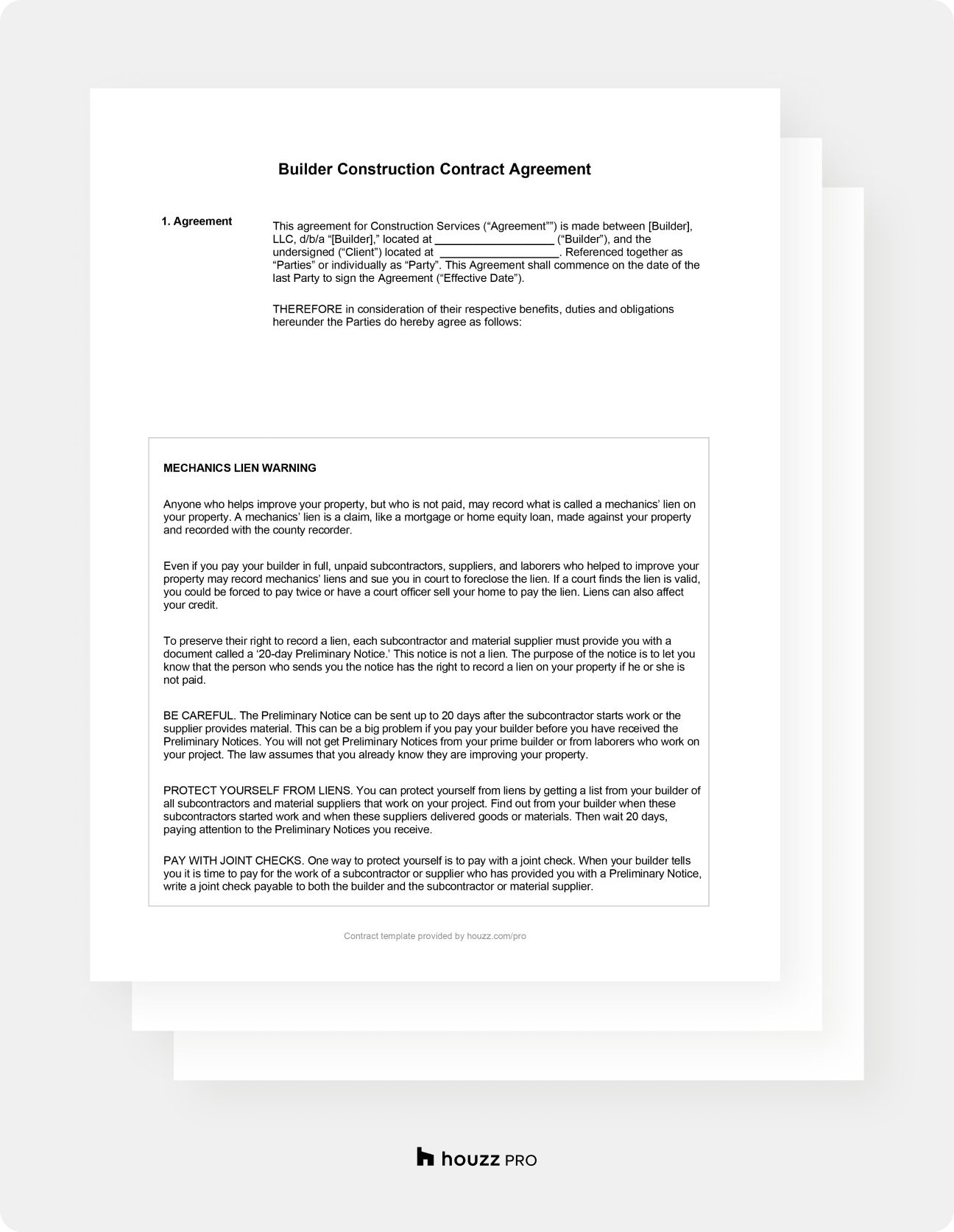
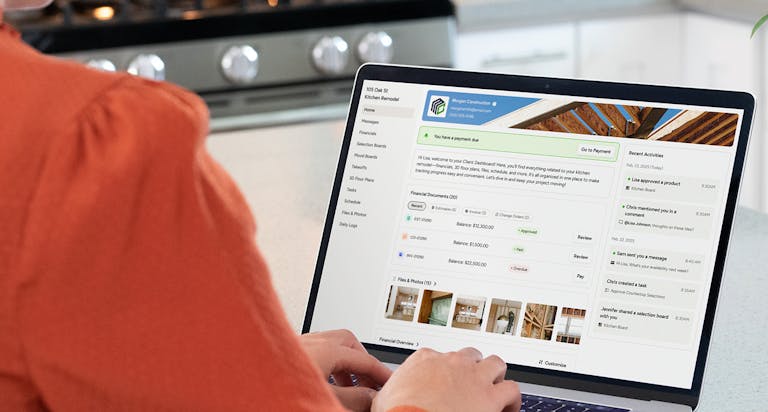
Besides using templates, professional homebuilders also turn toward homebuilder software to make the task even easier and run every aspect of their company more efficiently. With features ranging from lead generation to project management, homebuilder software can help you create homebuilder contracts faster, and it allows you to offer the convenience of e-signatures to your clients.
With software, you will no longer need to store your paperwork in bulky binders or file cabinets because all documents are stored safely in the cloud. Explore our Houzz Pro e-signature and single central business hub features for free today. Try a free trial of Houzz Pro.

What Is a Builder Construction Contract?
A builder construction contract protects both you and your client. It lays out every aspect of the project, the services you will provide, terms and conditions, pricing, payments, and more. Often referred to as agreements, builder construction contracts are more comprehensive than a scope of work or a change order, and they are legally binding once they are signed by all parties.

Why Are Builder Agreement Contracts Important?
Builder agreement contracts serve as a safety net for the multiple scenarios that can happen during the life of a project. It spells out how disagreements will be resolved, can protect you from circumstances such as weather delays, and serves as the go-to document if clients change their minds. Investing in getting this document right before starting a project can save you the burden and costs that can arise from multiple change orders, or even legal action.

When Do You Need a Builder Agreement Template?
A builder agreement template is best practice for every homebuilding project and even smaller renovations or remodeling work. It should be drafted and signed before any work begins, and a builder agreement sample can be a good place to start.

Types of Builder Agreement Contracts
There are various types of homebuilder contracts. These are four of the most common ones. They vary in risk and depend on your preferences and the type of projects you take on:
- Fixed price - Under this scenario, the entire cost of the building project is summed up in one lump sum. The client is responsible for paying that amount, but there also may be incentives built into the contract for finishing the project early, or penalties for going past the completion date.
- Cost plus - This method bills the client for the actual cost of the project, including labor and materials. It also adds on a percentage or fixed fee to cover your overhead expenses and profit.
- Unit pricing - When the project is divided into unit measurements, it is called unit pricing. The typical breakdown of the units include tasks covering the scope of work and the materials needed to carry out that work.
- Time and materials - For this type of billing, clients agree to pay a set hourly or daily rate for the project. They may also pay additional costs outlined in the contract, such as markup and overhead.

19 Clauses to Include in a Builder Contract Template
The sections you include in your builder contract template will vary depending on the type of project and the specific needs of your business. To get you started, we have gathered a list of the most common ones included in every homebuilder contract. You should always consult with a lawyer before delivering a contract to your client to make sure you have every aspect covered.
- Company and client information - Include the information about your company and brand it with your logo. Also, list the name of the client and contact information. In all cases, make sure you are using the full, legal names.
- Project property - Provide the exact address and location of the property where you will be doing the building work. Refer to the legal deed location of the property whenever possible to provide clarity, especially for home construction on a now vacant lot.
- Services - Detail which type of services your company is providing for the project, so that there are no questions down the line.
- Mechanics lien - Most states require that the property owner be notified in advance if you are using a lien to help guarantee payment. Make note of it in the contract.
- Scope of work - Provide a detailed description of the parameters of the construction work you will perform for the project. This section should provide clients clarity on the work they are seeking, and even what is not included.
- Materials and expenses - This covers all the materials and costs associated with carrying out the building project. Provide details to help clients understand the costs behind the work and the value they are receiving.
- Payment terms - Include a section that lays out the payment schedule and includes penalties for late payments or discounts for early ones.
- Construction schedule - Add a timeline, including the anticipated start and finish date as well as the target completion dates for various phases of the work.
- Permits and licenses - Remember to list all permits that are required, the costs, and who is responsible for acquiring them.
- Insurance and security - Not only is it legally required, but liability insurance protects you and provides clients peace of mind. Note your coverage parameters.
- Conditions and responsibilities - This section covers which conditions need to be met before work begins, as well as final inspections at the end of a project. It also outlines who is responsible for the tasks that make up the project work.
- Refunds, cancellations, and termination - Spell out the terms of when a refund would be issued or the contract canceled.
- Amendments - Note how you will handle changes to the contract if a client wants changes to the project scope, or if circumstances change on your end.
- Governing law - For a contract to be legal, you must list the state or governing law that interprets the document.
- Dispute resolution - Explain which steps will be taken to handle disagreements such as mediation, arbitration, and legal action.
- Warranties - List the guarantees you provide for your construction work and materials, what it covers, and for how long.
- Indemnity homebuilder contracts - These typically require builders to compensate (indemnify) the client for any injury or losses associated with the work or resulting from a breach in the contract. Third parties, such as other subcontractors hired by the client, may also need to be included.
- Force majeure - Your company is not responsible for everything that can go wrong. This states that you are not liable for damage caused by circumstances beyond your control, such as natural disasters.
- Signature terms - End the contract with a section to sign and date the contract. Make it clear what is being agreed to with the signing.

How to Create a Homebuilder Contract Step-by-Step
Now that you know what to include in the contract, you can get started gathering all the information you need to write it up. Here are the steps to get you there:
- Create a budget - The contract should include the exact and final cost of the homebuilding or remodeling project, so be sure you have calculated all the expenses associated with the work and have a quote or estimate prepared.
- Set a schedule - Determine the start and end dates of the construction project and the timeline for various phases of the work. Add target dates for each milestone. Anticipate possible delays caused by weather or other circumstances and build them into the schedule.
- Establish subcontracting terms - Review the type of subcontractors and tradespeople you will need to carry out your company’s end of the work and confirm the terms, costs, and availability of the labor.
- Define provisions of equipment and materials - Another key part of the project is determining the pricing and sourcing of the equipment and materials that will be used in the construction project. Confirm the availability of both to meet your schedule.
- Finalize the scope of work - By ensuring that you completely understand the expectations of the client and scope of the work, you can avoid disputes throughout the life of the building project. This may require checking back with the client and visiting the site to clarify and confirm their vision for the project and the services, materials, and labor you will provide.
- Determine payment schedule - Set the terms and stages of payment before writing up the contract. Seeking a deposit before any work begins is good practice, especially for such large projects, and ensures the client is committed to your company and the construction work. It also provides your company with revenue flow. Note when the payments are due throughout phases of the project and the penalties for late payments.
- Draft contract - Now that you have gathered every detail of the building work you will provide, it’s time to draft your contract. Add the information into the contract under each heading. Check and double-check your work.
- Consult with a lawyer - Before you send a contract to a client, protect your business by seeking the advice of a lawyer to ensure that you have adequately covered all the requirements.
- Review and send - Once you are happy and confident that the contract has covered all the bases, review it one more time and then send it to your client.

What’s Next? More Tips for Drafting Your Builder Contract Template
- Research state requirements - States have varying provisions and requirements regarding contracts for homebuilders. Check the websites of the locations in which you are conducting business.
- Include your license number - It is good practice to include this information on all your business documents such as estimates, invoices, and your website. Besides the legal implications, licensing signals the professionalism of your business and adds assurance for clients.
- Important note: Seek counsel from a professional lawyer - To make sure your contract is legally airtight, have a lawyer review any legal language in the contract or the contract in full. Paying an attorney upfront to review your contract may end up saving you money in the long run in case of disputes.
- Don’t forget the signatures - A contract is not valid unless it is signed and dated. Make it easy for clients to sign off by providing them with the ability to sign digitally, or online.
- Store documents safely - Devise a secure place to store the contract and all your business documents, so they can be referred to in the future and protect the privacy of your clients and your business. Cloud-based storage that provides security makes it easier to organize all your documents in a single place.

Conclusion
Homebuilder contracts are an important way to legally protect your homebuilding business and the interests of your clients, and they can help projects run more smoothly. Helping to ensure that everyone is on the same page, a professional, comprehensive contract can serve as the go-to document to help resolve disputes, and it can save your company costs.
Using a homebuilder contract sample or template is a great way to learn to write a homebuilder contract, but there are additional tools available that make drafting a contract easier and more efficient, and they can help you run and grow your business more efficiently over the long run.
Sign up for a free trial of Houzz Pro Homebuilder Software to explore our client communication, lead-nurturing, and file-sharing features, all of which can help you keep client documentation organized.
Learn more about growing your home building business and How to Write an Estimate for Residential Construction with a free template.
The information contained in this article should not be relied upon as legal, business, or tax advice. We encourage you to seek guidance from your legal counsel, business adviser, or tax specialist regarding how this sample homebuilder’s contract might or might not apply specifically to your business.


Want advice delivered to your inbox?
Unlock industry insights and updates for contractors and design pros
By signing up, I agree to the Houzz Terms of Use and Privacy Policy and that Houzz may use my information to contact me about relevant content, products, and services.