Why On-Time Payments Are Leaving Contractors Cash-Strapped
More than three-quarters of builders and remodelers experience a cash-flow gap at least occasionally while nearly 35% face cash-flow gaps on half or more of their projects.
The inaugural 2026 Houzz U.S. State of Pro Business Finance Report reveals that clients pay “always” or “often” on time for 86% of builders and remodelers. The bad news? Even with “on time” client payments, more than three-quarters of companies (76%) experience a cash-flow gap at least occasionally, and nearly 35% face cash-flow gaps on half or more of their projects.
If the vast majority of clients pay on time, then why do so many contractors deal with cash-flow gaps? It’s because the timing of payments often fails to align with the immediate needs of the business, such as paying subcontractors or purchasing materials. Additional factors include scheduling delays that directly postpone progress payments and stretch the company’s cash reserves, as well as scope changes or change orders, which can lead to unplanned expenses and delayed billing.
Other key takeaways from the survey:
- Offline payments still represent a majority of client payments overall, causing friction, delays, and gaps in financial visibility.
- To manage gaps between project expenses and client payments, some construction businesses rely on self-financing and high-interest credit.
- Client budget constraints are more widespread than companies’ own internal cash shortages when it comes to delaying or losing projects, yet most contractors still don’t offer financing.
- Visibility into real-time margin is a missing foundation in many businesses that can be solved with integrated tracking, job costing, and change-order discipline.
Online Payments Help Close Gaps
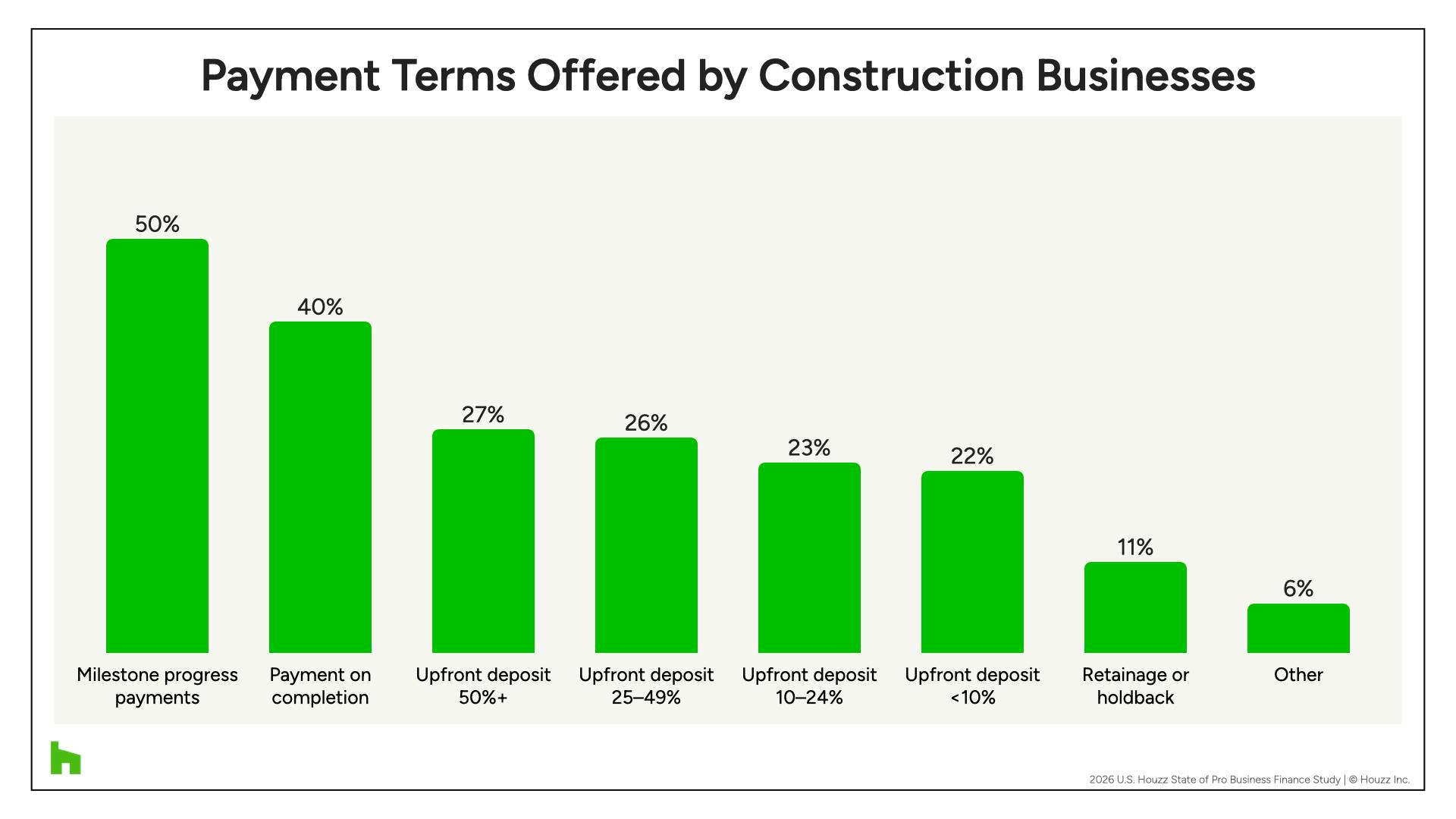
Upfront deposits and milestone progress payments are the most common terms contractors offer to ensure steady cash flow. Smaller companies tend to manage cash flow upfront and require a bigger client deposit to reduce their financial risk, while larger companies leverage their scale to provide them more flexibility and manage cash flow across the life of the project.
But cash-flow gaps don’t disappear with scale. Instead, larger companies appear to be more exposed to recurring timing mismatches, which likely reflects the greater complexity, longer payment cycles, and heavier working-capital needs that come with taking on bigger projects.
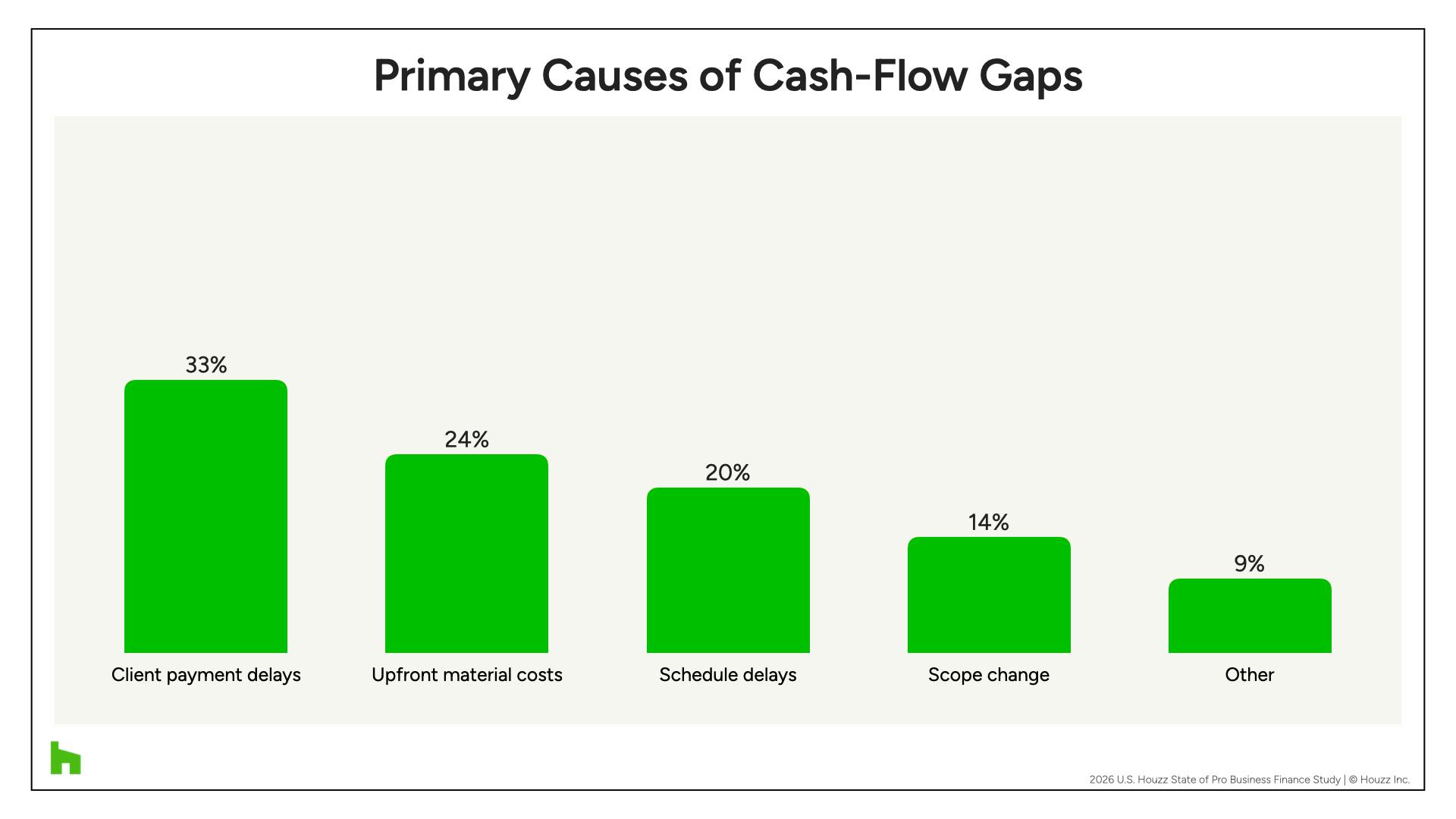
Client payment delays, where businesses face a gap between paying their own expenses (such as subcontractors or vendors) and receiving funds from clients, is the most significant cause of cash-flow issues (33%). Upfront material costs—the requirement to purchase materials before a project begins or reaches a specific milestone—often creates a temporary deficit as well (24%).
Scheduling delays in project timelines (20%) can postpone progress payments, stretching cash reserves. Scope changes or change orders (modifications to the original project plan) can lead to unplanned expenses and delayed billing (14%). Additional causes cited in the survey include permitting issues, bank draw schedules, insurance payment delays, and invoicing errors (9%).
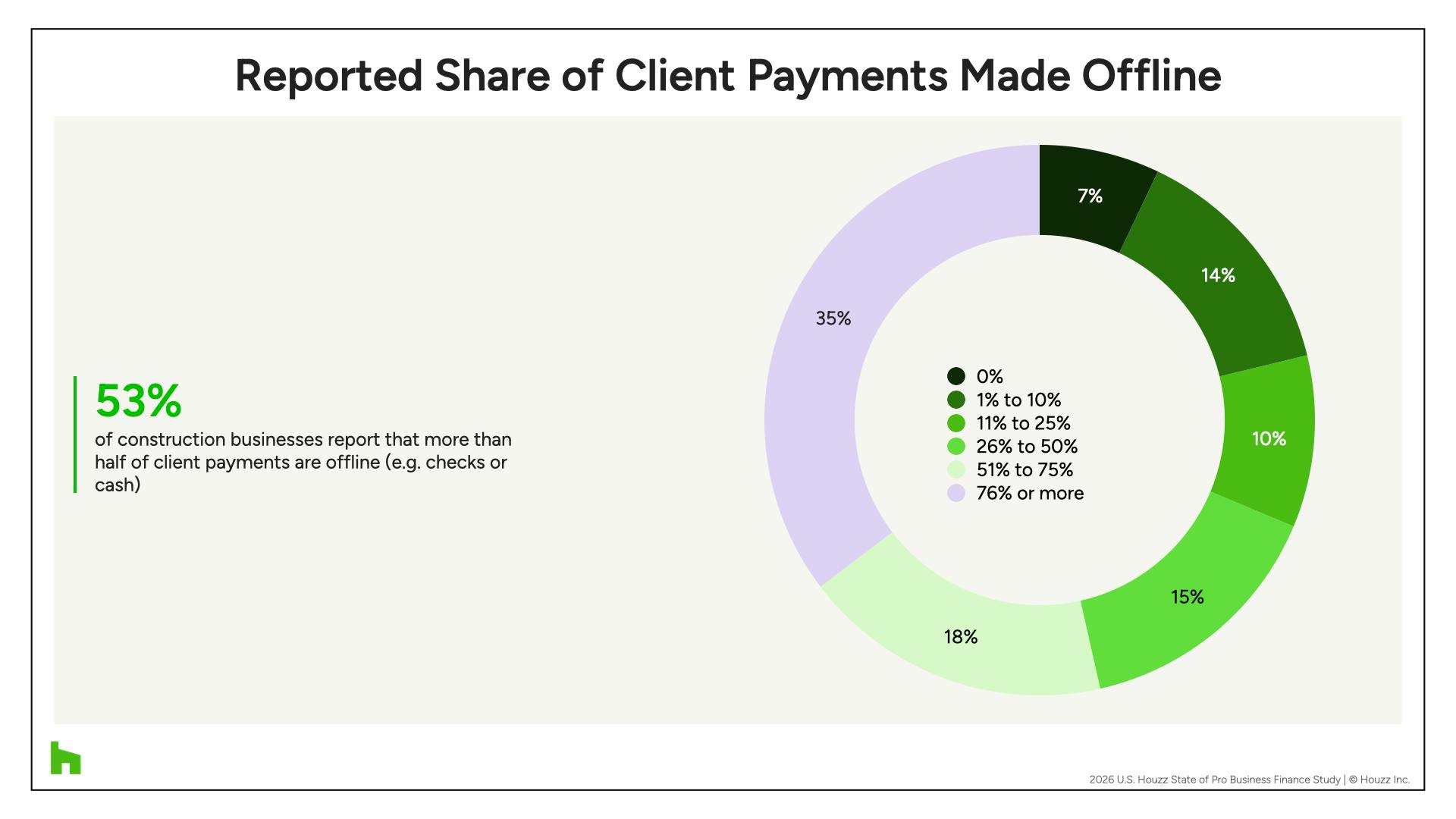
Despite the prevalence of online payments, more than half of all companies (53%) receive a majority of their client payments offline. By continuing to accept paper checks, they create a “black hole” in their finances where money is tied up in transit. Utilizing online payments would reduce the 7.3 days on average between invoice sent and funds received found in the survey.
“If I have to write you a check, you’re not going to get paid as quickly as if I can just click a link,” says Leslie Nicholson, director of finance for Quartersawn Design Build in Minneapolis, Minn. In addition to online payments, the company has clients pay monthly to stay ahead of potential cash-flow gaps and receive steady income regardless of where projects stand at any given time.
“If we do have one project that has quite a few invoices in a particular part of the project, we've got cash from other jobs coming in that might not be,” she says. “All our jobs are not starting and ending at the same time, so we're consistently trying to have an invoice go out each week.”
Through her participation in Remodelers Advantage, a peer group of remodeling companies, Nicholson has learned the value of doing WIPs, or work-in-progress reports, at the end of each month. “When there's money in the bank, [some owners] think it's theirs to take without realizing that it's not their money; it's money that needs to go out in three months when the next invoice drops,” she explains.
Some Contractors Are Acting as Banks
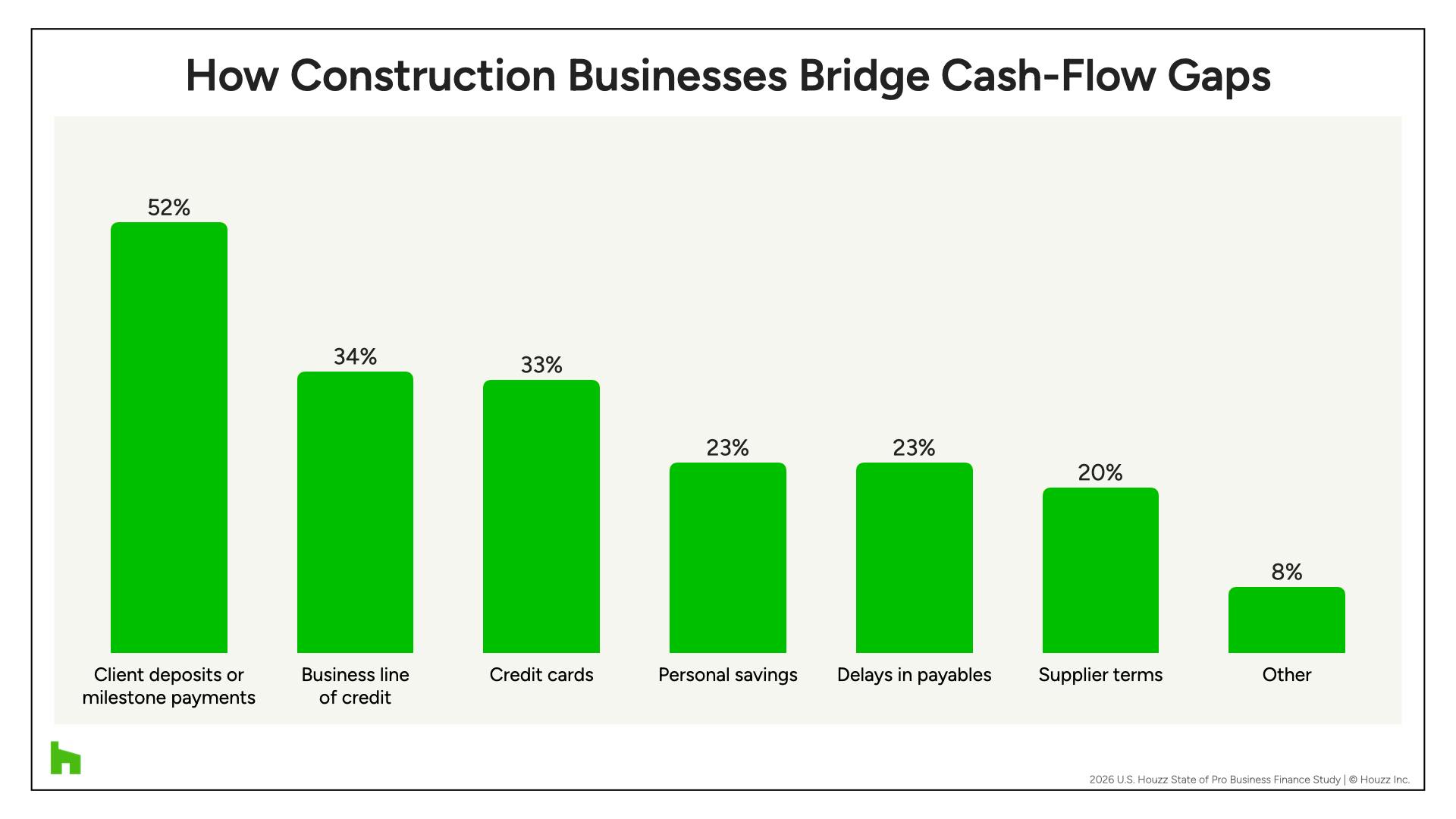
When businesses need to bridge a cash-flow gap, they are most likely to rely on other client deposits or milestone payments (52%). One-third of companies turn to a business line of credit (34%) or credit cards (33%). Smaller but still notable shares use personal savings (23%), delays in payables (23%), or supplier terms (20%), while another 8% of companies cite other methods.
“There's always going to be that timing gap to some extent,” says John Kurtin, CPA, principal of Rea Business Advisors in New Philadelphia, Ohio. “The mentality is that the contractor wants to reduce the under-billing position. Relative to the percentage of work performed on the contract, where do your billings stand? It's always more favorable to the contractor to be in an over-billed position, if possible. The contractor's payment terms in the contract will have a lot to do with it.”
Larger upfront deposits can alleviate the pressure, but in a competitive bid scenario, it could hurt the contractor’s chances of winning the project, he adds. “Then maybe it's a specific deposit for high-cost items where you can really pinpoint things on the project. And that's easier to relate to a customer: ‘Hey, here's this really expensive thing you've specced. We're going to have to get a deposit for that.’ That might go over better than just a bigger percentage of the contract overall.”
The better a contractor can align milestone billings with the cash flow of the project, the easier it will be to secure materials and weather labor-intensive phases. “What we recommend to clients is that project management should own billing rather than thinking of it as, ‘That's just something accounting does,’” Kurtin explains. “I think accounting can help with the administrative side of it and the collections on the back end if there are issues with that. But project management should really own the billing because they're much more in tune with what's happening on the project.”
Many of his clients default to a monthly billing for all their projects. “If you have milestone billing in your contract, could you even bill weekly based on where all the projects in your portfolio are rather than waiting until the end of the month? If you increase your billing frequency to weekly, you're billing all the milestones you achieve in that week. It puts you in a much better position.”
Kurtin also suggests that contractors add working capital turnover as a top KPI to establish a project-level cash-flow forecasting. Then they can aggregate it up to a company-level overlay with their backlog schedule. “That gives you so much more visibility into where you might run into these gaps in the middle of your busiest season, and the further out you can see that, the better you can adjust for it,” he says.
More Client Financing Should Be Offered
The vast majority of contractors (86%) say they didn't delay or decline a project in the past 12 months because of insufficient cash for upfront costs. Still, a notable minority of companies in the survey report cash-related project constraints, including 8% who delayed a project, 5% who declined one, and 1% who both delayed and declined projects. Overall, 14% of contractors say insufficient cash affected their ability to move forward with projects.
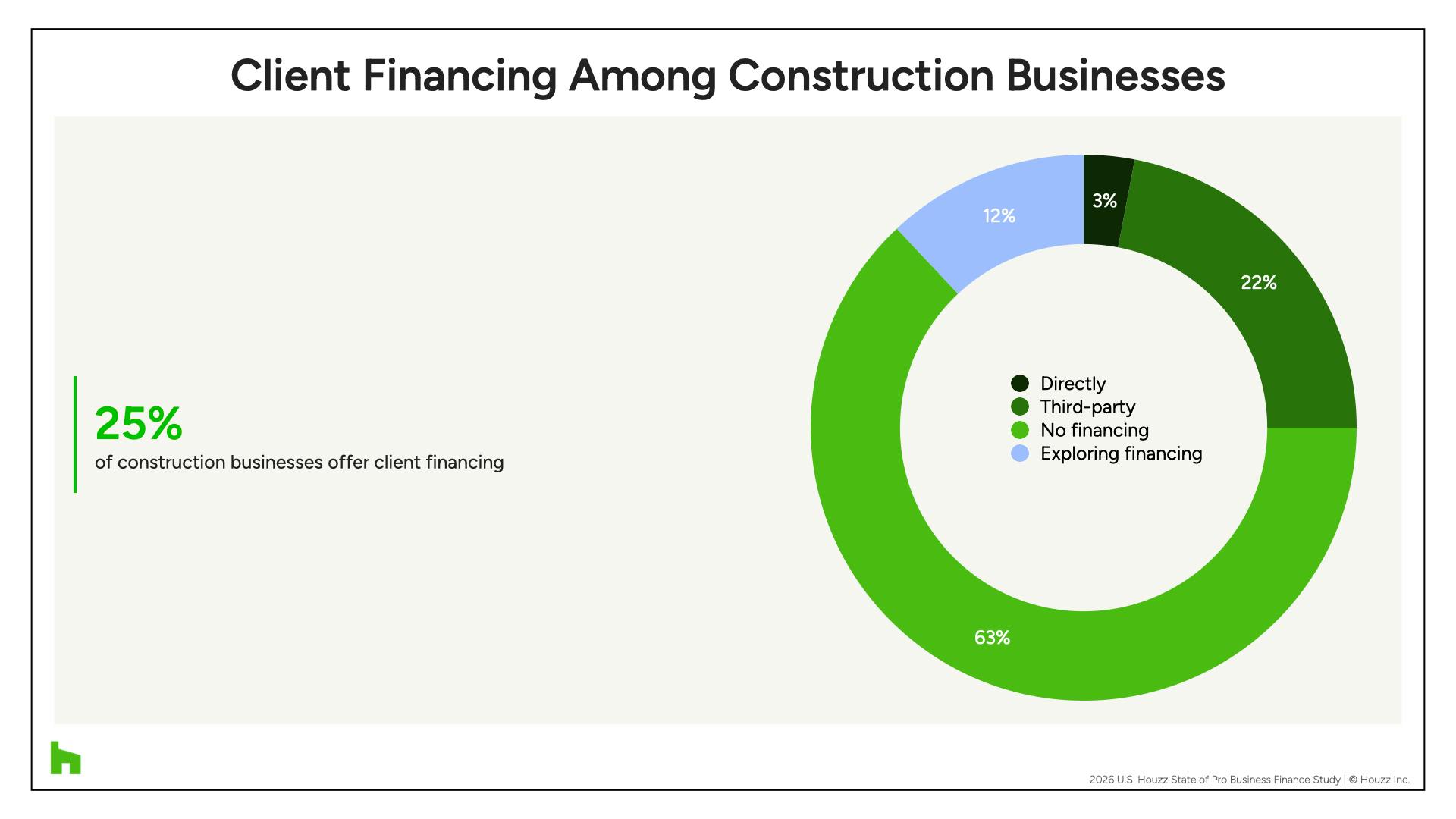
Clients delaying or canceling projects because of budget constraints is a different story. Overall, 57% of contractors in the survey say client budget constraints led to some form of project delay or cancellation. But despite clear evidence that client budget constraints tend to delay or cancel projects, only about 25% of companies currently offer any kind of client financing.
Among those contractors who currently offer financing, third-party financing (where the client applies for a loan through the contractor, who connects them with an affiliated lender to fund their project) is far more common (22%) than direct financing (3%), in which the client secures their loan directly from a financial institution and pays the contractor themselves.
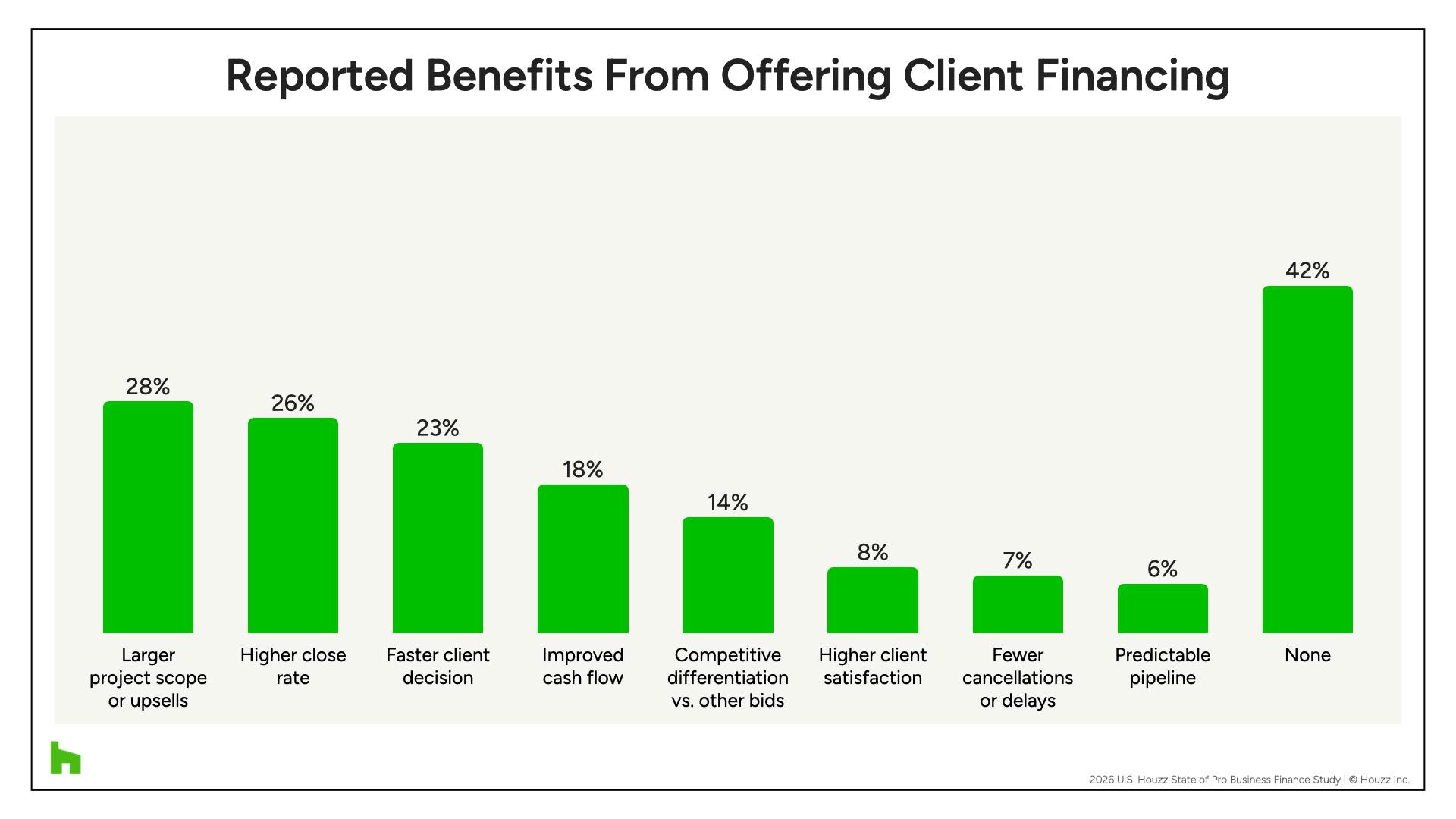
Client financing is important because it can be used primarily as a sales tool. Among companies offering client financing, the benefits cited are larger project scope or upsells (28%), higher close rates (26%), and faster client decision-making (23%).
Smaller shares of contractors attribute financing to improved cash flow (18%) and competitive differentiation versus other bids (14%) while a smaller number point to higher client satisfaction (8%), fewer cancellations or delays (7%), and a more predictable pipeline (6%).
Most Contractors Don’t Hit Margin Targets
Despite 89% of companies reporting they monitor gross margin, only 10% say they consistently achieve their margin targets. Overall, lower-than-expected margin is most often tied to cost escalation, labor overruns, and execution-related disruptions. When projects fall short of expected margin, rising material costs (44%) and additional crew hours (43%) are the most commonly cited reasons.
Schedule delays also play a significant role, reported by nearly one-third of companies (32%). Smaller but still notable shares of contractors point to additional subcontractor hours (27%), rework or quality deficiencies (25%), underestimated material count (25%), and unpriced or late change orders (24%).
When it comes to change orders, Quartersawn Design Build sends out allowance reconciliations swiftly to avoid potential cash-flow gaps. That way, the company can increase the next month’s draw or collect payment upfront if it’s sizable. “We'll ask for it ahead of time and not wait until the next month, or after it's done,” Nicholson explains. “We're not waiting until the end of the job to collect on change orders.”
If Quartersawn knows there will be $100,000 of bills coming in the next month, the company will also proactively tack on its 35% gross profit and draw $135,000 instead. “A lot of companies will just draw for what they know is coming in bills, and then they wait and take their gross profit at the end,” she says. “That’s not sustainable.”
Over 22 years of experience, Nicholson has learned the significance of knowing where accounts are at all times. “A smart businessperson doesn't pay their trade partners with their own money. They pay it with their client's money,” she says. “The biggest thing is to always be very clear about how much money you have—and how much of it is yours.
“A lot of owners get into that negative equity hole, which affects cash flow the most, obviously,” Nicholson adds. “It can get out of control quickly, by paying expenses without realizing what money in the bank is actually theirs. And all of a sudden they have nothing else coming in and more bills to pay.”
Companies who have been building up their backlog and are forecasting a lot of growth in the next year are especially susceptible, Kurtin says. “That's a counter-intuitive, hidden source of cash-flow strain that a lot of contractors don't think about. Most failures or bankruptcies happen when revenues are going up, which in a lot of industries is not the case. It's a demand-driven decline,” he explains.
“You're looking at your biggest year yet, and maybe you have larger projects than you're used to working on,” he adds. “The growth will eat cash before it generates cash a lot of times, and that can amplify these types of issues.”
How Houzz Pro Solves Cash-Flow Gaps
By unifying budgeting, invoicing, payroll, and financing into a single ecosystem, Houzz Pro enables contractors to protect their profit margins, get paid faster, and smoothly handle their business's cash flow. It reduces fragmented, offline invoicing and payment collection methods, such as checks, that are notoriously slow and disruptive to business momentum. In fact, clients pay 2.2 times faster online via credit/debit card or bank transfer through the platform compared with traditional checks.
To ease the transition to digital payments, Houzz Pro provides contractors tools to seamlessly handle processing fees. They can either offset/pass the transaction fee directly to the client or automatically absorb it into their overall markup. They can also bypass standard multi-day bank processing windows with instant payouts. The funds hit their bank account in minutes, even on weekends, ensuring money is immediately available to fund project needs.
The system tracks exactly what has been estimated, invoiced, and paid in one centralized place, feeding directly into the QuickBooks Online sync dashboard. The real-time logging of expenses as well as time entries allows companies to accurately anticipate vendor bills and subcontractor payroll against incoming client draw schedules, keeping the business from funding projects out of pocket.
Houzz Pro also automatically cross-references original estimated costs against actual numbers as they are incurred. Discrepancies appear instantly in a color-coded variance column (green for under budget, red for over budget). When project scopes shift, approvals happen digitally within the ecosystem. The platform automatically pulls verified changes directly back into the live budget view, ensuring unforeseen line-item costs never eat into the target gross margin performance.
Through the upcoming Gusto payroll integration, field team hours are logged directly inside the software, approved, and cleanly pushed to payroll. This setup eliminates manual double-entry, reducing payroll overruns and costly labor miscalculations. To maximize accounting accuracy, items like electrical work or flooring can be custom-mapped to specific income and expense accounts in QuickBooks.
That level of synchronization allows bookkeepers to spend less time troubleshooting generic transactions and more time generating automated profit-and-loss statements to maintain total command over the business.
In addition, Houzz Pro integrates financing directly into the workflow to bridge the client budget gap without asking the contractor to act as a lender or absorb direct financial risk. Companies can easily embed zero-risk financing options from reputable institutions like Figure (HELOCs up to $750,000) and GreenSky right onto their digital estimates and proposals.
Offering these friction-free payment alternatives helps them realize a 37% higher conversion rate on bids and secure 25% larger project scopes. Clients get approved for loans in minutes, and funding is distributed securely without complex paperwork.
See how Houzz Pro can serve as the all-in-one system to tighten your financial workflow with a personalized demo or start a free trial today.


Want advice delivered to your inbox?
Unlock industry insights and updates for contractors and design pros
By signing up, I agree to the Houzz Terms of Use and Privacy Policy and that Houzz may use my information to contact me about relevant content, products, and services.