2025 New Hampshire General Contractor License Requirements
Find the New Hampshire general contractor licensing requirements for 2025 and let Houzz Pro help you navigate the confusing waters of becoming a general contractor.

Guide to Getting A New Hampshire Contractors License
Choosing to work as a general contractor in New Hampshire can be a lucrative career choice. However, it can also be overwhelming due to varying requirements and regulations across different states. To make things easier, we have provided a comprehensive guide on obtaining your New Hampshire general contractor’s license, covering everything you need to know.

Obtaining a New Hampshire general contractors license
In New Hampshire, there isn't a clear definition of what it means to be a "general contractor". People have been discussing for a while what it takes to qualify as a general contractor, home contractor, building contractor, and so on. Because there's no official licensing board yet, you need to look up your local city or county requirements to make sure you follow the rules before doing any general contracting work.
Who needs a New Hampshire contractor’s license?
Even though general contractors don't necessarily need to be licensed, if you want to work in fields like electrical or plumbing, you'll need to go through a licensing process. This usually involves filling out an application, taking an exam, and completing education requirements, as well as paying some fees. The licensing process for each specialty trade is handled by its own department or board.
How to get a New Hampshire contractor’s license
While there aren't any state requirements for performing general contracting work, you may still need to meet certain business and tax requirements as a business owner. If you're planning to run a general contracting business in New Hampshire,, you'll definitely need to get a business license, and all businesses in the state need to register with the Secretary of State. The process for registering can be a bit tricky, and the info on the Secretary of State's website is limited, but it's definitely something you'll want to look into.

How to get a New Hampshire electrical contractor license
If you're looking to become an electrical contractor in New Hampshire, there are a few things you should know. While you don't necessarily need a state-issued contractor's license, you do need to carry a trade license, which is issued by the Office of Professional Licensure and Certification Electrician's Board.
To operate your own electrical contracting business, you'll either need to have a master-level license yourself or employ someone who does. If you're applying for a master-level license, you'll need to provide some documentation of your experience and training in the electrical trade, as well as pay some fees and provide some references. The application process can be a bit complex, but don't worry, we're here to help you through it!
How to get a New Hampshire plumbing contractor license
If you're interested in becoming a plumbing contractor in New Hampshire, there are a few things you'll want to know. Just like electrical contractors, plumbing contractors don't need a specific contracting license, but they will need to carry a trade license to perform plumbing work.
The process for getting a plumbing license is handled by the Office of Professional Licensure and Certification Mechanical Safety and Licensing Board. To operate your own plumbing business, you'll typically need to have a master-level license or employ someone who does. The application process involves providing some documentation of your experience and training, as well as paying some fees and providing a few other items like a copy of your testing results and a passport photo.
The licensing fee for a master-level license is $310, and it's payable to the "State of NH - Treasury." It might seem like a lot, but it's a worthwhile investment in your future as a plumbing contractor!

How to get a contractor license in New Hampshire at a local level
While in many states the cities take over licensing once the state steps back, in New Hampshire it's more common for cities to rely on permitting instead.
This means that if you want to work in a particular city in New Hampshire, you'll typically need to apply for a permit instead of a license. Meeting the requirements for the permit will show that you're qualified to work in that city, so it's important to make sure you understand what those requirements are
New Hampshire local permit offices
Concord: Code Administration Build Safety Department
Manchester: Planning and Community Development Building Department
Nashua: Community Development Building Safety Department
Rochester: Building and Licensing Services
Leveraging your license on Houzz
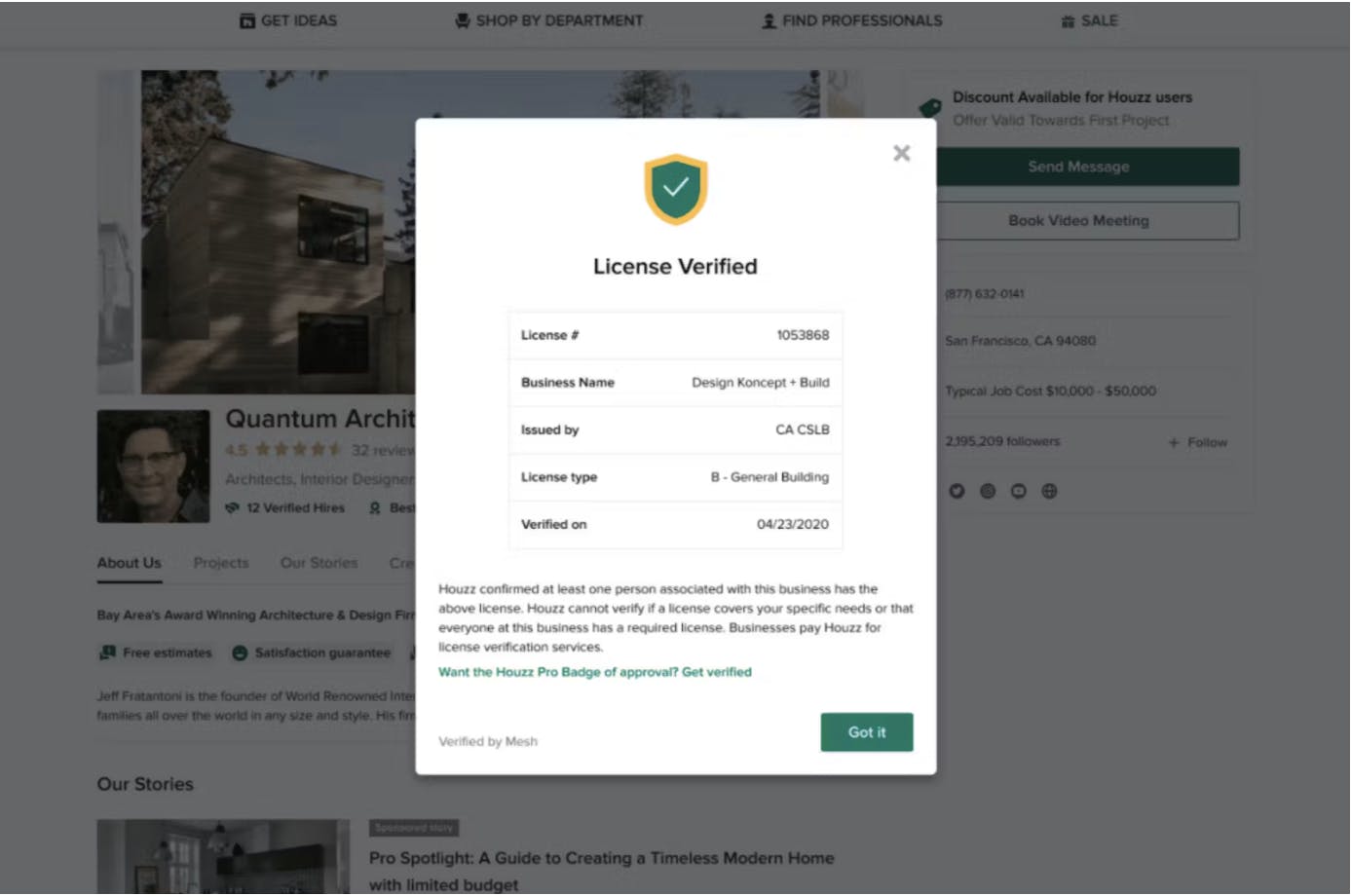
Now that you know how to get a New Hampshire general contractor license, it’s time to start thinking about how you can promote your license to potential clients. Everyone who’s anyone knows the value of a blue checkmark on social media. That’s what the green Verified License Badge is for businesses on Houzz Pro. With one glance, this Badge helps you:
- Let homeowners know that your business is licensed by state industry experts.
- Stand out from the competition while homeowners consider who to hire
- Add credibility to your company name, providing peace of mind to future clients
Here are the steps you can take to add a verified license to your Houzz profile. If you haven’t created a free profile on Houzz, sign up today and get ready to make a bigger impact with your business’ online presence.


Want advice delivered to your inbox?
Unlock industry insights and updates for contractors and design pros
By signing up, I agree to the Houzz Terms of Use and Privacy Policy and that Houzz may use my information to contact me about relevant content, products, and services.