EPISODE 2
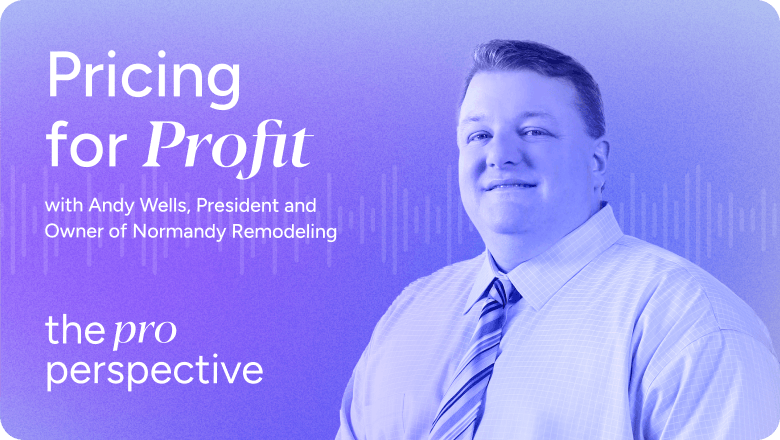
Pricing for Profit With Andy Wells
Striking the right balance when pricing projects is key to sustainable success. In this episode, design-build leader Andy Wells, President and Owner of Normandy Remodeling, shares his take on pricing strategy and profit margins honed from 45 years of managing the ups and downs of the remodeling market.
This is The Pro Perspective from Houzz Pro, where home builders, designers, and industry experts share their views on running a modern firm.
Liza Hausman: Want to know one of the secrets to sustainable success in the design-build industry? It all starts with how you price your projects. Join us as I sit down with Andy Wells, president and owner of Normandy Remodeling, as he shares his 45 years of experience finding the perfect balance between pricing strategy and profit margins.
Hi, everybody. I'm Liza Hausman. I'm the vice president of Industry Marketing here at Houzz, and I'm very excited to welcome today's podcast guest, Andy Wells. Andy is the president and owner of Normandy Remodeling. They're a design-build remodeler specializing in home additions and major home remodels in the Chicago area. We're excited to have him here today to share his wisdom on scaling a remodeling business. There are three main areas we're going to focus on today. Pricing your services, thinking about profitability, competitiveness, market condition, building a sales team that can execute on that pricing model, and then we'll close a little bit with some of the lessons learned. Andy, welcome.
Andy Wells: Thank you.
Liza: Maybe we could start by having you share just a little more about yourself personally and how you got started in the industry.
Andy: I came from a background of accounting. I went to accounting school, became a CPA, worked in public accounting for six years. My wife of 29 years, her father started this company with a partner 45 years ago. I got to be friends with my father-in-law, and he said, why don't you come work here? I didn't really know much about carpentry or electrical, but I did know something about business, and my lifelong dream was going to be to own a business, so I thought, well, this is a nice start. I got into business in '97. It's been a long 27-year road to get to where we are today, but it's been great. It's a tough but exciting business.
Liza: That's a long time. Maybe you can tell us a little bit about how Normandy Remodeling has evolved over the years. How big was it when you joined, and how large is it now, and how have things changed over time?
Andy: I started in '79 and started growing from there, got to about a level of $5-7 million with the sales force back in the early, mid-'80s, and then leveled off and stayed that way for about 10 years. Me joining in '97, we were about a $5.5 million company. Then, as you may or may not remember, the building craze happened because of the lead-up to the Great Recession where you could borrow money on your house with basically a heartbeat. People had access to a ton of money, houses were going up in value, and our customers were borrowing that home equity and building a lot of large additions.
From '97 to '07, we grew from about $5.5 million to $27.5 million. About five-fold. I don't take credit for growing our business that way. I do take some credit for managing that crazy growth. Then, of course, that whole model of people borrowing all this money really easily and spending it led to the crash of the real estate market and the Great Recession. That just hammered us. We fell within two years to about 40% of where we were, which was brutal. Spent five, six, seven years rebuilding. Today, we're averaging around $30-plus million in revenue.
I will say one major shift. Pre-recession, we did a lot more. The bulk of our business was actual construction and additions. We don't build any new houses. It's all on people's houses. It was mostly additions. The market shifted greatly for us after the crash because before we're borrowing money on the value of their home from a bank, after the recession, you couldn't really borrow that money because house prices went down. You had to choose to spend your own money, and they spent it on interior remodeling. Pre-recession, we had two kitchen designers, and we built that team. Now we have 13 or 14. We had a lot more focus on building an interior remodeling team with a lot of kitchens.
Liza: Interesting. You certainly survived and thrived better than the majority of companies, and obviously, so many went out of business. Impressive that you guys were able to pivot and serve the market that was post-recession.
Andy: Yes, I will say that wasn't our genius to say, let's pivot. The phone was ringing for kitchens and baths, and we're like, hey, we've got to do kitchens and baths more. We built them. We did a lot more.
Liza: You made it happen.
Andy: Right.
Liza: Maybe we can talk a little bit about pricing. When you and I spoke earlier, I think I shared that it's a question we get a lot from folks in the industry that are looking to get to the next level, who are often surprised that projects aren't profitable, or who are concerned about pricing a project competitively, or who struggle to communicate the value. Maybe you could walk us through some of the basic principles of how you think about setting prices and a pricing structure that's sustainable.
Andy: Let me get back up one second and just give you a little context. Doing around 30 million, our average job size is about 183,000 these days. Generally, don't do jobs that are under 100 very much anymore, up to 5, 6, 7—800,000. We really don't specialize in a million plus jobs. That's our target market. Then going into setting prices, coming from the financial world and the accounting world, and from all these years of experience, I have to say, if somebody is trying to operate a business without a budget, it's like going on a trip without a map.
You got to put a plan together. I would start with overhead. What is my rent? If you don't have rent, what's my truck and my cell phone package, right down your overhead of things that you're going to spend money on no matter what happens with how much you sell or how much you sell it for. Then, of course, have accurate costs of your projects. If you do some reverse math to say at the end of the year, I want to make X dollars or X percent, you have to set your price such that you can get there. Folks, so that's a little bit broader than just finding out that a job didn't make money, but also that you as a company or you as a private sole proprietor make money for a whole year.
You have to build into your price, not only covering the direct costs of the job, materials, and labor, but what it costs to run your business. It is what it is. If you sell it for less, you won't make money. It's pretty easy. If you're afraid of market conditions that I'm not going to sell anything, I know hundreds of remodelers who have said, well, in my market, you can't get that. Yes, you can. You can, you have to.
Liza: Going back to this, looking not just at the profitability of the job, but the profitability of the company, how do you balance the price with the number of jobs and what you think you're going to do for that year? How do you start thinking about that from, just a risk assessment? You can estimate, but if you are assuming a price of X, and you don't sell that many jobs, how do you think about pricing to cover that risk a little bit? How are you adjusting those estimates maybe throughout the year based on what you're seeing in terms of your sell rate?
Andy: I think we don't really adjust our price too much based on demand or lack thereof. It's more on what we know we're going to spend. There's a lot of planning that goes into, at the level we're at, we have a lot of leading indicators. In remodeling, it's a slower sales process than other businesses. Your best leading indicator is, what are your leads? If your leads are slow, you know you're not going to have as many sales just because there aren't as many opportunities, which leads into how many sales you have, which leads to how many production people you need.
I would say throughout the year, more of our pricing changes are in the last couple of years, especially 2021, and two was inflationary and making sure you were covering the costs of several price increases throughout the year, and that hurt us because it takes a long time to build these projects, and you sell one and the price goes up twice before you buy it, you make less money on that. There is that risk, but I think part of the overall theme of this whole conversation is you have to price it and sell it so that you make some profit, and then just having some retained earnings and some money in the bank is also a hedge against performance not being what you hoped.
Liza: What do you consider to be a healthy profit margin? Let's maybe start there.
Andy: When you say that, there's two numbers that you really look at, it's your gross profit, which is your sales price minus the direct cost of building the job, then you have to look at the bundle of all your overhead, your general and administrative expenses, and my overhead is probably going to be more than somebody who has only a couple of employees and maybe not even a location. You have to build in that number, and then budget for a net income, which could be profit.
I think a good company running well should strive for a 10% net income. Then your gross profit has to depend on what your overhead costs to get there. Two different businesses could both make 10% net income with a different overhead structure, and thus, different pricing.
Liza: Got it. You talked about those two profit numbers, are there other KPIs or key indicators that you look at to track profitability at the project or company level?
Andy: Yes. On a job-by-job basis, we have a budget for each job and each line item, and you track as you go through the build that you're keeping your costs in line with your estimate for, say, masonry. If you have 10,000 in for masonry and you build it for 10,000, you're right on budget. If you're not getting that done for 10,000, then you're not going to make as much money. Just to go back to that gross profit number, for our case, we strive for a 42% gross profit, and that's to get us to a target of covering our overhead and making a net income.
Liza: Would you say that number has changed over time as you've built a bigger team? How would a $5 million company think about it versus a $30 million company, for example?
Andy: That's interesting, because I know a lot of businesses around that I've met over the years, and there are a lot of very profitable $5 million companies who have the same markup and selling price that we have, but at $5 million, you may have less overhead and maybe not need quite as much of a markup.
Part of the selling process, as I'm jumping forward a little bit, is to deliver value, and to be able to deliver plenty of value and expertise, you have to charge for it so you can get that expertise and give that value. Yes, but a $5 million company may not have as much overhead, but you have to then sell the value of what a customer is getting for the money.
Liza: I do want to dig into that, but before we get into that, because I know you said we do hear a lot about folks being concerned about pricing competitively and not being able to get a certain price, and we should definitely drill into that, but you mentioned a little bit earlier having price adjustments for inflation and multiple price adjustments through the year. Tell us a little bit about what you've learned, I guess, over the years about the impact of inflation and how you're addressing it now.
Andy: We got spanked in 2021 bad. It was so fast. Historically, prices have not increased that fast in my career in remodeling. Historically, we've really honed in on our major vendors, like windows, cabinets, plumbing suppliers, to give us plenty of advanced warning when they're proposing a price increase. Typically, windows and cabinets had one in March, let's say, every year. We'd tell them, give us four months so we can build it into our pricing model so when we sell it and then order it, we've got that amount built in for those products.
What we didn't anticipate was the massive amount of increases in the number of them in 2021. What we started to do that year was look at commodity prices on a monthly and quarterly basis so we could just, not necessarily know exactly what a two-by-four costs, but if it's $1 today and $2 tomorrow, it just doubled. We need to adjust the pricing for lumber. We look at a bunch of commodity prices like copper and copper wire and different lumber plywood, and get a feel for where's the industry, where's the market heading so we can try to build that in as fast as we need to.
Liza: Got it. Is it something you address contractually as well at all? Do you make any changes to your contracts in terms of being able to address crazy price increases?
Andy: We do sort of. We put in allowances for the large pieces like a cabinet package. Here's an allowance of $30,000, and if it comes out when we are ordering at $33,000, we recoup the difference, because you can very easily separate that or a window package.
As far as lumber, when we sell, we're not giving the quantity and the price of each piece of lumber. Without offering that information up front, there's no way you can charge for a difference later because they don't know what the starting point was. We're not that granular. Again, historically, it's never really been an issue. In super inflated times, the other thing we did in 2022 was understanding as we watched monthly product prices going up, we just built in a 5%. I don't even know the number. Some number that says it's going to cost more, let's put it in our estimate now, and then when it costs more, we've got it covered, which we don't do anymore because increases have slowed down.
Liza: Right. Flattened off. That makes sense. Hopefully, we won't face it again. [laughs]
Andy: Right. That was brutal.
Liza: Definitely tough. Obviously, you weren't the only firm, I'm sure, when you talk to your colleagues that were always facing the same issues and struggling with the same kind of work.
Andy: The reason we really couldn't recoup that was because we still have a fixed contract.
Liza: Right.
Andy: If you're timing materials, then it is what it is. It didn't really matter. We don't do that.
Liza: Did you consider moving away from a fixed contract?
Andy: No. No, because there's something really important in the sales process to tell a customer, this is what it costs. If you're buying a car, you wouldn't go and the sales would say, it's going to be $45,000, maybe $50,000. You want the price. What is the price of the car? We would definitely want to have a fixed price that says, you can make this decision because you know the price based on these variables, based on these allowances and these material selections that we've pre-laid out.
Liza: Makes a lot of sense. I think that's a good segue to this idea of how do you command that price, because it's going to be a fixed price that's important for the client, but it's also going to be a price that you can be profitable on the project with, right? That might be a premium to what they've heard or what they expected. Maybe talk a little bit about how you approach educating prospective clients about pricing and the value you provide.
Andy: One of the tools we use has been around forever. It's Remodeling magazine's Price Versus Value Report. It's just very generic. It's actually been not really favorable in the last few years because the value of return on investment has been low for many things. This is a definite want to purchase by people. You're not going to get 120% out of your investment in this remodel.
That just gives you a starting point. The thing about this business is there is no Kelley Blue Book to go see what new Acura costs. You can't find out the price of a thing because there's no thing. It's a nebulous design and products and experience. At least, you give them an idea. Then we really load them up in the beginning of the sales process with renderings. We do color 3D renderings that allow them to envision the project where they may not have that ability generally without it.
We do a very detailed scope of work to say, here's everything that's included and really highlight some of the things that we feel like some of our competitors may not necessarily highlight, and it would be an extra later. That's the scourge of our business is people feel like I'm going to get change ordered to death later. They're going to lowball me and it happens. We really try to go in and say all these things are included. If you're comparing us, make sure you're going to need this, so make sure it's in your, and then we usually offer maybe three options of size and scope of a project, as well as then offering options of what to do within the project to put them in the driver's seat of choosing what they want to do.
Liza: Yes. The good, better, best. Yes.
Andy: Good, better, best, along with pieces you can put together.
Liza: Right. You're part of the decision, right? You're part of the decision-making process. It's not just off the shelf. There are some--.
Andy: It's not just yes or no.
Liza: Not just yes--[crosstalk]
Andy: It's this or this. Yes.
Liza: It sounds like there's a few, if I structure this, there's the sort of transparency of the estimate itself. You're putting a lot of detail into it is one way that you're building that trust and the fixed price, and they know what they're going to get. Then there's some intangibles, which is the level of service that you're providing and with the visualization, et cetera, right, that they're going to get this handholding and comfort level. That's a little bit more intangible than the cost side of it. Then there's sort of giving them a feeling of agency in the process as well, where they haven't just relinquished control, right. On something that they're spending a lot of money on, I know that comes up frequently. You think those are three main buckets. Are there any other key things that you think help justify the price or get clients comfortable?
Andy: I think one of the key things we focus on in our company with our sales team is to really build a relationship that fosters trust because you're buying something that you can't test drive a car. I go back to the car, but it's an easy analogy. You can go test drive a car. You like it, or you don't, you can't test drive your addition or your remodel. If people view what we do as a commodity, then it's just based on price.
I developed a little easy, I don't know, sales topic with our newer salespeople. The customer has to-- They buy three things. They buy in this order. They buy you, number one, the salesperson over the company. If we have a great company, but if you don't connect with the client, they're never going to buy from you. That's number one. Number two is the design. They gotta love it. It's got to solve their problems. The third thing they're buying is price. Now, if you don't develop the relationship, number one and three flip positions, and become a price designer for you and your commodity, and you haven't built the value of them seeing, I want to work with this person. I feel like I can trust them to get me through this scary, nasty time. You build that trust by offering up all the things you're going to bring to the table in this remodel through our company.
Liza: Obviously, that human connection is key.
Andy: Yes, because they really have a little bit of distrust.
Liza: They want to know someone's responsible, right? That they've got somebody to contact at the end of the day.
Andy: Right.
Liza: There's somebody who's on their side or in it for them. What kind of price objections come up and then how does that sales person address them beyond the personal touch?
Andy: The only one is it's too much. Then you have to dive into why. Generally, we try to work through that objection throughout the interactions. The sale is a natural progression of this relationship. You don't go through all this effort and then say, okay, now it's 200,000. They go, oh my gosh, I thought it'd be 50. You have to condition it throughout the process by showing value. Part of the value we show is we have two design studios, and we have a bunch of product selections here.
A client can do most of their shopping here. For tile and cabinets and countertops and most everything, which means they don't have to go to seven different stores. It's a real time-saver for these busy people. You're conditioning throughout. These cabinets would be approximately 25% more than these cabinets. You're showing them a product that's included in this price that you're giving them, not an estimate, but literally a price.
Right now, our closing ratio is phenomenal this year. Historically, we don't call it 20%, but 1 out of 5 would be 20%. We're up about 1 out of 3.4 this year. We've hit a groove. It's been phenomenal this year for us. Generally, it's about 1 out of 4.3 or 1 out of 4.5 team wide. What happens to the other 2.4 people?
Liza: Good question.
Andy: I think some of them find out what it really takes to model. They didn't know. They don't have the Kelley Blue Book of room additions or kitchen remodeling. They go, wow, that's too much for us. I think some of them go to a competitor, but we're getting our fair share.
Liza: It's impressive to hear it, because we hear from a lot of firms that customers are a little slower to pull the trigger this year. What do you attribute the improvement to?
Andy: I feel like it has slowed down in May a little bit. I got to be honest. Our team is just reengaged. They got burned out in COVID. It was brutal. It was tough. It was nasty. Work-life balance came into the mix. Now we have the opportunity to work remotely like we're doing right now. We've put in a lot of tools to help them not spend time commuting maybe. Our jobs are closing well, and inflation is. People's mindset is good. I also got to say our two sales managers are superstars, and they are really helping these folks be successful.
Liza: We talked a little bit when we met earlier about the sales managers, and that you've got 21 sales designers, which that number may be mind blowing to a lot of folks listening. How do I get from, I'm the owner selling to, I've started to hire a sales team so I've got 21 sales designers. We'd love to hear a little bit about how your sales model works specifically, and maybe thoughts you have for those owners that are thinking about that next step of starting to hand it off to a team.
Andy: Again, I've shared with lots of remodelers over the years. I've been in groups and met so many people. The scariest thing is to go from being the salesperson to giving up that control. I came into the business. We already had a sales team. I was in sales for three years. The advice I give to people who want to start building a team, especially if you do a mix of work like us, we do additions, but also interior modeling. The interior modeling is a little bit easier of a hire to make and to pass off.
Get an interior design person, partner up with them to show them how to do it and give them plenty of direction and oversight, but then give them a range and let them try. You have to understand that it's not going to be you, and we have a varying degree of talent here. I'd say it's all very good, but there's definitely people who are better at some aspects of design than others. We still monitor customers' happiness and things like that. We have great people, so that you can't start from zero salespeople to 21 overnight. It took a long time.
That'd be the first thing I would offer up is to get an interior design person. Our sales people that we've hired the last 10 years or more have all had a design background. They went to architecture school. If they're in our addition section, then they've usually gone to interior design school.
We've had other folks in sales who were not trained in design, and they were more in sales. They didn't have the passion for the design and for the products. People with the passion enough to go to school for it love this business, and it flows through in the relationship building. You have to teach them how to sell. Again, we're not a hard close. Here's the 21 closest to get over the objection and make them buy today. It's to make it all, and if they love it, they'll buy it.
Getting more and more salespeople, we definitely had to put together a written sales process that people can read, but also you can train on and say, okay, today we're going to go over this section. Ours is four pages on Word. It's not short, but it's not a hundred-page book that you've got to learn. You can reference parts of it. There are definite steps we've picked out that you have to go through, and do these things too. We call it the full money, to put together the whole package and present about what goes into that and the backstory of it.
Now at our point, we have two sales managers who run these two teams that we've split up a little bit. There are quite a few veterans who don't need much sales management. It's more of a monthly therapy session to just talk about what's going on in their life, but then newer people who are less experienced, it's about micromanaging on a project level. It's a review of the design. Does it work? Does it make sense? Is it good for the home? Is it something that we want to do?
There are certain things we don't want to do. It's about reviewing the price, and it's then about strategizing on how you are going to show the value and have this discussion with your client. That's on a job-by-job basis. Then when the job's built, we review how it came out against your estimate, because our sales designers do their own estimating.
Liza: They learn by doing but with some guidance.
Andy: For sure. Then after you have a track record, you don't need so much review.
Liza: Now the trust is there, and they know the business.
Andy: They know how to sell, yes.
Liza: They know what to sell for your company in particular.
Andy: Right.
Liza: Interesting. Again, I know you came in, and there was already a sales team, but tying this back to the original pricing discussion, how do you have that mindset change of paying commission and charging the higher prices that you need to cover the additional salespeople and doing the math to say, all right, the goal of hiring this person. I guess there can be multiple goals. Do you want to sell more work or do you want to spend your time as the business owner on other things?
Andy: Right. Well, you have to get out of the mindset that you're the only one who can make it rain, but you have to pay somebody to go do that. If you are a solo sales team and business owner, and at the end of the year, you make 10%, but you're not paying a salesperson, you have to still do that to make the business work. If you want to spend your time elsewhere working on your business, you have to pay people to do that. Just like you could be the carpenter who goes out and builds an addition and does not pay a carpenter, but then you spent your time doing that, and you're getting paid to be a carpenter, not the business owner. It's just part of the cost. Imagine it's just like a trade. You have to pay the electrician. If you do it yourself, you don't have to pay him. You could make more money, but you can't do everything.
Liza: Right. Got to figure out where you can get the most leverage.
Andy: It just has to be part of the equation. They bring tons of value to the client. We sell a couple hundred jobs a year. I can't talk to everybody. I don't want to talk to them. If I talk to somebody, there's a problem. It's rare, but there's a problem.
Liza: Right. No news is good news for you, conversation in front. That's interesting. What is the scope of that sales designer role? Do they stay involved from to the very end? Obviously, they're selling, but how broad is the job?
Andy: That's a great question. I think in all my travels around, we're different than most companies. The general taught methodology is to have a sales team and a design team. The salespeople are meeting customers and getting projects into the pipeline. The design team is creating a design for that salesperson to go sell. Perhaps they meet with the client, too. Then maybe you have an estimator who gets trades to bid on things. We have it all combined in one. It's a hard job. They are selling, but by doing that, they're meeting the client. They're coming up with the design. They're estimating because they know the job better than anybody else. Lots of training and estimating for us and reviewing.
Then they also do the selections where they're meeting with the client to pick out all their fun stuff. Then they review the plans and walk through the client, approving. Here's the job. We then hand it off for production. Our sales designers stay involved. The good ones have a relationship with that client beyond the job. That's where I think a differentiator for this type of team is we get a ton of referral and repeat business. A ton, because there's a personal relationship.
One of our two sales managers, I actually trained a million years ago. She became friends with one of her early clients. She still gets a Christmas card. She went to their kids' weddings. She goes to their Christmas party. This is 15 years ago, and they're still friends. By having that connection, that really builds a book of business for somebody in our world.
Liza: Two questions coming out of that, because I think that's super interesting. One is, so are they actually going to the job site and checking on the progress?
Andy: After it goes to the field, they stay involved, and they'll go out maybe every week or two, and meet with the superintendent. Other places call it a project manager, but that's the person running the job and go over details. Maybe meet with the customer. Probably not these days. Well, actually, these days, customers are home. It used to be that everybody was at work, but yes, they stay involved, and then they communicate with the client. I was at your house today, and I saw that the hood went up. It looks beautiful. Let me know if you need anything. If they do need anything, they'll communicate with that sales designer.
Liza: They are actually going out there. That's great to hear. Then second, obviously, it sounds like longevity with your company and retention is super important. You mentioned implementing remote work practices and things that help with work-life balance. What else are you doing to retain these folks so that you're getting value out of those relationships that they're building for the long term?
Andy: I feel like my passion is to have a business where I like to come to work, and I want other people to like to work here. We are very high on company culture around the team, not the sales team, the whole company. I would say, generally, we all get along pretty well, and we're all here with the goal of getting these projects built and making customers happy.
It gotta be somebody that we like on the team. You like coming to work. We also have a lot of support for people. We have some design development support. We have some product consultants that help support because it's a really hard job to connect the design passion with the sales aspect. You've got to estimate it. Then it's hard to get that's a hard person to get up and running. Not everybody can do it. We do support that team effort a lot.
I guess this is not a reason people say, but we have started recognizing anniversaries. We've got people. One guy was just in our sales team, 25 years this year. He's been here half his life. He's built a very good life for himself. Another thing is we pay very well because it's a hard job that requires a lot. You should make a career. It's not a job. It's a career. The longevity that I talked about a little bit about those referrals and repeats, we don't do that many. You don't do an annual job for a customer. You do one, maybe two, maybe three.
Liza: Life is life, yes.
Andy: You build a referral book of business. By being here for 10, 15, 20 years, you got a whole long list of customers who are singing your praises. That helps you sell more because it's better and easier to sell a referral. It is a cold lead, frankly. Yes, it's treating people fairly. There's no games. There's no hiding costs and messing with their pay. It's being upfront and transparent about everything.
Liza: Does a large portion of the team interview potential new hires, given the importance of the culture and fit, how do you handle that?
Andy: I wouldn't say a large portion. Generally, if we're going to hire for the sales team, our sales managers will do the initial interviews, then I'll interview them. We'll send them out with one or two people, and we tell them it's to see what the job is and see if they'd like it. Really secretly, it's for our person to be riding around in a car with this potential candidate to see if they're normal.
Liza: [laughs]
Andy: Not too many. Yes, we don't make all perfect hires, but we've been very fortunate in getting quite a few.
Liza: Other than that design background, that passion for the industry, is there anything else that you look for in the background or how broad a skillset can be successful in this role?
Andy: I don't know if there's a skillset. You can say it's personality. You can't train personality really. They have to have people skills that they can connect with customers. We do look for some computer literacy because one of the things, especially in these days, being nimble is really important to sales success. That if there are some minor changes, you can just make them, instead of waiting two weeks for somebody else to make them, and thinking on their feet.
Going real back, just a second, I talked about the salesperson's role. One of the things that other companies sometimes do is take out the selection process of all those materials. Our people would fight you for that. That's the part they really love. That passion comes through when we're meeting with their client. Like, "Look at this new grout."
Liza: 100%, yes.
[laughter]
Andy: You couldn't take that away from them. That feeling is felt by the customer so much about their passion for this stuff.
Liza: I love it. It's interesting, and maybe we'll do our wrap on this topic, but we talked a little bit about execution. It sounds like a lot of what I'm hearing in these themes is execution oriented, right? That the folks are detail-oriented, and focused on really delivering for the client, and that these things are what add up to profitability in an effective sales process.
Andy: I came from the accounting world. Most people think that's nerdy and introverted, and stuff like that. I figured out sales, and I didn't come from a sales background. The biggest thing I figured out, two things, be on time and do what you say you're going to do. If you say, I'm going to have this for you, have it. Don't not have it. It's about setting expectations and meeting or beating them. It's not that hard. You'd be surprised how many people don't follow up on those little details and things. That's part of the sales management to say, "Did you do this piece? Did you do that piece?" Because all those little pieces add up to-- Any one of them at any time can break a relationship, and you don't get the sale for something stupid.
Liza: It seems like that's part of the company culture. Because you say it shouldn't be hard, but if you think about when the industry has a bad reputation, it's exactly for lack of execution and not doing what you say you're going to do, or setting expectations poorly. It's super interesting that in some ways doing something simple, but doing it right is one of the keys to success.
Andy: Right.
Liza: Awesome. Andy, I want to thank you for spending this time with us, and our community who are really going to benefit from all the advice. I appreciate you sharing your personal experiences in the business too. I think folks always love to hear stories. Thank you again. We loved having you on the show and hope to have you back sometime in the future.
Andy: Thanks very much for inviting me. It was fun.
This series is brought to you by Houzz Pro. To learn more about our best in class software for winning clients, managing projects, and simplifying your workflow, visit houzz.com/pro.
THE PRO PERSPECTIVE
Ready to Hear More?
Take your pick from our other expert-led podcasts with more can’t-miss insights.
When Passion Meets Process With Melissa Kennedy
With the right strategies and systems in place, passionate work is sure to shine through. In this episode, Melissa Kennedy, President of Meadowlark Design + Build, speaks on keeping your creative spark by establishing productive processes that combine “the energy of an amatuer with the wisdom of a pro.”

Winning Over Clients With Bill Millholland
It’s hard to come in second when you put people first. For Bill Millholland, Executive Vice President of Case Architects & Remodelers, this philosophy applies to both clients and team members. Leading one of the largest full-service remodelers in the country, Bill discusses his approach to team building and how that drives a winning sales strategy.
Designing a Dream Team With Christine Woodward
For firms that are ready to grow, finding the best talent is just the beginning. In this episode, Christine Woodward, Founder and CEO of 19th & Co., a women-led business consulting firm for interior designers, shares strategies for recruiting and retaining better teams based on her experience with helping top firms thrive.