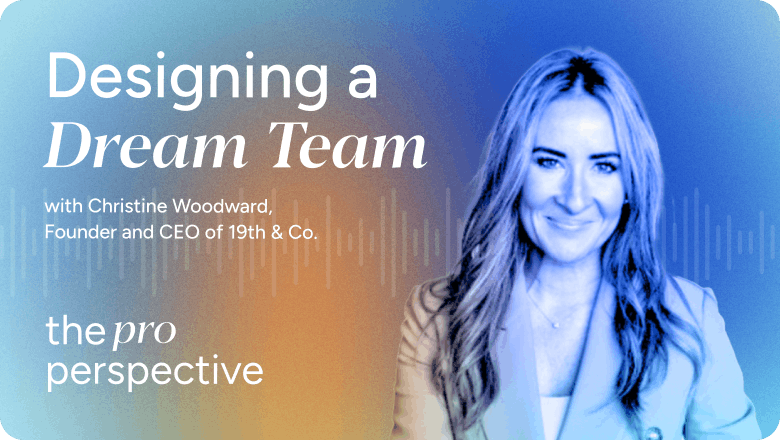
EPISODE 4
Designing a Dream Team With Christine Woodward
For firms that are ready to grow, finding the best talent is just the beginning. In this episode, Christine Woodward, Founder and CEO of 19th & Co., a women-led business consulting firm for interior designers, shares strategies for recruiting and retaining better teams based on her experience with helping top firms thrive.
This is The Pro Perspective from Houzz Pro, where homebuilders, designers, and industry experts share their views on running a modern firm.
Liza Hausman: Are you ready to take your interior design firm to the next level but struggling to find and keep the right talent? How do top firms consistently attract and retain the best teams? Join us as I explore this question with Christine Woodward, business coach and founder and CEO of consultancy, 19th & Company.
Hi, everybody, I'm Liza Hausman with Houzz. I'm the vice president of industry marketing, and we're very lucky today to have with us Christine Woodward of 19th & Company. She's the founder, CEO, and principal consultant, and we're very excited to have her sharing her wisdom, some of her wisdom, with us today. Obviously, Christine, you have a ton, but we're going to focus on recruiting and retention today. Maybe before we jump into it, I'd love to have you share with our audience a bit about yourself and your business.
Christine Woodward: Thanks, Liza. It's a real pleasure to be here. In a nutshell, I'm a designer turned business consultant to designers. A little bit more detail behind that though, I have a master's in architecture, studies in management at Harvard, practiced interiors for 15 years, and I'm currently an MBA candidate at Johns Hopkins. I parlayed all that experience to provide a back end or back office for designers, specifically focused on streamlining operations, financial projections, recruiting, which is why we're here today, just to name a few. We really pride ourselves on providing strategy coupled with implementation. I really think that's the key to being an asset to owners.
Liza: Fantastic. Welcome again. You're clearly an underachiever, Christine. I love hearing your background. I love that you're such a go-getter, and I think it's going to be inspiring for our audience. I'm sure folks that often feel overwhelmed with everything that they have on their plates. I think this is really terrific to get expertise from you. Let's start with a little bit on why you feel recruiting and retention should be on these design business owners' minds going into the new year.
Christine: Yes, well, we are coming out of a boom, right? Things are starting to normalize. People are thinking, is this the new normal or rather the normal that we used to live in? Attracting the best talent, we're going back to the old ways of it being quite competitive. With that, having the best recruiting practices and being able to practice those as part of our recruiting method is going to be vital moving forward to continue your success in your firm.
Liza: Makes sense. Obviously, as things get more competitive, not just for talent, but for clients, having the best team is critical to any company's success. One of the questions I hear a lot is, how do you know when it's the right time to expand? How do I know when I should go from one person to two people or three people to five people? How do I understand what's the right time? What are those triggers?
Christine: Yes, it's nuanced, as you can imagine, and very much a case by case. For the most part, there are symptoms similar to when you're turning down work or when you have so much work that the team or you can't handle, right? In scenarios like that, there's a lot of mistakes being made because of overworked or understaffed. You as the owner maybe haven't taken a vacation in a little too long, over a year plus sort of thing. I know everyone's out there nodding. Yes. That's me. That's me.
You need someone with a specific skill set. That could be another need, right? There's caveats to all of these points. That one in particular, that one can be outsourced. I say that one lightly. Another is just, has your business been profitable for a significant amount of time? I know that's a subjective timeframe, but I would say at least a year, being a little wary that we were just in a boom. 2023 is actually not too bad of an indicator, given it really softened out toward the end of the year. Hopefully, that helps.
Liza: Got it. I assume that it's not only the need, but are you financially in a position to support giving someone a paycheck on an ongoing basis?
Christine: Yes. Even if it's-- right, because these roles, a lot of designers, everyone thinks, "Oh, well, they're really billable," but we'll go into that a little bit further where the recruiting process is pricey and it does cost firms more than it does retention, but I'm getting ahead of myself.
Liza: Got it. Maybe just high level, what advice would you give to a business owner looking to expand their team?
Christine: Yes. You've got two options, and I was just alluding to the second ago, and the first is retention, right? It's promoting from within. That helps to create a growth-focused culture and reduce costs. It is less expensive to retain than it is to recruit. Option two, if you don't have the first option of promoting within, is to recruit.
Some initial ways to get that launch, that effort of recruiting is analyzing the traits of past employees, being able to cherry pick from them, what are must-haves, what are nice to have that you'd like in this next hire, and also evaluate the current culture to determine what would be a good fit culturally in your next ones. I really mean, with someone who is more level-setted because we've got someone who's-- a team that's mostly in the clouds sort of thing in terms of creative. Hopefully, that helps in that initial laying of the foundation of what's next for the recruiting process.
Liza: Makes sense. I imagine for someone who's never hired before and can't really think about past employees, perhaps you can think about just other people you've worked with.
Christine: Yes. That's a great point.
Liza: It's a good person to work with and listing that out. We've all had those experiences of what we do and don't want in a colleague or someone we work with. If somebody has made the decision that this is the right time to start recruiting and bringing somebody new in, what types of questions should they ask to determine a candidate's skill set? I know we talked a little bit about fit and culture and all of those pieces too. Maybe you can talk a little bit about both skills and fit.
Christine: Yes. Before we get into what's asked in an interview, and frankly, whether you've interviewed a lot as an owner or not much, I can't tell you how often we hear of owners feeling insecure in that area of questioning, what are the questions, what are the right questions to ask so that they can suss out the true skill sets or personality of these individuals. No one's alone in that feeling.
Before we even get to the interview process, we've got a job description which helps to illustrate the role. That might sound like an obvious, very easy task, but you'd be surprised because, A, they get really lengthy and directed by LinkedIn themselves. You want to keep it really short and high level. We really like to recommend to our clients is actually grouping those tasks by category.
For instance, you can imagine a senior designer, as we all would hope, would be equal parts project manager and equal parts designer. You want to actually label that, the bullet points that would be associated with that project management, and then bullet point those designs. If you have one that's more important, put it at the top. It just unintentionally and subconsciously conveys to the candidate the most important thing.
If project management's more of their role, they'll see more bullet points, they'll see it listed first, and then they'll see design, which is a couple design or a little couple bullet points under that. Maybe there's even another section of business development or miscellaneous tasks or office management, right? You put that in there. You can start to convey the role at a really high level through that job description.
Once you have that job description, now we're coming to the table, that interview, more on the same page, right? We start to dive into equal parts, their skill set and their personality, which has to translate to culture, right? Four major categories we really dive into in terms of skill set are, one, drafting, two, licensing, client interaction, and project management. I don't want to go too deep into these, but I do want to share a couple of tips and tricks on that.
First, and this goes with any question, is not to have leading questions, right? You don't want to say, "So you do elevations and floor plans, right?" We don't want to set them up for that because a lot of people are people pleasers, and they will unintentionally exaggerate on things a bit, and we don't want to guide them down that path where they're feeling really bad about their interview, because that's our jobs, and especially if you're a really high profile designer too, or owner, right? That can carry a lot of weight in the interview.
For instance, drafting. When we're asking about drafting, it's, "So tell me about your drafting experience." Open-ended, right? They start telling us, "Here's what will happen, guaranteed." Yes, we have done many projects at the current firm I'm at where we're doing this and we, we, we, we, we. You need to make certain that you push back and say, "Love hearing that. Great. Can you tell me what you independently, single-handedly did and contributed to those drawings?"
Then when they say, "Yes, I've done," general terms again. Now they're saying, "I've done elevations, I've done floor plans," whatever it might be. Then you drill down one layer deeper and you say, "How many projects have you done that on?" Use that, those layers, both in terms of go from we to I, and then in the I, go to how many for every one of those four categories. You could probably apply that to any other questioning you're having as well. Super important.
Namely, because the owners are likely to, I'll hate to use the D word, but in a desperate state. We're subconsciously, when you as an owner sitting there in an interview, you're really hoping this person works out, especially if you're really liking them and you guys are jiving. Make certain that you're trying to be as-- trying to get at those facts as much as humanly possible, even though you're really liking this person.
Another one you want to sprinkle in there is behavioral-based questioning. We really base a lot of our behavioral-based questioning from Harvard Business Review's research, which is past behavior being a huge indicator for future performance. I'll give you two examples that you could use. One would be a challenge that your current firm is going through. Just throw it out there, say, "Hey, actually, we're currently going through this. How would you get to a solution to this?" Allow them to brainstorm some ideas right then and there.
Another would be just a general example where outside of your firm, but just a question, random saying like, "Oh, recall a time when your supervisor was unavailable for a problem that arose." I chuckle at that question, and I actually do ask that question, but I chuckle at it because at every firm that I have ever been a designer at, or have consulted at, which is probably going on 75 plus firms, every owner is unavailable when a problem arises because owners are just out. They're business development, they're at project sites, job sites, they're with clients, and they're out. That's a huge, big question that I ask because it really helps to indicate to me what kind of-- if they're a hunter, and they feel okay being nudgy, I guess you could say. I really love proactive, nudgy people. That's a big question I ask.
Liza: Love that, and I also use behavioral-based interviewing. It's a must, I think, no matter what you're hiring. I think that's a great example of a sort of very specific question of the kinds of things that come up. I do think asking people about challenging situations or, "Tell me about a past challenging situation you faced," and hearing how they addressed it is a great way to really understand exactly how they would behave in the future.
Christine: Yes, absolutely. Just even in that, I appreciate that example, Liza, you get to then hear how they think through things too, right, because if they weren't prepared for that question, you can see how they work under pressure as well. It helps in that area, which leads me to my next point, too, can you imagine this person being promoted? I know that's a lot to ask in an interview when you're already just trying to figure out can they even do this job, but it's a great thing to push yourself to imagine because that will help you decide on the role even for the here and now, right? Lastly, I end in level setting, and I can't tell you how important that is.
Liza: Let's talk a little bit more about that level setting, because I agree, and I think maybe the good parallel for level setting is you set expectations with the client at the beginning of every project, right? That's going to set it up for success, right? Let's all get on the same page on day one so we don't have any misunderstandings in the future. Maybe talk a little bit about how that translates when you're talking about your own employees and your own hires?
Christine: It's a great analogy. I really appreciate that. The level setting I'm speaking to is exactly that, is making certain we're managing expectations, and I'm translating that as honest feedback. When you're 90% of the way through in the interview, you've captured all you can, you've exhausted every question, drilled down to as many layers as you can with your questioning, you then have what I'm hoping is a full picture. I literally imagine a picture that I painted of this person. By the end, I'm regurgitating, which is this level setting, where I think they land in a title.
You can imagine, I even educate candidates, and frankly, even owners, that my theory on titles, right? The title isn't just black and white, it's got a spectrum. You can be very green or you can be very senior or seasoned and ready to tip over into that next title. Where do they fall in the spectrum of those titles, right? Specifically the title and then on the spectrum. What goes into that is the years of experience, past work experience, the pedigree of that work. Honestly, it's about 9 out of 10 of the calls that I'm level setting on, calls meaning interviews.
A perfect example is an interview for a senior designer role, right? They have the senior designer title at the current firm they're at. We get on a call, by the end of my questioning, I'm realizing they're actually closer to that middle of the spectrum of an intermediate designer. I'll say, "I really love getting to know you. I think you have incredible experience, but I actually think you're more middle of the road, intermediate designer. If you're okay with that," and of course, letting them know that this is specific to the firm we're talking about, because at the next firm, just like the firm they're at, they're a senior designer. At the next firm, they could be the principal. It varies, especially in our design industry with small to medium sized enterprises.
Helping to educate them, "Look at this firm that we're interviewing for, I think you're here." I then say, "Are you okay with me presenting? I still think you'd be an asset and I'd like to present you to the owner." Obviously, if I only truly think that's the case. The best thing for a firm is actually to help grow someone into a role.
I think what often happens is we think they're already there. It's like counting your money. It's better to underestimate where their level is and make certain you set the title and the salary at that. Let them know, "If I'm wrong, prove me wrong, please. In six months, let's reevaluate. I can't wait to have that conversation." That sets everyone up for better success than anything. It's also mentoring the candidates, right? It's this: pay it forward. With such a small industry, it just makes a lot of sense to help everyone along the way as opposed to-- the alternative would be, in this interview, just write in your notebook. No, they're not a senior designer.
Liza: Yes, you're helping the candidates. Then if they do come in, obviously, in that particular firm, if there are other designers, if you want to have a happy workplace, then everyone has to feel that everyone's at the appropriate level and being recognized at the appropriate level. You don't want to throw a little bomb into your team and bring somebody in the wrong place.
Christine: Seriously, yes. I have had so many candidates say, "Thank you so much for your transparency and honesty." They'll say, they'll actually admit, "I have had a hard time getting interviews or getting to the next step in the senior designer role. Now you're confirming my suspicions of why." It helps in so many ways. There's often an issue where a lot of firms think titles are cheap. I know that's a term or even a school of thought, but they're actually not. They really cost people hiccups in their career, and it's unfortunate. We have to be really mindful of that.
Liza: Yes. I think also understanding why people are leaving a previous position and making a change. Sometimes that uncovers gaps in their abilities that need-- again, they may still have great talent, but that they need gaps that will need filling and they that they haven't even-- why was I passed over before? Oh, well, here's what I'm seeing, and getting everybody to understand where they are right now.
Christine: Yes. I get into that. I do want to talk about that later, but I don't want to jump in.
Liza: Yes. I think that's great. We talked a little bit, you're wrapping up with that expectation setting, level setting with the candidate. How do you close out that interview after you've done that?
Christine: Yes, it's pretty straightforward. It sounds like obvious points, but I just call them the housekeeping items, right? That is where you are in your search. That time is really important. It's something that's glossed over, I think because the owners are just like, "Well, the only thing in my world right now is recruiting." They forget the idea that these candidates could be at the tail end of their search. They could be at their second interview with four firms and an offer that's in the works.
If we don't open up that topic, the candidate might feel like they're bragging or uncomfortable to bring it up. Then we think they're the greatest candidate, but we take our time and sit back. As oftentimes is the case, because recruiting takes a lot of time and energy, and then we lose them. We wonder why we keep losing candidates, right? The key is speed. I'll get into that in a second.
Another question I ask is salary range, right? Salary, compensation, and money is always very uncomfortable for everyone to bring up, but you have to ask it in this first question, in this first interview that you have rather. I don't know why I'm going to say this analogy, but it's like dating someone for too long and not knowing if they want kids or not. That's a deal breaker, right?
Liza: That's so funny, but I would say, you need to be the grownup in the relationship in this conversation. Someone has to be the grownup. Sometimes that's in a relationship, but this is a relationship too. You're the hiring manager, whatever your role is, you need to be the grownup in that relationship and take charge. It's going to go downhill fast, yes.
Christine: Exactly, so you've got to say it in that first one, not just hope that they fit your mold. Simple questions, and I'll just even give you a soundbite real quick, is just, "So what are you looking for in terms of your salary range? What compensation are you hoping for?" It's asking them what they are hoping for, not in any way committing to you, right? You're just gathering information. Keep it as simple as that. Don't waver, don't swallow. It just shows that you're uncomfortable. We want to make this just a really comfortable situation because like you just said too, it helps to set the tone that you're in control and you are the CEO of your business.
Lastly is a start date. Sounds like an obvious one, but it goes back to the timing that if they can't start for three months from now, well, again, that might be one of those deal breakers that you need to know about now. When you get off the call with them, so to close the loop on an interview process, I cannot stress enough how speed is everything in recruiting.
Speed translates to TLC, tender loving care, to the candidate. If they're not feeling that love from you, why would they hold out if they've-- if their timeframe gets misaligned with yours, they get an offer. They won't hold out. They will have nothing that makes them want to work with you on your timing. Keep the ball rolling, and it translates to that love.
Another thing, this is research-based by SHRM, the Society for Human Resource Management, but something I say all the time, this is my little soundbite, is that good talent goes fast, that's an obvious one, but so does mediocre talent, and no offense to the mediocre talent out there, that's still growing. They go fast because they're scared they're not going to get another offer, so they're going to take the first offer, and if you're not the first offer, then they're gone. Talent goes fast, period, the end, and that's why speed is so important.
Liza: Makes sense, and I like the point about timely feedback, too, because appreciating someone, it's free, it doesn't cost you anything, right? That's an easy way. Having someone feel like they're wanted is a great recruiting tool that doesn't cost anything, and if they feel you're more excited to have them than another firm, that's an edge, right? That's a perk.
Christine: Excellent point. You've got leverage now. Yes, you won't lose out to someone who has more compensation power or brand leverage over you, because you've shown so much love, they're going to be like, "Oh my gosh, this is what the culture is like." They're translating that to the culture of the firm, and hopefully, it's a one-for-one, but those are great points, exactly.
Liza: Great, so let's say we followed your instructions, Christine, we've done this well, we've filled this open position, what happens next? How do we make the next steps go well?
Christine: I am glad we're talking about this, because what often happens is as soon as the new hire is determined, it's a really funny-- I see this, I would say 85% of the time, where the owner is just like, "Awesome, job done, check, new hire," and they mic drop that candidate in or the new hire into the firm, and maybe they do an onboarding of one day, especially when it's a senior designer, they will just think, "Oh, they know what to do, I should be able to just literally drop them into the business and let them run."
Specific to a senior designer, let's be real, while they may have a ton of experience, they don't have experience about your firm, so there's ramp up even there, so there's two aspects. There's ramp up on the firm, but the other aspect is ramp up in skill set, right? If you have anyone below a senior designer, they're going to have both those layers to their ramp up. Senior designer will definitely have your firm, but you may have picked a, and hopefully you know this, but a senior designer that has no drafting, right?
How does the workflow work? Again, that goes back to understanding the firm, but it also then is how do we support and leverage their strengths and then support their weaknesses. There is real onboarding. I don't care what role you're bringing into the firm, but on that, I had a wonderful experience at a firm, and it was a 15-person firm, so this might not go very far as advice for firms that are two people or one, but is to have the new hire actually meet with each of the team members and go sit with them for an hour.
Ask them, "Hi, who are you? How did you get here? How long have you been here? What are the projects you're working on? What does the owner like to pull you into projects for?" Basically assessing out strengths and weaknesses, but it really helps with the camaraderie and the culture and makes the new hire essentially immediately feel part of the team as they get to know everyone. Again, smaller firms, that's not quite the case, so you're going to lunch with them on their first couple days.
Besides those more minutiae items that we can talk about, I'm going to pull out at 30,000 feet and talk about a really important thing that no one does, and that is a 30-, 60-, 90-day check-in. In fact, it's something that dawned on me probably about a quarter away through us offering recruiting in our consultancy, and I started making it optional, and now it's required, and that is a 30-, 60-, 90-day check-in that has associated milestones. It sounds obvious when you think about it like, "Oh, right, of course, we would need to sit down with them."
I think people were intuitively having those check-ins really informally, but when it's not structured with expectations, going back to your point, Liza, like managing expectations of what they're hoping from this new hire and vice versa, the new hire of the company, if we don't provide that opportunity for open communication around those things, I can tell you, after 90 days, yes, we're going to have a lot of issues, and I see it all the time.
Both the owner, myself, and the candidate all thought this was going to be a great fit, 90 days comes, or a little bit longer, whatever, but things start to really unravel, and it is because we weren't talking.That's the key. It sounds so obvious. Those milestones I'm talking to, too, don't tie them to and marry them to the job description. It really is about their strengths and weaknesses and how that's unfolding in real time.
Liza: Yes, 100%. Again, I think it's good advice really for any hiring situation, but I agree that the milestones are important. Like you said, it could be what their expected ramp is. By 30 days, I expect you know how to do this and you know where these files are and you know how to find this client information. By 60 days and 90 days, you're here and you're contributing, you're able to contribute in this way. That way, when you're having these check-ins, you can see are they onboarding, or do we need to make a change and fix something or is this not working out? If something really is going south, you want to catch that early.
Christine: Yes. No, good points. Exactly.
Liza: This is great advice for retention. It's like, how do we make sure that this employee is successful in our firm? What are some of the other reasons that retention is important other than, obviously, it's aggravating having to deal with things when they're not going well?
Christine: Yes. You should really take away the idea that retention is predictable expenses, right? Hiring is costly for two reasons, the money, obviously, but your time. I know everyone's like nodding, "Yes, it takes a lot of time." It does. Recruiting takes a lot of time, whereas retention can take a lot less and then you get to have those people that much longer, right? Your investment into them, your ROI is just that much greater.
Really think of retention in terms of cost savings. Hiring costs that time and money because of recruiting, we work very differently than recruiting agencies. We're like a fractional COO and you're paying us up front. Other recruiting agencies, you're paying us 25% of the salary, give or take. There's also, like I said earlier, the unknown length of time.
Frankly, because it does take and consume so much time, you have no idea with you doing it, it's such a thinned out process or diluted process. We typically quote three months, but if you're doing it on your own, I have seen it run four to six months and you're going to-- here's what's going to happen. You get exhausted by that point and then you start making desperate decisions and then you don't make the right decision at the end.
We're also trying to safeguard your willpower for those decisions because at the end of that journey needs to be one of the best decisions you've made in who you decided between all the candidates. Super important to safeguard that willpower of yours, and I could talk about that on many other fronts, and because retention in recruiting and hiring a new person, 50%, so even if it's a designer who's fully billable, technically and eventually, in those first three months, if not longer, 50% is not billable because of their ramp up. Hopefully, you can exceed that, but really focus on retention for all these reasons.
Liza: Makes sense. I know one of the stats you shared with me is that the national rate for employee retention is about 87%. This is slightly lower for architecture. There isn't any data gathered for the interior design industry. How do people know how they're doing? How do designers know what their retention is? Is it something they can calculate, and how can they improve their retention?
Christine: Yes, so easy calculation. Take your number of employees that you had this year, divide it by the number of employees last year, turn it into a percentage by multiplying it by 100. You've got your retention rate. As you said, Liza, the national average is 87%. Architecture firms, ever so slightly below that at 86%. Interior design firms or industry don't really have a number out there. Either it's not so great or it's just unknown likely because it's just too small of a space.
Find that out and see how you measure against that architecture. If you're somewhere around there, you're doing well. If it's not that great or if it is and you want to keep it there, you can promote within. I know we've already discussed this, but promoting within. If you cannot promote within, share with the team why. Why not, right? That's a hard conversation to have in trying to keep it really high level.
I think you would say less about, "It's for these reasons you don't have this experience, but more as a team holistically, we're really looking for someone who's got this that can really pull us up," and even throw yourself under the bus. It's really important to say, "I don't have these strengths and I hire people who have strengths that I don't have. Right now, we're looking for this. I think, as a team, we'll all benefit from it." Keeping it really general.
Liza: That's the point of saying how they would benefit, that we're all going to learn from somebody in the firm with the right skill sets.
Christine: Yes. You could even reiterate, "Great opportunity. Just as I learned from you guys every day from all your strengths." Good little soundbites you can be tossing in there that doesn't happen because we're all so inundated with the day-to-day weeds that we're in.
Liza: What you're sort of touching on is the company culture and how people feel. I would love to hear a little bit more about how that ties to retention. I think it's certainly a great recruiting tool. We didn't even talk about that during the recruiting process that having that great company culture, you can tout that as an advantage for why somebody would want to join your firm and why some people might take slightly lower comp even if the work environment is a really great work environment with opportunities to learn, advance, et cetera. Maybe talk a little bit about how firms can improve their company culture.
Christine: Yes, I can't tell you in my MBA that I'm in right now at Johns Hopkins, it is course after course. I don't even care if it's not relevant. It's course after course that touts one leading factor to retention, and that is recognition. Easy to remember, starts with an R just like retention. Recognition, recognition, recognition.
Oftentimes we think it just comes down to salary or full compensation package and title. Those are ways to recognize people, but because those are expected and every job comes with it, it's those recognition methods that are a little outside of the norm. That talent to your point, Liza, a second ago of when you are recruiting, if they're seeing this on your social media feeds, the website, i.e. displaying the team. Social media feed saying, "Look at Sarah's project." Those sorts of things, they're already starting to see that recognition is part of your culture and you're not fibbing about that if you do just say you're doing it but not actually walking the walk or talk.
Recognition is a big one. Like I suggested, social media posts about people, even just within the team, giving high fives and shout outs on a weekly basis about successes that everyone's had. Even if they're the smallest successes, it doesn't matter. Recognition. Tying into that is open communication as well. Anytime, which is pretty often and throughout everyone's weeks, is improving processes and policies. Get the feedback and open it up to the team to be able to weigh in on that.
I love to use the start, stop, continue method, which is helping the team and yourself to think through any policies or processes that you should start, so implement that you don't currently have, any that you should stop using because they're detrimental and you're getting feedback from the team and all of this, or any that you should continue.
Giving that space for those concerns and innovations, frankly, on any one of those topics is buy-in. That's what we're looking for from the team. That buy-in puts the skin in the game, increases productivity. It just is tenfold in what buy-in does. Buy-in starts with open communication. Walk-in talks is a great way to start that open communication, getting people out of the office, which leads me to my last one, which is just having fun.
I know as owners, we get really bogged down. We're not even having fun sometimes. How dare anyone else? We have to snap ourselves out of it. If we can't, then we just go appoint someone who's like the fun steward. The goal of that, even if it's tiny things, a little happy hour in the office, doesn't have to be a huge thing. It could be retreats if you've got the financial and headspace for that.
The goal is to work on the business and not just in the business paired with that team bonding. I can't tell you what that will do for your culture, which in turn will do for your productivity, which in turn will do for your profits, which let's be real, at the end of the day, that's what we should all be focused on.
Liza: I'm going to repeat one of the things you just said, Christine, because I believe it's so important, which is working on the business instead of in the business, because it's very easy to have your blinders on and your head down and you're so busy and you're working on these things. If you're that business owner, working on your business and developing your business and your people and looking at it holistically, taking that step back, getting feedback, et cetera, taking time to acknowledge people in a genuine way, even if it's just things that they're working on.
"I see you putting in a lot of hours to learn X, Y, and Z or do X, Y, and Z," is recognition. It doesn't mean you've done something that's enormous. It can be something, as you said, very small. I think that thinking, having the mindset of working on your business is a great one to leave people with. Gosh, this was just incredible and very efficient advice, Christine.
I think people are going to get a lot out of this conversation, and folks out there, if you'd like to learn more about what Christine does and how she helps firms like yours, just reach out to her at hello@19thandcompany, 19th and Co. Hopefully, we will have more great insights from Christine in the coming year. With that, I'm going to sign off and give Christine another big thank you for her time and wisdom.
Christine: Thank you for having me, Liza.
This series is brought to you by Houzz Pro. To learn more about our best in class software for winning clients, managing projects and simplifying your workflow, visit houzz.com/pro.
THE PRO PERSPECTIVE
Ready to Hear More?
Take your pick from our other expert-led podcasts with more can’t-miss insights.

Growing With Intention With Kate O’Hara
Looking for your big break into the luxury design space? In this episode, award-winning designer Kate O’Hara, CEO and Creative Director of O’Hara Interiors, discusses successful strategies for scaling responsibly, all while mindfully balancing creative aspirations with the daily demands of the modern firm.

3D Visualization Today With Sean Corriel
It’s no coincidence that terms like 3D, AR, VR, and AI have been everywhere lately. In this episode, Sean Corriel, Director of Product Management for Houzz Pro's 3D tools, shares his insights on emerging trends, AI's impact on design, future innovations, and how 3D visualization is transforming the industry.
Built to Scale With Mark Richardson
Growing a firm from the ground up takes two things: process and patience. In this episode, Mark Richardson, a renowned business consultant, author and leader in the remodeling industry, digs into tried-and-true leadership and marketing practices for scaling a business.