EPISODE 9
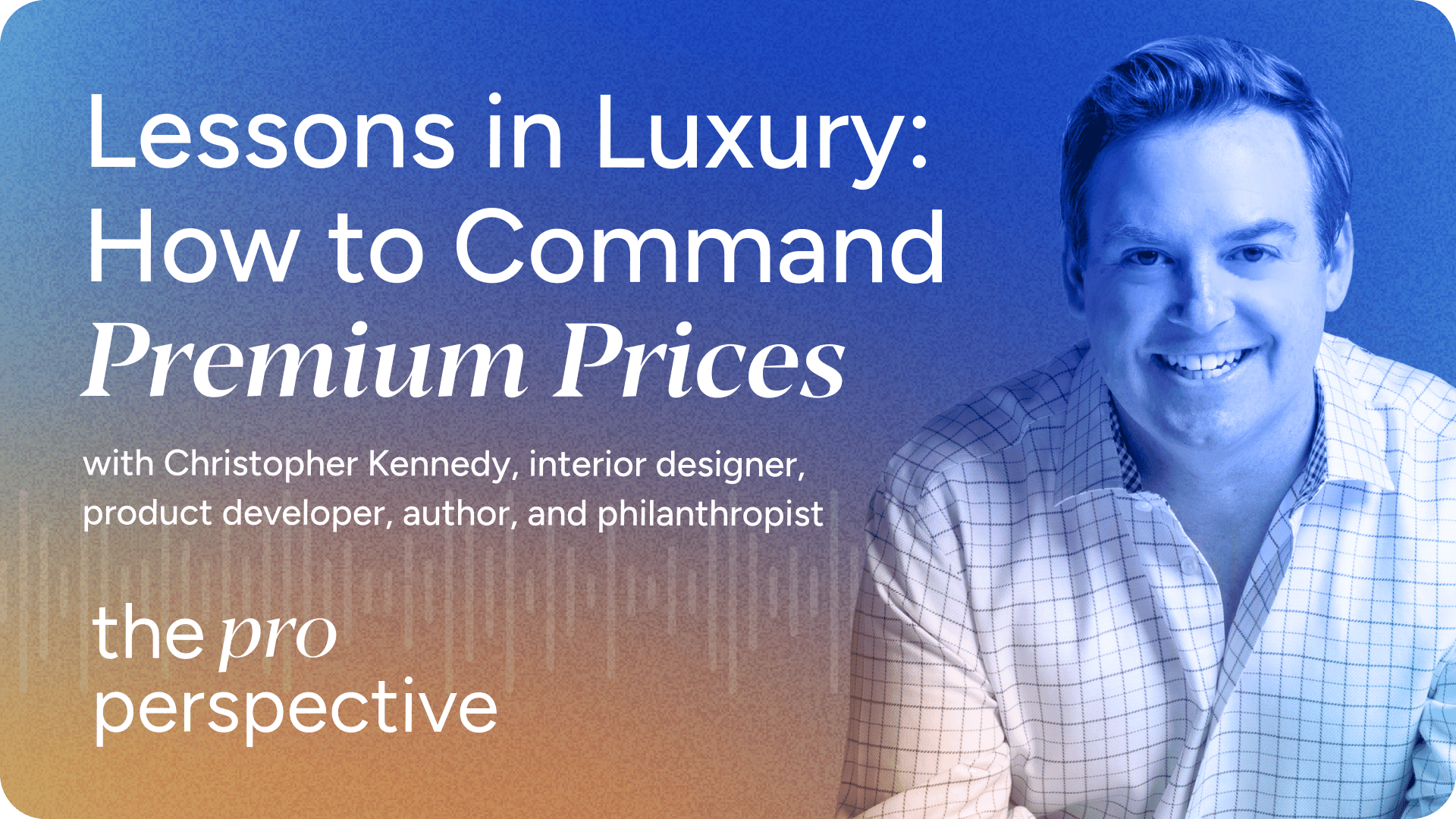
Lessons in Luxury: How to Command Premium Prices With Christopher Kennedy
Commanding top dollar for your design services is an artform anyone can master. In this episode, multifaceted interior designer Christopher Kennedy, takes a break from product designing and his philanthropic efforts to explore how to successfully elevate your pricing by building up your brand, portfolio, and confidence.
This is the Pro Perspective from Houzz Pro, where homebuilders, designers, and industry experts share their views on running a modern firm.
Liza Hausman: If you've ever wondered how to command top dollar for your design services, you're not alone. In this episode, interior designer, product developer, author, and philanthropist Christopher Kennedy shares why he's passionate about pricing, along with the journey, insights, and actions that have helped him build a luxury design business and get paid what his time is worth.
Hi, everybody, and welcome to The Pro Perspective. I'm Liza Hausman, Vice President of Industry Marketing at Houzz. I'm so excited to welcome today Christopher Kennedy. Welcome, Christopher.
Christopher Kennedy: Hi, Liza. So good to be here.
Liza: Today we are looking forward to a really, hopefully, a little bit of a spicy conversation about pricing. If folks aren't familiar, Christopher is an interior designer, product developer, author, philanthropist, has mid-century Palm Desert, Palm Springs focus, which is where he's based and what he's known for. We're excited to learn from you today, Christopher, about how you do business.
Christopher: It's a big topic.
Liza: You're going to be great. Folks are hungry for information, so I'm looking forward to talking about it. When we talked earlier, I think one of the ways that we thought about pricing was, it's really not just about setting a price, right? Sometimes people are like, "Oh, is it just how I structure my pricing or is it just what I'm charging?" When we discussed, we thought, oh gosh, this is actually, to do it right or when you're thinking about pricing, there's really a structure and three buckets that we came up with.
One was this idea of confidence behind your pricing. Internalizing that luxury clients expect and even want to pay more. I think we'll dive into that. The second area was knowing your ideal client and setting expectations from the start. The third was that number part, knowing your numbers and what you need to be a thriving business. In that vein of communicating confidence, I wanted to hear a little bit from you about how you define your value to the world as a professional designer.
Christopher: Oh, just that? Just how do I define my value in the world?
Liza: We can start there. We can start where you want.
Christopher: Let's just start with the existential question. Let's just dive right in. It definitely takes practice. It's hard for newcomers out the gate just to have confidence. I've been doing this for 20 years to give you some background. It took me a long time to get to where I'm at. Of course, we're still always having to go back and rethink things and look at the numbers and look at our clients, as we'll talk about.
I think when we really focus on the impact that we make in people's lives, I think it is how we can define our value as professionals. That we're not just drawing floor plans or selling products. That we're really creating a big picture of how these people are going to live their best lives in their homes, probably their biggest investment. When we bring value in terms of, I think, impact and creating a home that you love and a space that brings you joy and is set up to be organized, beautiful and to function for your family, that's where you can really communicate.
That is what we do. I thoroughly believe that that is what we do. I think when we look at it in terms of end result and impact, then you can charge what you're worth. It goes beyond the hour it takes to draw a floor plan or the price of that land.
Liza: Less executional and more of that big picture right there. They're looking to live a certain way.
Christopher: Live a certain way and that we're taking stress off of them. It's stressful to have your home not finished. That we're really providing a service that frees them up to do whatever it is that's important to them. If they're retired, perhaps they're just doing charity or golfing. If they're raising their family or if they're working, that is a lot of work to create a home and that it's also very stressful. We're making their lives easier and better, that's priceless.
Liza: I 100% agree. I think we could talk even a little bit more about that service aspect because, of course, the value is the end result. They want to get to that finish. The process and the value that you provide in providing a good experience for the process itself, talk to me a little bit about that because folks have had good and bad [laughs] experiences going through these things. Makes a difference.
Christopher: Providing a good experience throughout the process. Obviously, in order to charge these fees, you have to have the processes in place. You have to have your act together. While we're all creatives, unfortunately, the creativity part is probably, sadly, 20% of our job. The rest really is implementation. When you're owning the business, it's the HR, the management and all those things that we didn't think about. Was like, "Oh, I just want to be an interior designer and make things pretty."
Having your act together, having processes in place. There's great tools these days that can help you do that. In terms of just Zoom meetings and Google calendars, and templates you can buy online. We can get into that. You can buy emails that are pre-drafted for you. You can really be a professional. There's all this Slack and Asana. There's so many ways to really have your processes in place. That is an integral part of it.
To create that Zoom-less client experience is going to get you those testimonials and get you those referrals when you do that for your clients. You implement it. You relieve the stress. You try to-- I was in a meeting with a hotel client recently. The GM, we just renovated five presidential suites. We weren't the project manager. There was a project manager who was texting the manager at 6:00 AM and creating all this drama. It didn't have to be that way. It was called out in the post-project meeting.
I'm like, "Ooh, I'm glad we weren't there." We're told that we make the process fun and as stress-free as possible. I think that's part of our success.
Liza: How do you communicate this value? Is it verbally? Are you using your website? What are the channels you have to get this message out there?
Christopher: All of the above, I guess. These are such simple things and I need to hear them too. To say that you need to ask your client for a testimonial when the job is done. We know that we need to do these things, but we don't always do them. They're simple to do, but not always just easy to implement. We just get busy. Ask your client for referrals. Use that. You can have a really professional-looking website these days.
When I started 20 years ago, I had to hire someone to create a website from scratch. Go in and do the coding. Nowadays, you can buy templates that are pretty affordable. You can implement yourself. Technology has come so far that there's ways of making yourself look more established than maybe you feel if you're just starting out. Investing in photography like we'll talk about. I think you can hire a copywriter. I happen to be a pretty good writer. All of our messaging is about that experience and how you feel in the house at the end.
Liza: That's interesting. It's on the website. Is it in your proposal? What kind of conversations are you having with the clients? Again, I know they're obviously coming to you. They've seen your work. They think your work is beautiful. They're not necessarily seeing the price at that time.
Christopher: They're not. We got better. It finally took me 20 years, 19 I guess now, to have a client services guide. Actually, from the very beginning, I always went to a meeting and I took a contract. We had one contract and it was hourly. I would take it. I had a really high closing rate. I was probably too cheap. That's a signal that I needed to raise my prices. I just like to have that conversation up front. I would leave. I said not to be high pressure, but just to be up front. I would leave the agreement.
More than half the time, they would sign it and give me the check on the spot. Nowadays, we've met our clients a bit more and we have a lot of little, I've heard them called investment guides. I happen to call it a client services guide. It was created in Canva, which is basically free. Graphics are practically free nowadays. We used to hire graphic designers for $100 an hour. Now, you can do that yourself in Canva. It was made in Canva. It gets emailed out to every prospect. It says how much we charge.
It's in there. It's lovely, along with a lot of pretty photos. We charge a price per square foot, generally, for a design. We have an investment minimum. Those things are disclosed. I think it's just important to get on the same page really quickly and to not waste your time or the prospect's time.
Liza: You seem pretty confident now. Have you always been this confident? What were some of the things that triggered your thinking around pricing?
Christopher: Can I tell you a story? Back in, I guess, 2019, a couple from Seattle. She was VP of sales for a big financial services firm. Bought a house in Palm Springs, full price, first day. It was remodeled. I met her, actually, socially. She bought it in March. I met her socially over the holidays. She said she loved my work and wanted to hire me one day. If I had a nickel every time I'd heard that, I'd have a bigger house. She actually did come back. She did buy a house. She did hire me.
She hired us in April. I had just started doing a price per square foot pricing. At the time, this is in 2019, in the spring, I was charging $4 a square foot for design. Now, keep in mind, our homes in Palm Springs are not huge. This was a mid-century house. It was maybe 3,000 square feet. My total fee was like $12,000. She probably spent about $150,000 on merchandise, maybe $200,000. We did it over the summer. We did the big reveal in the fall.
She said that it was the second best day of her life only to her wedding day. Again, this is back to that experience. She's done everything from our warehouse to our project management to our weekly email reports, making it really stress-free. We do the big reveal, talk about that experience. It's not unlike what you see on TV. I think that's part-- It makes things better for everybody. We really do focus on that big reveal. We have champagne if the clients indulge or coffee or tea, we have the charcuterie board and really make it a whole experience.
After we were all done, she had me over for a glass of champagne over the next winter holidays and said, "Christopher, now that we're done and we're friends, I can tell you need to double to triple your fee." When your client tells you that, I guess it's saying something. She said, "I thought you were going to charge me at least double." She said, "I would have paid triple. I wouldn't have slept for one night, but it was worth it and I would have paid it."
I'm like, "Okay." She is very smart. She's in sales. She said people to some degree expect that they're getting what they pay for. At a luxury level, honestly, when you have money, isn't it fun to spend it, frankly, people? When you've got money, it's fun to spend money and people that have money like to spend it. Our ideal clients have resources and they're used to-- They don't drive the cheapest car. They don't carry the cheapest bag. They don't wear the plainest shoes. It's a bit of a status.
They often expect and want to pay more. There's an assumption that they're getting what they pay for. Those shoes with the red bottoms might not be actually any more quality than ones that don't have those but there's an assumption that they do because they're more expensive. She said, "You will get more and better clients when you raise your fee." She was absolutely right.
Liza: That's super interesting because it's essentially a signal. If you're going in with too low a fee, they're thinking, "This isn't going to be a luxury."
Christopher: He needs the money. What's wrong? If it's too low, it signals you the other way. Absolutely. I think part of that messaging is I'm in Facebook groups and I see these things and I think when designers-- Well, this is about confidence. I can save that thought if you want. I guess having that confidence to know. I remember the first time I went to charge a bigger fee, I was a little nervous.
Part of the reason sometimes we express our fee as a price per square foot, our fee is now $12. It has tripled. I like to be fully disclosure. I hate going to a panel and four experts are up there talking about fees and don't tell you what they charge. I'm an open book. I think we just have to communicate as an industry. A sidebar is that I think consumers are confused because as an industry, we're not at all standardized. I know we're never going to be, we're not like the realtors who got together and fixed their fees and often charge more than we do on a project.
When the realtor is making more money, not to say that they don't work hard, they do, but they're probably not in it for a year or two like we are doing every detail. We're never going to be standardized, but the more we can talk about it and the more consistent all the players get, I think, and the more the rising tide raises all ships. Consumers are confused because we don't have it standardized, but back to come as I'm saying, when we now charge a price per square foot, if for any reason you, I do stutter like when you have that internalized fear, you don't have to do the math.
You don't have to say, "I'm charging you $60,000 or whatever." You can let them do the math. "He charges this much." They can do it. If you're uncomfortable saying that number, like I have been.
Liza: Here's my fee.
Christopher: I think people are accustomed to a price per square foot. We price tile on a price per square foot, homes are assessed at value oftentimes as what do you pay per square foot? I think it's something that's [crosstalk] and it's easy.
Liza: It's also nice because it ties it to the amount of work that has to be done. The nice thing about using that square foot number is it gives them meat to how you come up with the fee. In some ways, it is a very transparent open book number because you're like, "In our experience, it's tied to how much house we have to work on." That's logical.
Christopher: Transparency. We also charge hourly for project management. The design is the price per square foot. Then often, we're doing big remodels and things. Project management, site visits, all those things tied to construction are charged hourly at $75 an hour.
Liza: Do you estimate them up front? Do you know from the size of the project?
Christopher: No. If we ever do charge an hourly, which sometimes we do, yes. My problem with hourly is you're punished for being efficient and for having experience. It's hard to say, how do I charge for the fact that sales reps come and see me and bring me the new spring fabrics that I go to a trade show to do sourcing? There's all these things that we're doing that bring value to the project that we're not doing singularly hourly just for that client. When you charge hourly, what's the next thing they ask? How many hours is it going to be?
Liza: Exactly.
Christopher: Every time, every client I've had, they're going to ask that. You have to get to that hold a number either way. Whether you do it, but almost every client now says, "Well, how many hours is it going to take?" We do generally have a range when it's hourly, if we'd ever charge hourly, just so that they know what they're getting into. That's only fair for both parties.
Liza: The project management piece is to understand.
Christopher: We don't estimate that hourly, but if we ever do our design fee hourly, which we do sometimes when a client requests. Like we're doing one commercial job now and they really want it hourly. It's out of town, it's [unintelligible 00:15:43] County so there's travel, but we're giving them an estimate upfront of a range.
Liza: You give them a design fee and you give them a project management fee?
Christopher: Yes.
Liza: Got it. That makes sense. You mentioned this idea of the ideal client. Tell me how does that fit into your process and how should designers think about defining and identifying their ideal client and why is it important?
Christopher: I think it's important to realize that we are a luxury service. I think it's important to acknowledge, at least for the world I live in, that we're not for everybody. It costs a lot of money. It just does. It's a luxury service. I think owning that to yourself and your firm is going to help you be more successful, help you serve the clients that you're best at serving. When you look at these magazines or you look at people's websites, it's a lot, a lot of money that goes into these rooms.
If you're building a new house, it's incredibly expensive. I think accepting that and owning that is really important and messaging it. I see Facebook groups and designers are like, "Oh, my messaging is about I split my discount with them or I save them money." Personally, I think that's the wrong message. I do think that we bring value and I think that we help people avoid mistakes. I think that do we save them money in that regard? Yes. Do I think that that's the message we should be sending? I think it's about maybe value and avoiding mistakes.
I don't really think that we're saving people money. We're a luxury service. I think we should own that. It costs a lot of money, whether it's just the shipping, the storage, the receiving, the art installation. It's a lot of money. I think adding that up and looking at it to define your ideal clients. To answer your question, I think you should look at your project. If it's 1 year, you've been in business 20 years.
Look at the projects you are most proud of, the ones that you want to put on your website and on Instagram, look at what those costs and realize that's where I want to be and we should be messaging to those where did that client live? What did they drive? What country club did they go to? Then really target that and then communicate to that person.
Liza: I love that you're saying out loud, you got to acknowledge this is a luxury service.
Christopher: It is.
Liza: This is something to do when you have a lot of disposable income because again, hiring someone to help with this is not inexpensive.
Christopher: It's not. Years ago, because we live in a resort town and sometimes we get asked about doing vacation rentals. This is probably well over five years ago. My husband just went in because someone thought they could do their three bedroom or maybe balked when I said, "Your three bedroom vacation house or Airbnb is going to cost $100,000 to furnish." What are you talking about? I'm like, "My husband went onto westelm.com and made a shopping cart."
By the way, West Elm sells mattresses and they sell drapery panels and two pieces of art for every room and a rug. That's a great exercise if you haven't done it for yourself or if you want to make a spreadsheet for clients just furnishing an average three bedroom house, soup to nuts, it adds up really, really fast.
Liza: Your time is money. It was interesting when--
Christopher: [crosstalk] You're not assembling that furniture.
Liza: It was interesting when you were listing out, oh, the art installation, all these pieces. How often do clients ask about what goes into a project and do you have a discussion where the detail of the work that you are doing comes up?
Christopher: It's a good question. I guess we do. We say that we're full service. Our services guide when I was worried about my fee, honestly, it has a page where it's in little tiny print like, "These are all the decisions that we're making for you." If it's new construction, we sat down one night, I think over happy hour, if you know me, it was like, "It's the door hinges. It's the cabinet hardware." You don't realize that I've seen a couple of high-end designers on Instagram lately that it was real and in this one kitchen, how many decisions were made.
They had all the decisions popped up on the reel and I'm like, "That was brilliant." It was like 30 decisions in this one photo, when you realize how much work goes into it. We do occasionally-- Our service guide shows how many decisions are made. Now when we do our merchandise proposal, we upfront put a range or a budget for the inbound shipping, which has gotten what, 15% nowadays and the receiving and storage and the delivery and installation. We do budget that up front with the merchandise.
We used to bill it at the end and then you get this huge bill and we haven't collected the money so we're fronting the cash flow, which is a bad idea too. We collect all that up front now.
Liza: In terms of setting client expectations, which it seems like is the key to having things go well down the road, you've got a few key tools.
Christopher: We're pretty upfront now that our minimum furnishings and decor investment is 250,000. That's our threshold. If you want Christopher Kennedy to come into this project, that's where we start. I had to send two emails last night with a services guide where we had inquiries. We do have a little online form on our website that lets people inquire and it asks how much they want to spend. They want us to do one or two rooms. It's like, "We just don't really do one or two rooms."
I never have. Nothing wrong with that. If you're starting out, by all means, I'm not saying I'm above it. Since I started 20 years ago, I live in a resort town. Even when I was doing two bedroom, brand new condos, people didn't have anything. They were moving. It was a second or third home as a vacation home. We do live in a different bubble, I realized, but we really only do whole houses.
Liza: I think the key part of that is you're anchoring them. They know what that minimum is. It's interesting because I'm listening to a book on negotiating right now. People might come in thinking this is going to be $100,000 and when you come back with a totally different, you're re-anchoring them to a different place with some information about why, like, "Oh, well, just the furnishings alone they can cost $1,000, let alone our time and effort and the project management and everything else associated with it."
It's such a great way, I think. You're doing the luxury signal, I think, which keeps you up there, but also getting people to rethink.
Christopher: What makes me crazy about the industry is when I've heard designer chatter on whatever Facebook groups and like, "Oh, if someone asks what it's going to cost?" The client's, "Well, that depends. I don't know. I can't tell you." Then we're just bad business people. Honestly, if we can't go into a first discovery meeting and tell someone to the nearest $10,000 what this is going to be, we're just bad business people and it's not doing anyone any good.
If you don't have any idea, then go back to what I said earlier. Look at a living room that you're most proud of and look at what that costs and just say, we should be able to tell someone if you want our look and you liked what you saw on this photograph, this room or this house, this living room was $50,000 or this whole project was a million. We should be able to do that. As designers and architects, if we can't do that, then we really need to look at our business practices.
It almost borders on malpractice to me to say, "Well, it depends what you want." If they want to go onto Amazon and buy all the furniture, then they're not your client anyway. We should be able to tell a prospect who's even within, at least in our world, to some degree, what this costs.
Liza: To know what's typical. When you work with me, here's what's typical.
Christopher: You say what's typical.
Liza: I think referring to one of the techniques that I've heard a lot of people use, and even outside of interior design, whether it's construction, et cetera, is to show them another project. Here's a project similar to yours. This is what it costs to do.
Christopher: Absolutely. I think to ask them what they want to spend. That's what makes me crazy when clients don't know. When the client comes, it's like, "Oh, I don't know." They do, they have a number in their head. They didn't go to their realtor and say, "Show me everything from $200,000 to $2 million." You don't go to the car dealership and look at everything from a Hyundai to a Bentley. You know that you're going to buy a Mercedes or you're going to buy-- You have a range.
I think it's not the client's job to always know what things cost. They have an idea of what they want to spend, but we're the professionals. We know what things cost and they don't often know. I don't think that's their fault. I think it's our fault as an industry for not saying, "Hey, you like what you saw in Elle Decor, those people spent a million dollars on furniture in that project." I think we need to be better at educating them about what things cost.
Liza: I think that's a really good point. To your point about the lack of standardization, I think what it does is it gives people the impression that it's a negotiable service. I think that's the biggest thing. One of the things you're doing with your approach is like, "This is not a negotiable service."
Christopher: It's not. An architect taught me something once that-- Not a lot of clients have negotiated, but a few have. An architect, I think at a conference one time told me, he said he had one client who asked for a negotiation or asked for a discount, and his response was, "I have 12 clients right now, all paying me my standard fee. Do you really want to be the one in 12 who is paying a discount? Who's going to get my best service? Whose email am I going to answer first? Whose phone call am I going to return first?"
That was one way to put it. I tend to say something more like, "It really wouldn't be fair to my other clients who are paying my going rate if I offered you a discount." I've seen some great advice. If someone wants to pay less, then you need to remove scope of service. I could maybe do this for less, but you're not still getting A through Z. You're getting A through L, but that's hard for me to do because we did full service, but I think it is a good thing to do. If someone wants to pay less, then they need to get less. If you're going to negotiate, then you need to remove the scope.
Liza: I'm not changing my effective hourly rate. I'm not going to make less for my time. I think the other thing that comes into it is I'm here to help you make the best choices. You take a home, you've got a kid's room. Sure, we're not going to put-- We're going to put durable things. There's a lot that we're going to do to help make this-- There's a total cost of ownership piece here long-term. This has got to work for you. You don't want to redo this in five years. You don't want to get something that's not good quality.
That we're putting things in place that are going to let you live in this home for years and years and hold up, et cetera. I think there's something to expanding the conversation between like, "Hey, it's part of that, what are you getting for your money?"
Christopher: I think if you called any of our clients, they say that we're actually a bit practical. Even though we're serving luxury, we're not buying the most expensive of everything. We're not putting in all Holly Hunt furniture, or all Design Center. It's a mix. I don't want to say a mix of high and low, but if I can find something at West Elm that works in the guest room, I'm going to mix that and spend more money over here, so being smart with the overall investment.
We're not just-- Our clients, even if they have all the money in the world, they don't want everything to be the most expensive thing in their vacation home. They have kids and grandkids and dogs, and it has to be practical, as you said. It is about a mix and knowing where to spend the money for the bang for the buck. I use that term a lot. We're going to put it over here. I might buy the $300 a yard fabric for the pillow, that's what everyone sees, but buy the affordable fabric for the whole sofa. It's about the overall total investment and being smart with it. Once they know that you're being smart with their money, I think things relax a lot.
Liza: I think that's another great aspect of setting the expectations of you having that conversation. That they probably have money because they've made smart financial choices-
Christopher: That's right.
Liza: -to just throw it on the most expensive thing every time. I think sometimes it's about given that mentality, you're like, "This is going to be a luxury experience, you're going to get what you want, but we're smart. We're making smart choices. We have you in mind when we're making these choices."
Christopher: We do. What I found is when you're serving a luxury client and what's so great and freeing is when you get to that level and you are speaking to those clients, they're the easiest, honestly. The people that have the money that really-- It's so much more relaxed. It's the ones who are a bit stretching, who maybe can't afford you where they really have that stress. In my experience, the people that have the resources are accustomed to hiring professionals in other areas of their life. They listen to your advice.
They're not second guessing everything because they're accustomed to hiring attorneys and CPAs and other professionals and they take their advice. They're accustomed to paying professionals for their advice. They don't second guess it. They make quick decisions because often they're running companies, they're running businesses. They make quick decisions and they're dream clients. When you get to that level, honestly, you'd think they'd almost be more demanding, but I find that they're actually-- They have high expectations and you have to perform, but I think they're less demanding on a day-to-day basis.
They just set back. Once you get the budget established, once you sell the vision, they're like, "Great, do it. This is what you do. Call me when it's ready." That's a little bit much. We keep them informed, but they're not second guessing everything. They're not sending me 10 texts a day. They're not out shopping at Home Depot and say, "How about this lamp?" No, they're not doing that. They're out running their lives and their businesses and turning it over to you as a professional.
Liza: Which is a great situation to be in. Do you still take on those stretch clients? If so, how do you deal with them?
Christopher: That's a good question. I guess less and less. My team reminds me. I don't know, the small projects, they're just the hardest. I don't know how to-- It's just the rule of life, I guess, and then there's no room for mistakes which happen. They do when you're dealing with hundreds of thousands of moving parts, something's going to go wrong. We have to be able to absorb that without stress. It's less and less because it's energy and time.
It's really hard and it's hard when you are running a business and have a payroll to turn down that immediate $10 and wait for the $100. I believe in woo-woo and law of attraction and all that. You do have to free up that space and allow the right project and client to come in the door. It's hard to say when you have payroll next week. It is, I fully acknowledge that.
Liza: You do. You see a lot of great designer discussions about the regret of that project that you knew was going to be a nightmare.
Christopher: If I had any advice, it's about when someone shows you who they are the first time, believe them, or when your gut is telling you this is a bad fit. Generally, I think listening to your guts, my key advice is if you think that paint colors too red, it probably is. If you have a bad feeling about that project, that client, listen to it. Every time I've not listened to my gut, I've regretted it.
Liza: With that first meeting.
Christopher: I can make this work-- If a client comes to you and interviewed three or four other designers and didn't go with them, or if they come to you in the first meeting talking bad about their other designers, there's probably a reason that they're not working together. I think generally, designers, we're pretty good people. We're not the greedy ones. We do this because we love it. That's why we don't always make enough money because we do it for free. We do it for free.
Generally, we're not the greedy assholes out there, generally. I think if someone's had a bad experience with designers, it's really-- You have to ask if this person's a good fit for any designer.
Liza: Makes sense. Certainly, that early meeting is going to be the honeymoon. That's the best it's going to get. If that's bad, it's unlikely to get better.
Christopher: If it's hard to get the contract signed, exactly, it's not going to get better. It's not going to get less stressful. You're right.
Liza: Red flags. What was the point in time when you felt like the business was finally shifting from that investment period where you're taking on projects may not necessarily make the most money at, but you're building your portfolio to feeling like, "I've shifted into the phase where taking on just what I want to do?"
Christopher: It was recently and talking about pricing. Something that I believe in is can we, as an industry, stop using the word markup? It makes me absolutely insane. It just sounds like something that's willy nilly that we're just charging a markup for no reason on top of the retail costs. It makes me crazy. It makes me crazy that customers, clients, think that they can ask us our profit margin. They can ask for our cost on an item and want to see the markup.
What other industry allows that? You don't go to Starbucks and ask how much the beans cost and the cup costs and the green apron. You just pay $6 for the cup.
Liza: It's not a negotiation. Exactly.
Christopher: It's not a negotiation. Howard Schultz isn't disclosing his profit margin. It's crazy. We have to stop as an industry allowing that. It's none of their business what something costs. What did shift, and I think it's listed by this partner, is when we started charging reasonable retail for pricing. Again, because we're transparent, we sell merchandise. We sell everything in the house and we sell it in more or less retail. I like to use the word reasonable retail pricing.
When I first started, I came from a very high-end firm. You've never heard his name. There's a lot of great designers that you've never heard of because their clients are private and they've never published. His average project 20 years ago was a million dollars in furniture and it was all Design Center level. It was all Pacific Design Center, D&D in New York. Every sofa is $15,000. He was adding a 35% markup to that. That was standard back before the internet and 20 years ago was a 35% markup in the industry.
That was a different time. When I opened my doors, I was adding 35%. I wasn't buying everything from Holly Hunt and Dongia and Ralph Pucci. We're selling retail brands like Arteriors, Bernhardt and Four Hands and adding 35%. Doesn't make any sense. You can't make a living. When we said, okay, and when clients ask us, we're going to sell you that at reasonable retail. Generally, we're matching the price that someone sees online. We're not promising them less.
I will say if we are saving someone money on an item, we'll show that. We have an itemized proposal. If our purchasing power is enough that we're coming in $25 below the MSRP, we're going to show that on our proposal to them on a price invoice. No, we're just charging a reasonable retail. Depending on our purchasing power, we might have a 50% margin on some things and 100% on another. It just washes out and the client's paying a fair price.
No, they don't get to know our gross profit margin. That's none of their business. A shift definitely happened when we stopped saying, "Okay, I'm going to add 40% markup," I hate that word, "to this Arteriors lamp," when the retail is 2.5, 250% markup. I think designers can make more money the minute they shift to charging reasonable retail and stop splitting their discounts or pretending that it's doing anyone a service too. It's only saving that client money.
If the client can go on Perigold and buy that lamp for $900, then that's what you should be selling it to them for if you're buying it wholesale. Why should it be less? You're doing a service. You're handling it for them.
Liza: Exactly.
Christopher: It should be more, the recharge, so it really shifted when we just started charging retail pricing for the merchandise.
Liza: Perfectly reasonable. Why do you think it's such a difficult conversation between designers and clients? What can they change about the dynamic of this?
Christopher: I think it's a difficult internal conversation. I think, because as an industry, we've allowed this thing of like, "Oh, you designers get discounts. Shouldn't I get your discount?" I get a discount for my loyalty. It's really an incentive to purchase from this company because I'm a good customer. It's not for you, Mr. Homeowner.
Liza: I do multiple projects. You're not doing multiple projects.
Christopher: We don't get discounts. We get preferred pricing because of the volume that we do. We're not getting a discount for no reason. Sure, if we want to walk into our-- RH, they don't even give designer discounts anymore because they have their member pricing. Sure. Is there a time that if I, a client go, into a store and I can get 15% off with a phone call, do I let them get one item? Sure, it just feels good. Generally, but our clients aren't out shopping. That's our job.
They want us to handle it for them. I think it's difficult because as an industry, we've allowed it and we've encouraged it that we're saving people money by passing on our discounts. That's why it's hard. The minute that we say, "This is how we do things. No, you don't get our discount." Then it'll go away. Our clients don't push back. They shouldn't buy it through us for less than they can buy at the store.
Liza: It's also the important reason that the design fee and the project management fee is separate from the products because this whole idea of I'm being shopped, well, that doesn't happen if you're cheap. It doesn't happen.
Christopher: I think that you communicate value and you establish a budget for the whole thing. One way if a client-- We don't really promise that they're paying the cheapest price. I don't often have to have the conversation, but might I have to say, "Sure, on Black Friday, if you want, you might search for this one lamp and pay $100 less, you might," but in general, you are paying a fair price. It's within the number we've agreed upon and they don't complain.
They're not shopping for each and every single thing. If the client's doing that to you, they're not your ideal client. In order to say, "Hey, are we coming in on budget for this room?" Yes, well then what's the problem? We're also being very fair. We're not overcharging them, but we're also not promising them that on any given day, they're paying the absolute cheapest price for that one lamp.
Liza: Again, I think this comes back to this as a luxury service.
Christopher: Yes. Here's the total that we've agreed upon up front. We know that we're going to be spending about this much money. We've come in on budget. You've seen that everything is in general a fair price. Just do it. Just move on. It's a luxury service. We're not promising to be the cheapest, no.
Liza: Are designers just developing their pricing? Maybe they're doing a range of different types of projects. Do you recommend that they start with hourly and then get to flat fees once they have a better sense? What's a sensible progression as you're developing your business and moving maybe more upmarket?
Christopher: I think a flat fee is more sensible. I guess I enjoyed it. First of all, I'm terrible at tracking my hours. I'm really bad about it. It just takes a lot more time. There's a lot more backend work that goes into it, tracking it, keying it into whatever software you're using, sending that invoice. I think in general, we're probably not good at it. When we get into our zone of genius and our magic spot, time passes quickly. We're not looking at the clock when we're having fun.
I think having a flat fee, I would probably recommend that over hourly. I just think it's easier. I think you communicate the value upfront. Billing is easier. We have a flat fee, we either take 25% upfront or 50% or whatever, and then over the next 6 months, just whatever 4 equal payments. It's done, the client knows, it's easy. I would probably be a fan of the flat fee.
Liza: Do they get to that number by just coming up with an estimation of the hours? What's the safe way to do that? I know folks would say, "What if I end up losing money? This ends up being a crazy project." How do I put boundaries on it?
Christopher: Depending on the team that you have, what you're delivering, if you're delivering really, really detailed CAD drawings and elevations, you need to look at what that costs and who you're paying to do that. We're always evaluating that internally. In general, I would just say, I think what people are probably charging for new construction, I think they're charging at least $20 a square foot. That was a few years ago, probably more like $25 a square foot.
We're charging $12 to $14 for furnishings and decor only. I would think no one would be charging less than $6 to $10. Again, it could depend on the size. If you're doing a really big house and there's just big public hallways that don't require as much thought, then sure, that can massage, look at the whole number. I think just like when you buy a house, the smaller the house is, the higher it is per square foot. Look at how many hours.
I think, again, I started making way more money when I began doing a flat fee because we're pretty good at our jobs. We're pretty fast. We've been doing this for 20 years. Honestly, I would never be making what I'm making now if I just charge hourly. I wouldn't be able to. I would never log enough hours to make the value that we bring to the project.
Liza: I know folks shouldn't share necessarily their profit margin, but what is a reasonable range for designers running their numbers? What should they be making?
Christopher: I saw something like the average intern designers making like $45,000 a year or something. I think that's way too low. It's not hard to get gross profit, to get a six-figure furniture project. It took me years to get to multiple seven figures, but that's where we're at, and that's doable. I think when you're charging fees and you're selling the merchandise, you can make money.
Liza: You can make money.
Christopher: There's designers making good money.
Liza: Don't feel bad about it.
Christopher: Don't feel bad about it. You're worth it.
Liza: I love it. This has been amazing advice. I think people would love to just have a little fun, maybe some fun info about you.
Christopher: This wasn't fun?
Liza: About you personally. It's a little super fun, and it's great to see how passionate you are about this, and I think it's served you well. Actually, there was one other question I wanted to ask you, which is, how do you know it's time to update your pricing? How often should you revisit?
Christopher: If you're me, your client flat out tells you. [laughs] It was slapped across my face, but no one said I was a quick learner. I had a mentor years ago, James Magni, a great interior designer in LA. He taught me, if your clients aren't complaining about your bills, you're probably not charging enough. It's like, okay. I rarely had a client complain. You should constantly be looking at it. You should constantly be looking at your payroll.
If we're good business people, we would look at the end of a project and look at how much you made, how many hours do you think you actually spent? If you're outsourcing CAD or drafting perhaps, or even internally, how many hours did that team member, whether they're remote or internal, spend on that? I think doing a post-mortem on the project and looking at was this profitable enough? If not, then look at, do we need to increase it-
Liza: I think that makes sense.
Christopher: -every year.
Liza: I do agree. Every year looking at the project level is important and just seeing did my receivership costs go up? There are things that can really affect me.
Christopher: We hadn't raised our price. Everything is going up. People are raising their prices. Then for us, it was looking at how we can make more money on the client we already have? We started now-- We're purchasing a lot more of the materials that we're specifying. We don't contract. I know there are designers like Michael Smith, who's, well, clearly makes a lot of money, that if he specifies it, he sells it to the client. We don't contract that, but we started getting into why shouldn't we sell them the tile? Why shouldn't we sell them the plumbing fixture?
We're making more money just by being more full service and they're going to spend that money. The thing is, if the client's hiring you, hopefully they like you. Hopefully, you're a good person. You're having fun. They want you to be successful. They would rather spend money with you than at a big box store that they don't know. Why not? It makes their life easier. You have more control over the project. We're now generally purchasing the plumbing fixtures to make sure that it's what we want, to make sure that we know it's here.
We're purchasing the tiles. We are doing more full service. Again, it's taking stress off of the client and we have more control over the project and we're making more money. It's like this great win, win, win. On those things, we'll just charge 20% like a standard GC would, and no one's questioning it. 20% on a house full of plumbing fixtures that you're specifying anyway, that I'm creating cut sheets for anyway. Make more money doing the things you're already doing and serving the clients you're already serving.
We don't sell appliances, full disclosure. That I'm like, "I don't need to sell the appliances." We just go to whatever, Ferguson or--
Liza: Go to the appliance store.
Christopher: Write it up and let them get the miles on their credit card and everyone's happy. Generally, we looked at why aren't we selling these things that we're specifying?
Liza: That's smart. Take a look at the opportunity.
Christopher: Why should you turn it over to a tile guy to make 20% on $50,000 worth of tile that he didn't do anything for? He didn't do it.
Liza: You're doing the work anyway.
Christopher: We're doing the work anyway. I don't know if that relates to anything.
Liza: I love that.
Christopher: That's how I think people look at making more money. It's really a win-win. Their clients love it when they see it. They just have everything handled for them.
Liza: You totally love what you do. What inspires you?
Christopher: Oh, geez, what inspires me? The big reveal, when you get that call from a client. I had a client move in last week to her house and she texted me on Saturday morning and was like, "Oh, just waking up here, it was just so beautiful. Thank you." I think when we do our jobs right, we really are impacting people's lives. That really does inspire me. Sometimes it's easy to forget when you're in the nitty gritty or you've demoed a client's house and you're walking in and it looks like a war zone. You're looking around and you're like, "What the heck have we done?"
I think that inspires me. Freeing up that time, I've been a little bit too stressed the last few weeks and years. There is so much implementation that goes into it that the more clients you're serving, the more projects you're taking on because they're smaller. It just really is soul-sucking and time-sucking. Our clients are hiring us often for-- They're hiring us for our zone of genius and our creativity. They don't realize they're hiring us to also execute it, but it takes time to get into that zone.
The thing I struggle with is it just, I know there's studies on this, it just takes time to get your head around a project and to do what they're actually hiring us for, to be creative. It takes hours to transition out of email and text and like, "Let me just sit down and think about what should, Mrs. Jones' living room look like."
That's such an amazing opportunity that they're giving to us that it just takes having that white space, whether that's turning off the email or going for a hike or just saying, "I'm going to be in my studio surrounded by the fabrics that I love. Let's just brainstorm what this house would look like." Not to answer your question. I guess what inspires me is trying to give myself some more space to be creative. Whatever that looks like for you, if that's hiking or meditation or walking your dog and then getting into that zone of genius. I think it just takes white space.
Liza: That makes a lot of sense. In a similar vein, you were mentioning those high levels of stress. What do you do to decompress?
Christopher: I work out now. I took 10 years off and didn't exercise, which I don't advise. I go to small group personal training, where I have gym friends now. That's fun. Actually working out. Of course, we all know that just gives you endorphins and makes you happy. I exercise now. I don't watch-- People assume I watch HGTV or something. I've been on HGTV, but I don't watch it. When I come home after a long day at work, that's work. I watch stupid stuff. I watch anything but home design shows, Hallmark movies or whatever.
Liza: I totally feel you.
Christopher: If I'm watching TV, I'm not watching design or real estate shows. Be with my dog, be with friends. Palm Springs is beautiful. Go for hikes.
Liza: Lovely place.
Christopher: Just the usual things.
Liza: Any favorite bad habits?
Christopher: Bad habits. Chocolate, Ben & Jerry's, [laughs] half-baked or the sundae dough, if you must know. [laughs]
Liza: That sounds great. I will confess. I think I ate a half gallon of Tillamook mudslide last week to cope with everything.
Christopher: We all need it.
Liza: We're good.
Christopher: It's all about balance. We need to indulge for sure now and then. It's okay.
Liza: 100%. Christopher, thank you so much. This was an incredible conversation. I think things are going to love, love, love every minute of it.
Christopher: I hope it was helpful. Feel free to write to any of you guys out there, if you ever need support, just DM me on Instagram or email me. I will back you up. I'll remind you of your worth. We are worth it. We are not overcharging. We are delivering amazing results for our clients and we're worth every penny. Don't forget.
Liza: You're going to go into coaching and positive [laughs] [unintelligible 00:50:05] your career. You're so good. Wonderful. All right. Thanks so much.
Christopher: It was really fun. Thank you, Liza.
This series is brought to you by Houzz Pro. To learn more about our best in class software for winning clients, managing projects and simplifying your workflow, visit houzz.com/pro.
THE PRO PERSPECTIVE
Ready to Hear More?
Take your pick from our other expert-led podcasts with more can’t-miss insights.

Growing With Intention With Kate O’Hara
Looking for your big break into the luxury design space? In this episode, award-winning designer Kate O’Hara, CEO and Creative Director of O’Hara Interiors, discusses successful strategies for scaling responsibly, all while mindfully balancing creative aspirations with the daily demands of the modern firm.

3D Visualization Today With Sean Corriel
It’s no coincidence that terms like 3D, AR, VR, and AI have been everywhere lately. In this episode, Sean Corriel, Director of Product Management for Houzz Pro's 3D tools, shares his insights on emerging trends, AI's impact on design, future innovations, and how 3D visualization is transforming the industry.

Built to Scale With Mark Richardson
Growing a firm from the ground up takes two things: process and patience. In this episode, Mark Richardson, a renowned business consultant, author and leader in the remodeling industry, digs into tried-and-true leadership and marketing practices for scaling a business.