EPISODE 7
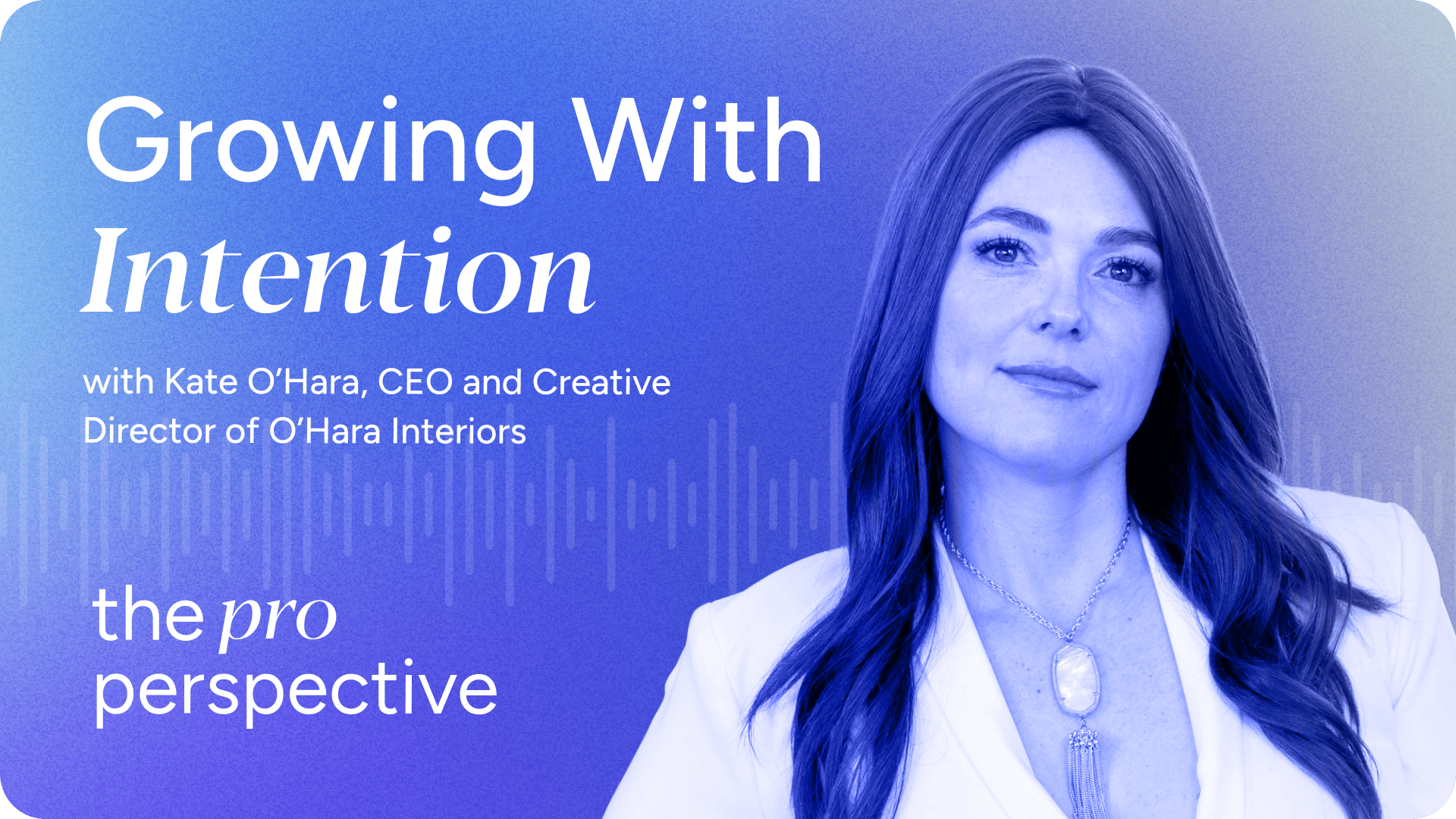
Growing With Intention With Kate O’Hara
Looking for your big break into the luxury design space? In this episode, award-winning designer Kate O’Hara, CEO and Creative Director of O’Hara Interiors, discusses successful strategies for scaling responsibly, all while mindfully balancing creative aspirations with the daily demands of the modern firm.
This is The Pro Perspective from Houzz Pro, where homebuilders, designers, and industry experts share their views on running a modern firm.
Kate O'Hara: If you've ever wondered what's next for your design business, you're not alone. Taking a step back to think about where you want to be and the work you want to do is an important exercise for any business owner, or even you as the owner of your own design career. Join me as Kate O'Hara, award-winning CEO of O'Hara Interiors, and I explore some paths to success and fulfillment that may make you assess your own journey.
Liza Hausman: Hi, everybody, I'm Liza Hausman, and welcome to the latest episode of The Pro Perspective. I'm here today with Kate O'Hara, who is an award-winning CEO of O'Hara Interiors. Big welcome to you, Kate.
Kate: Thank you, Liza. It's been a minute. [chuckles]
Liza: I know. It's been a minute. I'm going to say Kate and I met over 12 years ago. Kate, maybe just take a minute and give folks a little bit about your background.
Kate: Sure. I am the second generation of a design firm with locations in the North and South. We're focused on residential projects as well as commercial on the hospitality side of things. Our projects tend to be throughout the US and globally. My team is fantastic, and I have a team of about 30. I've just been really fortunate to step into a role that led me to leading a company that my mom founded probably close to 40 years ago. I've been with the company for over 15 now, and she passed the reins over to me about five years ago.
Liza: Amazing. As I said, I'm particularly excited about today's conversation because we've met nearly 13 years ago, and we've seen the growth and evolution of each other's careers and businesses. Today, we're going to talk a little bit about what to think when you step back from the day-to-day activities and start to wonder, what's next for my business? It's very easy to be caught up in the day-to-day of just getting one foot in front of the other, and so we're going to cover three key topics along those lines.
The first is thinking about where you want to be and the work you want to do, and what are the paths to get there? I think it may surprise our listeners that it isn't always about growing larger. It doesn't have to be. The second topic is, if working with luxury clients and projects is on your list of goals, what does it mean to build a luxury design brand, and how do you start moving in that direction? Finally, number 3, how do you stay creative and run a business at the same time?
Jumping into topic 1, Kate, thinking about goals for a business. What are some of the things that you think it's important to consider as you're thinking about? Should I grow? Should I change?
Kate: I think you have to decide a little bit. This is a bit of a cerebral exercise, but you have to decide what you want for your life, because the way that you grow your business, how you grow it, what you decide to do with it will really determine a lot of what your life looks like on the day-to-day. As small business owners, we're making decisions when we grow to invest ourselves, maybe capital, but maybe more importantly, our time and our lives to that activity.
I think that any successful business owner, especially on the startup and founding side of things, tends to be very competitive. They tend to be really good salespeople and they tend to be really motivated by seeing growth on the revenue side of things. Growing revenue comes with growing sort of pressure in building your team, in maybe building your physical overhead. That comes with the new volume requirements to maintain your margins and so on.
There are a lot of incredibly successful designers who are incredibly profitable and making plenty of money as smaller operations because they are being selective about the projects that they're taking on. They are happy to keep a wait list of projects and to say no to some things, which we all need to do ultimately, and to say, I can just be really selective and the people who really want to work with me, they will. Others want to see a higher level of growth. That really does take, I think, a bigger vision for how you might achieve that beyond just we'll take on more projects.
If you're solely of the "we'll take on more projects" mentality, it gets difficult to get out of the grind. It really does. You need to have a bigger plan than that.
Liza: Maybe talk a little bit about the motivation. What are the different motivations that are out there when you're considering whether you're going to change? I know you said a lot of the things that you're going to consider when you're thinking about my future goals, really about what's motivating you to make that change.
Kate: Sure. I think that the role you want to play in the firm might be a pretty significant motivator. If you want to remain a designer or the designer on every project, you immediately have a limited number of projects that you can work on because even with a team working behind the scenes for you, there's only so many first appointments and presentation appointments you can go to in a day, in a week, in a year.
If the motivator has a little bit to do perhaps with how you imagine your business or your brand, some people's motivators are more money-driven. Some are more artistic. Some have to do with, "I'm a designer because it gives me flexibility." Some are really trying to build an empire and take over the world, right? There are some that are just going to be in Arch Digest, ride or die, they're going to get there. Each of those motivators really is going to determine, and there's so many, right? There's an infinite number.
I think that people who are prone to grow their business to something larger are really looking at design firmly as a career. They're at least to some degree motivated as a business person. They're thinking from a business mindset. Those who choose to stay smaller might really deeply identify as a creative designer and they might feel particularly protective of that as well as somewhat protective of how much growing the business might require them to let go of some aspects of the business, because it does. You can't stay in charge of everything and scale. Those two things are mutually exclusive, I'm afraid.
Liza: Yes. I think that does play into the motivations, right? You might feel like, "Oh, I want to be a bigger business," the feel of a bigger business. If you like to do hands-on design, you have to figure out what your role is going to be in the business going forward to fill in the gaps. Yes.
Kate: Exactly. Yes, and there's no wrong answer. Long as the answer feels appropriate for you and your business. I think that where people do sometimes stumble into wrong answers, this is like a therapy session now, but where people stumble into wrong answers is when they're doing what they think they're supposed to do and prioritizing what they think is important. We tend, when we talk about business, to really prioritize things like growth. I don't know if that's always the right answer for everyone.
I think that there can be a really healthy, well-run small business that doesn't require a great deal of growth. In an industry of small businesses, I think it's okay to celebrate that as much as we celebrate the larger companies.
Liza: Got it. Again, if you do want to grow, you can move up market, maybe you're shifting gears in terms of the type of work you do. In terms of the types of work, it's really about like, "Hey, I just want to do other types of work," what other options are there? I think you had mentioned to me at one point, as an architect, in the twin cities that I'd had found a way to achieve their goals without necessarily growing to be a very large firm. Curious, your thoughts on what other options are there?
If you're like, "I don't want to be stuck where I am now, I do want my firm to change and evolve," but it isn't always necessarily about getting bigger.
Kate: Yes. I think if you're not interested in the complexities of growing a large team and dealing with things like management, operations, larger scale logistics, and HR, if you're wanting to not have to deal with those types of things, but you still feel like your business is plateauing in a way that doesn't feel right. This is, I think, your opportunity to perhaps consider who is your ideal clientele and what is your ideal project? The answer might be more than one thing, but it should always be specific.
This is a struggle for a lot of us to say, "I can do anything. I can work with anyone," is a common answer. As long as their budget aligns with my capabilities, I can do it. That's nice, but if I am living in a loft in New York City and I want to hire a designer, am I going to hire the designer who can do anything? Or am I going to hire a designer who specializes in art curation in high-end design for New York City lofts?
If you can find your key clientele, then you can also start really communicating through your branding and also where you actually show up in that work, that this is who you are and how you specialize, and you can start talking about yourself that way. People are looking for people who specialize in what they want. To some degree, yes, we can do everything, anything and everything. We get asked sometimes to do things that would surprise people because it looks outside of the wheelhouse that we present, but what we're presenting generally for our brand is what we excel at and what we think our ideal clients are looking for.
That does evolve over time. If you're going for more commercial work, it might be time to start talking about that. I do think one mistake some people make is talking about what they want to do or what they're planning to grow into, rather than simply saying, "This is who I am and this is what I do."
Liza: "I do this now." Exactly.
Kate: Now, I already am the specialist. You have to talk about it as though it's already true for some-- nobody wants to be your guinea pig. I promise. They don't want to pay you to be the guinea pig.
[laughter]
Liza: That's, I think, an interesting point. I guess it falls a little into the fake it until you make it category, but obviously, you have the skills, you have a vision, you know what you want to do. You can absolutely do that. One thing that you guys have done successfully is grow and expand, for example, to additional offices, in another state. You're in Minnesota and you're also in Austin, Texas. Maybe talk a little bit about what pushed you to make that decision. Obviously, it's a big country. There are places you could go.
Are there customer insights that helped you decide where you were going to expand, and what was the process? I know you certainly get inquiries from all over the country. How did you make that decision and how did you decide where to expand?
Kate: That's a good question. At the time that we moved to Austin, I think we could have almost as easily opened an office in New Jersey with the number of projects we were doing there. I remember that time really clearly. Martha is my mom. She founded the business. She was running the company at the time, and I was working diligently in my role. We started to get a lot of work in Austin. Austin was suddenly growing. People were finding us online. Next thing we knew, the phone was ringing.
Sometimes it was ringing in California and sometimes it was ringing in New Jersey over and over again. It was ringing in Austin, Texas. We did have some family connections there. My grandmother lived there. My uncle still does. We have other families in Dallas and Houston. We had strong connections to Texas. I've lived there and so on. With friend projects or family projects were leading to friend projects. Then we had all the phone ringing.
Honestly, what happened was that one winter when we were working on quite a few projects in Austin, Martha and I were chatting and she turned to me and she said, "Kate, I love Minnesota, but every time it's January and we're in Austin and we have to fly back to snowy Minnesota, I really wish we didn't have to buy back just yet." She sort of gave me the command to let's see if we can open an office here. The work is here. There's a ton of growth. Real estate was already starting to really pick up.
It just seemed like there was a lot of energy in the area and there was a lot of demand. We let the demand lead our move, and our move was gradual. We started with a lot of flights back and forth between the North and South. Then we had a small space that we used and then that space grew. We shared a place from an accountant and then we took that space over. It's just grown bit by bit and we were really fortunate to catch the wave at the right time. We were paying attention. I think the important thing for us was that it fit two really important needs.
It fit the business need in terms of the demand being there and growing, and it fit personal needs, which is we have a reason and a love of being here personally. If New Jersey's fantastic, but I don't have family there and we had no reason to go there other than our clients, it might've been as a small business, a little more challenging to say, yes, let's definitely create a business there and who's going to be going all the time and who are we staying with when we're first getting started? Because the logistics would have been a real hassle.
There's a little bit of that to consider because we're not a tech company on the brink of a massive turn, we're an interior design firm. Design firms working with really luxury custom clientele are going to tend to stay small, and that's how we like it. That's how we made the change.
Liza: I love that story. I can just picture Martha having that weather conversation. [laughs] I'm sorry for more than January having been out there. It's interesting. I love that you talk about business and personal needs driving the decisions. Given that when you grow, there's obviously, challenges, risks, as you mentioned, there's just more overhead, the economy changes, do you think having that Austin location that served both the personal and the business needs helped you weather the challenges of expansion? Making that choice?
Kate: Absolutely. Yes. Austin has been just incredible-- and Texas actually, because we work throughout Texas now, has been just an amazing place for our firm. What we've found, you go into any new venture knowing hopefully a lot, but certainly not enough, never quite enough. No matter how much you know. There's always some risk involved, but we've learned that being in Austin and throughout Texas has really helped diversify our business in ways that we maybe had grown accustomed to not being diversified.
It also just has created a little bit of a balance, because seasonally, what people are doing in the summer in Austin is what people are doing in the winter in Minneapolis, which is leaving the state. They are heading out. Project cycles actually take on different rhythms between the two cities and states. Some of the styles, some of the architecture, the lifestyles, there are just enough differences. It's been fun actually to take some of the aspects of home that we see really frequently up North to some of our Austin clients, they've never seen a mudroom before. I mean they have, but not locally very often.
Yet it can make a lot of sense for certain clients with certain things, certain types of land and things that they're doing or families. Similarly, there are things in Austin that we were like, "Oh, we should maybe bring this up North." I think that it makes us better designers, honestly, for our clients. Points of functionality, and then also just getting more and broader experiences with style and what people are looking for. Minneapolis tends to really like classic design. Texans are a lot more of a mix in terms of what they're looking for.
There are very traditional homes. There are very modern homes. In Austin in particular, there are so many people coming from California and New York to Austin these days. For the last 5, 10 years, there are a lot of coastal influences coming into the city that are creating this whole evolution of design in the state, the city specifically.
Liza: Interesting. We'll come back to the creative side of it. You mentioned that you're serving high-end luxury clients in both places. I know that's been an evolution for the business 40 years ago. I think it wasn't necessarily a luxury firm and you've been instrumental in helping the firm evolve to the amazing luxury brand that it has now. What's your take on, is there a formula for being able to take on and attract luxury clients for folks listening who want to move in that direction? How do you think about it?
Kate: Yes, I suppose you can almost create a bit of a formula for anything. It often happens, and can happen organically. Some people just find themselves evolving in that direction. There are some key considerations, things that you really can and probably should consider if you want to move in that direction and there are a lot of paths to get there. Within the world, there are some designers who will purchase homes in particular neighborhoods or areas. They will work those homes. They will remodel those homes.
They will design those homes to the nines, photoshoot them, get their sign out there, and make sure every single neighbor knows that's where they are, and it's a huge investment, but sure enough, next thing you know, you might be working with some of those neighbors. You also probably sell a house in the process. There are also ways to maybe integrate more in the communities that don't require so much of a capital investment, but perhaps more time and thoughtful networking.
I think that that's where it really comes down to, A, developing a clear understanding of who you're trying to reach; B, developing a brand that is going to appeal specifically to that group of people; C, considering what are they reading, what are their hobbies, what are their lifestyles, where are they, and how are they spending their time, and finding ways to integrate there? Maybe it's going to have to do with the magazines you're getting published in, which I know sounds just like, "Oh, just go ahead and get published in that magazine. No big deal."
There's a whole process to that as well, but you need to know what you're aiming for if you're going to get there. It might be a matter of being involved in really specific associations and in knowing-- not just knowing the right people, but finding your way into groups of people who can introduce you to more. It might be that you need to know realtors. It might mean that you need to know professionally different groups of people, but it also might mean that you need to pick up a new hobby, like golf or sailing or skiing or you name it.
I mean I'm picking some pretty stereotypical activities for people who have money to spend on them and time to spend on them, but I think they're probably true for a lot of people.
Liza: Let's say you're integrated there, but it doesn't necessarily mean you have brand to show. What does branding mean? You were just talking about sort of the delivery vehicles or the ways to get exposure, but what are you exposing? How do you build that brand for a luxury market?
Kate: You can work with people. Absolutely. There are great people out there you can hire and work with. That's probably a good idea. We have internally done a lot of our branding and rebranding over the years ourselves, and have been told that we're nuts and it's just wild that we attempt this on our own. I am just wildly fortunate to have a team that loves branding and does it incredibly well. I can tell you what we've done. I just don't know that I recommend it. It's like, "Don't try this at home."
Liza: Don't try to do it all yourself, right? Figure out if that's not your specialty then.
Kate: Exactly. I'm not trying it myself. The fact is I have a marketing manager and coordinator we've got internally. I'm working with a larger team. Internally, I have team members who are graphic designers, who are copywriters, and who can do these things. If you don't have those and why would you, you should probably hire a firm that can do high-end branding for you.
That will come down to determining everything from what type of language do you use to just like, well, even before that, you'll be thinking about that key clientele. You'll be thinking about your brand pillars. You'll be thinking about the key language that you use about each of those pillars about the brand, about yourself, about maybe key team members, your language might shift a little bit from one market that you work into another. You'll be thinking about your key services and how you talk about those. You'll be looking at your logos and your fonts, and the things that will represent you.
You'll be considering the platforms and places that you are most likely to be found if you can make it on them by your clients. You'll be giving consideration to your color palettes and it can get very specific. I know there are some designers out there who don't show up in anything other than certain clothes or certain outfits. They have branded themselves very clearly. I think of just off the top of my head, Pure Salt in California, they are in Newport Beach, I believe. You will almost only ever see them in neutrals. They are pure salt, right? They do not wear colorful outfits. They are branded.
Then you look at a gentleman like Corey Damen Jenkins. I don't think I've ever seen him in anything less than a suit. He is always to the nines because that's how he designs. You really drill down even to how you speak, dress, and present yourself. Of course, then you have to start thinking about things like your photo shoots, what you're choosing to shoot, what you're choosing to represent online because people will want to see your work.
Liza: It's so much detail. I definitely hear a lot of consistency messages there. As you said, they're wearing the same outfit. It's definitely about being able to present that consistency of your work and your brand. A lot of what I hear designers talk about these days are sort of luxury experiences. Especially even post-COVID when folks were competing for the types of things people can spend their money on, which tend to be experiences, travel, or other things that they can do and do out of the house.
Since they compete, they're making sure that the whole experience is going to be pleasurable and a luxury experience. I'm curious how you think about that.
Kate: I think it's incredibly important. Everything up until this point is just how do you even break in? How do you get found and break in? Once you're working with a luxury client, I think it's important, no matter who you are as a designer, your client is paying as much for the experience of working with you as they are for the ultimate design that they'll receive and the home that they'll live in. There is a lot that you can do to create really curated experiences for your clients and to ensure that they feel the personalization along the way.
It might be that you have a thorough onboarding document that asks questions that will allow you to curate the experience they have down the road. What's your favorite coffee? Now, you know what coffee you'll be serving them during appointments, things like that. You also can make sure that you have identified important milestones in the client journey. We all know that there are high points and low points. The high points are when we're asking for referrals. That's when we're asking favors, right? Is at the high points.
We don't wait until the whole project's done, but the low points are not when we run away. The low points are when we make sure to send a gift or a personal card, or we do something to ease or acknowledge that this is the tough part. The more people feel seen, the better things go. Even more so than that, the better expectations we can set from the start, the more easily things can go to, but no matter how well an expectation is set, that acknowledgement in the moment is quite important, I think, to a lot of our clients.
Liza: On that note, with all the extra hand holding, gifts, how do you price to serve luxury clients profitably, or for someone who's thinking about making that move up market and for so many designers and really professionals in general, talking about money is uncomfortable? How do you approach it?
Kate: When designers price, there are so many ways that we can go about it. It really does depend on the market that you're in. This is something that I say frequently because we got our start in the lakes region, which prices very differently than-- if we were in LA or Miami or New York city. There are a lot of different models for how to price. When you move into a luxury market, you do need to remember to update your pricing. This is something you should be doing annually, and maybe even more frequently than that sometimes, but there are a lot of ways to price.
It's going to depend on your services. If you're working on construction level services, you might be working on a per square foot. You might be working on a percentage basis. You might be working on an hourly basis. There are a lot of people out there who have really strong opinions about this and who will say that to do one thing is an insecure approach and to do another thing is better. I think that's silly, honestly. I do think that firms can figure out what is best for them.
I do think that you shouldn't price from a point of being afraid to try something new or different or to price where your value is, but I also think that there are totally valid ways to price from a lot of different standpoints. When you move into furniture, there are a lot of other considerations. How are you doing furniture? Are you shopping retail? If you're moving into a luxury clientele, probably not. You're probably working with a lot of custom lines. What are your relationships with those lines? How is your pricing with the furniture itself? Then additionally, how are you pricing for your design services too?
When you're thinking about a luxury clientele though, I think the important things are to have an incredibly buttoned up contract that outlines your pricing clearly and that you know well. Don't be afraid to revisit it. We have a very buttoned up contract and I would have said that three years ago and two years ago and one year ago. Yet there hasn't been a single year that has passed where we haven't updated something within it because something odd happened that we thought, "Well, we hadn't anticipated that or we hadn't thought about that before." Now, we address it.
I think that luxury clients appreciate transparency, they appreciate ease. They don't want to be taken advantage of, but they also expect to pay for the ease that they're getting from you. Your process needs to create ease and your fees need to cover all that extra work. That would be my short answer, I suppose. [chuckles]
Liza: Makes sense. Any anecdotes to share on the unexpected that has come up that you've had to adjust for?
Kate: So many. Actually, just today, one of my senior designers messaged me and said, "Hey--" When we are working on a photo shoot and doing some extra work related to a photo shoot, we have ways that we handle billing for some of the different items that may get purchased as a part of that. Turns out, some of the wording that we had was present in one document, but not the primary contract. It's like three or four words that probably need to be moved over just to make sure we're fully covered. Sometimes it's just a little thing.
"Hey, I noticed it's in this document, but not this one. Can we make it consistent?" Then other times, you have a client cancel an entire project and you suddenly have a household's worth of furniture that has already been ordered and is sitting in a warehouse. You need to figure out what to do with that. Your contract may cover you in some ways, but until it happens, you don't always know exactly where you're covered and exactly where you're not. You learn, you learn as you go.
It can be big scale issues where you're thinking, "Oh, yes, we're covered." Then you're like, "Well, I was never expecting quite that to happen." Then sometimes, it's just the little stuff where you just need to make sure you're consistent.
Liza: It's surprising there isn't a giant designer database of things that could go wrong that I could consider addressing in your contract. [chuckles]
Kate: I have always said it would be a really fun panel to just be like, everything that's gone wrong over the years, the big stories, the things that we learned from.
Liza: We might have to do that someday, Kate. [chuckles]
Kate: It would be fun. It really would be. I'm always really cautious to say this is how you have to do things because I have listened to speakers and I've sat in conferences and I've just heard over and over again the ways that a business must be run. All it ever seems to do is fill me with things. Because I'm thinking, "Oh, we're not doing exactly that. Should we be changing everything?" Whenever we're talking about what we do and how we do things, it's just like that contract.
We were doing things really well three years ago and our business has changed as it does for every business year after year after year. I'm a big fan, and I probably learned this from Martha. We're finding the low hanging fruit. What's the easiest thing we can fix right now and let's fix it. Then we move on to the next and the next and the next. The trick, of course, is not just being in the business, but also always looking more broadly at where you want to grow and making sure you're working on the business as well, that you're not just doing process things all day long.
Liza: 100%. Obviously, there's so much to stay on top of and you have a big job. Let's talk about you for a little bit. How do you stay creative and still run O'Hara Interior successfully at the same time?
Kate: Well, I've been really fortunate that as part of my job is getting to travel. Sometimes it's to clients, sometimes it's to conferences, sometimes it's just between our offices. I feel like there's a lot of creativity that comes from seeing what other designers are up to, seeing what's happening in one city versus another, talking to builders and architects who are doing things all over the place. It's really genuinely fun because I feel the level of exposure you get when you travel is just powerful.
I mentioned business-related travel because sometimes it feels like that's all there's time for, but then I also do try always to make time to travel just for the fun of it, and with friends who are explorers and adventurers who will want to approach anywhere we go with a lot of curiosity. That, I think, is important. I like to study fashion, too.
I pay a lot of attention-- I read magazines, home magazines, and I see what they're up to, but I really like to see what's going on in the world of fashion because, in my experience, what's happening in fashion is what will be happening in homes just a few years or seasons, sometimes beyond.
Liza: Makes sense that the fashion tends to move a little bit, a little bit faster in terms of the lines. What was the, I guess, last place you traveled for fun?
Kate: The last place I traveled for fun? I don't know if this counts because the last place I traveled for fun was West Virginia where I went whitewater rafting. I'm not sure if that's the type of trip. [chuckles]
Liza: No, that counts. That counts. It's definitely getting you into a different head space.
Kate: I was inspired by the river and survival.
Liza: Yes. What's on your bucket list? Where do you want to go next that would be an inspiring travel destination?
Kate: I would love to get to Europe next year. I'm hoping to make a trip to Europe. I've been really fortunate to get to do a lot of fun travel, but the year of the pandemic, I was supposed to spend some time in Paris and it, of course, did not happen. I just have not gotten back since. I'm hoping that this might be the year. If not Paris, I'm thinking broadly so that one of my friends-- I'm very fortunate that I have friends who like to travel. They'll usually say, "Oh, I'm planning a trip." Then I can just tag along and I don't have to be responsible for planning.
Liza: That's the best, 100%. What keeps you awake at night? What's on your mind these days?
Kate: Currently, our ERP system.
Liza: [laughs]
Kate: It's a really strange answer, but we are a business that was formed in the '80s. I've actually said, we're like a house built in the '80s that's undergone a series of remodels and not really terribly good ones. Now, we need to just get the whole thing and start over. We're working on a new ERP system that will work for our business. We don't have the luxury of being able to build our business around what is available to designers today. Instead, we're a business that was built on triplicate.
We're now working on something that can work with us and how we work. We'll modify some of what we do. That's probably my most sleepless night at the moment. I'll be so thrilled once that's all buttoned up.
Liza: It's a great visual of this business that started in the '80s. It's been renovated. I sort of envision a book or a little video about the evolution of O'Hara Interiors. It's like looking at pictures of yourself over the years, right? They're like, "Oh, yes, '80s, that's not my best year."
Kate: No.
Liza: [laughs]
Liza: That would be a fun thing to put together. I guess, where do you get your support for these things that keep you up at night? What does your support network look like? How do you leverage them?
Kate: My support network is-- I feel really, really fortunate. I have friends from just almost every phase of my life scattered across the US, and also, just a phenomenal team and a family that is very invested in this business. It was, after all, founded by my mother. She's someone who I can, to this day, call and say, "Have you run into this before?" Not much surprises me anymore, but every so often, and she usually has dealt with that very thing. She's amazing to be able to talk to and bounce ideas off of.
I have friends within the industry. I've got probably seven different text groups and other messaging apps who we all just stay in touch with constantly. "Well, how would you handle this? What would you do about this?" I just need to vet. We have those that happen all day long.
Liza: Love it. I guess on the work-life balance side, I'm sort of fascinated that you're a Krav Maga practitioner. How do you fit in the fun stuff, the exercise, the things that are outside of work that you need to stay you?
Kate: I travel a lot for work and that can really be disruptive to having a schedule, but I try when I'm not traveling, when I'm not traveling for work, I really try to have a pretty consistent schedule and a schedule that follows me somewhat through my travels. Usually, it's evolved this way. It involves waking up really early. The part of the day I know I'll have, whether I'm at home or traveling, is the early morning. I tend to get up early. That's when I work out.
Usually, every city I frequent often, I have a go-to diner or breakfast place and I'll usually sit down with myself, listen to the PBS NewsHour from the day before and get yesterday's news. Sometimes I'll be reading The Wall Street Journal because a lot of our clients are reading that, too. Then I just enjoy-- I take some time for myself and I try to start every day off with my schedule blocking out focus time, at least a couple hours of focus time every day before appointments can be booked. That's typically just so I can get through my agenda items.
I find that I'm a lot more available to the rest of my team and just more present in those meetings when I'm not running through a checklist of things I haven't gotten to yet that day that I'm hoping to get to. Yes, it's funny because I'm not a very regimented person, but my schedule has become a little bit more regimented or at least blocked out. I know I get those workouts done in the mornings. Evenings are when I do Krav because that's when the classes are, and that's great. I get to punch a lot of things. Those endorphins just fly and it's a lot of fun.
Liza: That sounds amazing. I still have one last question for you because you took over a family business started by your mother, do you feel like you got pulled into it? Was there a point at which you made a decision, "Yes. This is what I want to do with my career"? Was there an inflection point for you where you were like, "Am I going this way or am I not going this way"? Because I'm sure there's a lot of folks that are in your shoes or have been in your shoes and just curious how you process that.
Kate: Yes. I mean you're asking the question and I already know you know the answer because I talked to you about it at the time. It was a very sort of existential crisis of mine to decide how I wanted my role to function. If I wanted to think outside of the company, this was very early on, probably within my first five years. When I realized that I really enjoyed-- working for my mom and at her design firm was not something I had ever planned for or envisioned. I had a completely different career path and stumbled into working for her one summer and it just never stopped.
When I realized that I was actually setting myself on a potential career path toward one day running the firm, it set me back a bit because it's a rare job where you can realize that that's the path you're on. As Martha's daughter, it was actually firmly evident that might be the case. What was important to me was making sure that I and she both understood the difference between offering me a job and asking me to run the company for the rest of my life. A career is different from ownership. Those are two separate conversations and they don't always happen at the same time.
It was very important to me to know that while I was being asked to put myself on a certain career track, that there was also a plan B, C, and D. If a greater opportunity or just something-- I shouldn't say greater opportunity, but if something came along where I was like, "I cannot pass this up," I wouldn't feel like I was abandoning my family in the process. That was the sticking point and difficult part for me. I think that if anyone is starting a business and thinking they might pass it on to someone, I think it's really important to consider that.
Thankfully, my mom was incredibly receptive to that conversation. She was like, "Yes, we should talk about this. Absolutely." Then we did talk about what I was actually committing to when it was sort of like, "Do you want to be on this career path?" Which was long before we were talking about the longer-term commitment of something like ownership. Those are two very different conversations. When you are talking about passing your business on to someone, you can't just pull the trigger in one year.
It's a gradual process and one that needs to be really well considered, I think. That's what did separate the two conversations, which I think came as a surprise to both her and me. I did find myself, you and I spoke, and I was so conflicted and I really wasn't sure about why I was so conflicted. It was that. I felt like I was being asked for the long-term commitment that this is it forever, that a founder feels about their business before I would have that level of investment when I was still just being prepped for leadership.
Liza: That's so powerful. I appreciate you, it's honesty that you shared that with, because I think it's-- and again, even if it's not a family business, I think that's often-- being able to have the conversation about it, being able to have the self-reflection to say, "What is bothering me about this? Why is this a difficult decision?" I think taking that time to pick that apart so that you can have a productive conversation about it is so difficult to do.
I was always impressed with your maturity, focus, and talents, Kate, but it's really interesting to hear about this later, X years later, where you are now and just hear how you got there. Just thinking about our conversation today, and then that piece is powerful into itself. It's the three things I took away from the topics that we talked about. The first was, thinking about both business and personal needs, driving your decisions.
I think you said something about what designers often fall into, "This is what I should be doing versus what I want to do," and then figuring out how do I get from point A to point B for what I want to do and making sure that you're doing it for the right motivations. You're doing it for the right reasons. I think that's super important. Again, correct me if I-- If you think differently about any of this, but I thought that was pretty wise. I think for the luxury side, it's interesting to think about investing in the community you're looking to serve, investing time, investing relationships.
You hear a lot about just photography or brand building, or just thinking about your ideal customer profile. I think this idea of really having a presence in the community you're looking to serve is an interesting one that you don't always, you don't always hear about. On the creativity side, I think obviously, hopefully most folks, and it's not always the case, your mom's a super business person, but most people go into design because they love design.
Being able to take advantage of the opportunities that the work itself presents to stay creative, to network, to be exposed, whether it's through travel or through groups that you're a part of, but to keep yourself exposed to your community, to the network of other designers, to people doing interesting things, even if it's take advantage of, even the opportunities in your work, even if it's hard to get to get away.
Kate: Yes, I think that's all right. I love that we talk about all problem solving that creates creativity. That's true. It's true. Sometimes the opportunity to step away. I sometimes hear people say, "Oh, well--" Pressure creates diamonds and bread rises when it rests. There's time for both, like time for both. When we can step away and just get out of our usual, that's where I think a lot of creativity has sparked.
Even if it isn't the moment where you think of the idea or you determine what you're going to try next or what you want to explore soon, just that time to step away and let your brain slow down a little bit and think a little bit differently. It comes back and it serves you later.
Liza: Thank you so much for your time today. I think this was a fantastic conversation. I know I got a lot out of it. Hopefully, everybody else did too. Look forward to hearing about your next steps and your business and personal life. Thank you again.
Kate: Thank you, Liza. It was great chatting. I'm so glad that you invited me on.
This series is brought to you by Houzz Pro. To learn more about our best-in-class software for winning clients, managing projects, and simplifying your workflow, visit houzz.com/pro.
THE PRO PERSPECTIVE
Ready to Hear More?
Take your pick from our other expert-led podcasts with more can’t-miss insights.

Hitting Reset With Paul R. DesRoches II and Dave Greksouk
Paul R. DesRoches II and Dave Greksouk—CEO and Principal & VP of Moss Building and Design respectively—developed a unique team-based model that has helped deliver a consistent, premium experience to their clients. But in order to get there, they first needed to hit their business’ reset button. In this episode of The Pro Perspective, they share why taking a moment to step back—and ultimately change—how their business operated was well worth the effort.
3D Visualization Today With Sean Corriel
It’s no coincidence that terms like 3D, AR, VR, and AI have been everywhere lately. In this episode, Sean Corriel, Director of Product Management for Houzz Pro's 3D tools, shares his insights on emerging trends, AI's impact on design, future innovations, and how 3D visualization is transforming the industry.
Built to Scale With Mark Richardson
Growing a firm from the ground up takes two things: process and patience. In this episode, Mark Richardson, a renowned business consultant, author and leader in the remodeling industry, digs into tried-and-true leadership and marketing practices for scaling a business.