2025 Massachusetts General Contractor License Requirements
Find the Massachusetts general contractor licensing requirements for 2025 and let Houzz Pro help you navigate the confusing waters of becoming a general contractor.

Are you a Massachusetts general contractor looking to obtain or renew your license in 2025? If so, you'll want to know what the licensing requirements are. In this blog post, we'll provide an overview of the Massachusetts general contractor license requirements for 2025. We'll cover topics such as eligibility criteria, and application materials. With the information provided, you can be sure that you have everything you need to submit a successful application.

Who Needs a Massachusetts General Contractor License?
In Massachusetts, nearly all contractors face a set of rules and regulations related to licensing and registration. General contractors and specialty trades professionals are obliged to possess a state-issued license. On the other hand, home improvement contractors are mandated to register their businesses. In certain situations, it may be necessary to fulfill both licensing and registration requirements.

Who Issues a Massachusetts General Contractor License?
The Massachusetts general contractor license is issued by the Massachusetts Division of Professional Licensure (DPL). The DPL oversees the licensing process and ensures that contractors meet the necessary qualifications and standards to practice in the state.
Different License Types
Depending on the nature of your work and the types of structures you'll be dealing with, your Construction Supervisor License (CSL) in Massachusetts can be categorized into three distinct licenses:
- Restricted CSL: This license is for overseeing construction work on two-family dwellings, including any associated buildings and structures.
- Unrestricted CSL: It allows supervision of construction work on various types of structures, including two-family dwellings, buildings not exceeding 35,000 cubic feet, agricultural buildings, structures, and walls up to 10 feet in height.
- Specialty CSL: Specialty CSLs fall under the umbrella of an unrestricted CSL and encompass specialized trades like masonry, windows, doors, siding, insulation, roof covering, solid fuel-burning appliances, and demolition. Specific details regarding specialty CSL classifications can be found on the Board of Building Regulations and Standards' website.
New Updates for 2025
CSL Testing Changes
- Testing Based on the 9th Edition: CSL testing based on the 9th Edition of the State Building Code will end on December 31, 2024.
- Testing Based on the 10th Edition: Exams following the 10th Edition of the State Building Code will begin on January 1, 2025.
Testing Agency Transition
- New Testing Agency: The testing agency for the 10th Edition CSL exam is yet to be announced. PSI will begin accepting applications for testing on the 10th Edition starting December 17, 2024.
- Prometric Exams Discontinued: Prometric will no longer deliver exams for Massachusetts Construction (MACON) after January 1, 2025.
State Building Code Requirements
- Applications for the 9th Edition: Applications received on or after July 1, 2025, that are based on the 9th Edition of the State Building Code will no longer be accepted.
Full Implementation of the 10th Edition: The 10th Edition will be in full effect starting July 1, 2025.

Massachusetts General Contractor License Requirements
In Massachusetts, the path to obtaining a Construction Supervisor License (CSL) involves a series of steps, irrespective of the specific CSL category you pursue. Here's a guide to the process:
1. Registration and Prometric Exam:
- Your journey begins with registering for and taking the Prometric exam associated with your CSL category.
- Eligibility for the exam requires you to be at least 18 years of age.
- You'll need to provide documented proof of three years of work experience in the field of building construction.
2. Exam Completion and Success: Successfully complete the Prometric exam, ensuring you score 70% or higher.
3. Apply for Your CSL:
- Following a passing exam result, you will receive detailed instructions for applying for your Construction Supervisor License.
- The application process is overseen by the Department of Public Safety, operating under the State Board of Building Regulations and Standards.

Tips for Passing The Massachusetts General Contractor License Exam
Preparing for your exam can be a challenging task, but with the right strategies, you can increase your chances of success. Here's a step-by-step guide to help you prepare effectively:
1. Understand License Requirements: Begin by thoroughly understanding the Massachusetts contractor license requirements. Review all the essential information and guidelines provided by the Massachusetts Office of Consumer Affairs and Business Regulation
2. Study Relevant Materials: Familiarize yourself with all the relevant study materials and resources recommended by the licensing authority. Ensure you have a solid grasp of the content you need to know for the exam.
3. Prep Course and Study Materials: Consider enrolling in a prep course or utilizing online study materials to supplement your understanding of the exam topics. These resources can provide valuable insights and guidance.

How Much Does Licensing Cost?
In terms of fees and costs associated with licensing and registration in Massachusetts, here's what you need to know:
- When it comes to taking the exam, there is an Exam Administration Fee of $100 per exam.
- For obtaining a CSL, you'll need to pay a CSL Licensing Fee of $150 per license.
- If you're planning to register as a Home Improvement Contractor, the registration fee is $150. Additionally, there's a requirement to contribute to the Guaranty Fund, with contributions varying based on the size of your workforce:
For businesses with 0 to 3 employees, the contribution is $100. - If your company employs 4 to 10 individuals, the contribution increases to $200.
- Companies with 11 to 30 employees are required to contribute $300.
- If your workforce exceeds 30 employees, the contribution to the Guaranty Fund is $500.

Penalties for Unlicensed Contractors in Massachusetts
Operating as an unlicensed contractor can have serious repercussions for both you and your business. Massachusetts places a significant emphasis on the importance of licensing and registration. Engaging in contracting work without proper licensure can lead to severe consequences, including fines of up to $5,000 and potential imprisonment for up to two years. Therefore, it's imperative to ensure strict compliance with Massachusetts contractor licensing regulations to avoid legal consequences.
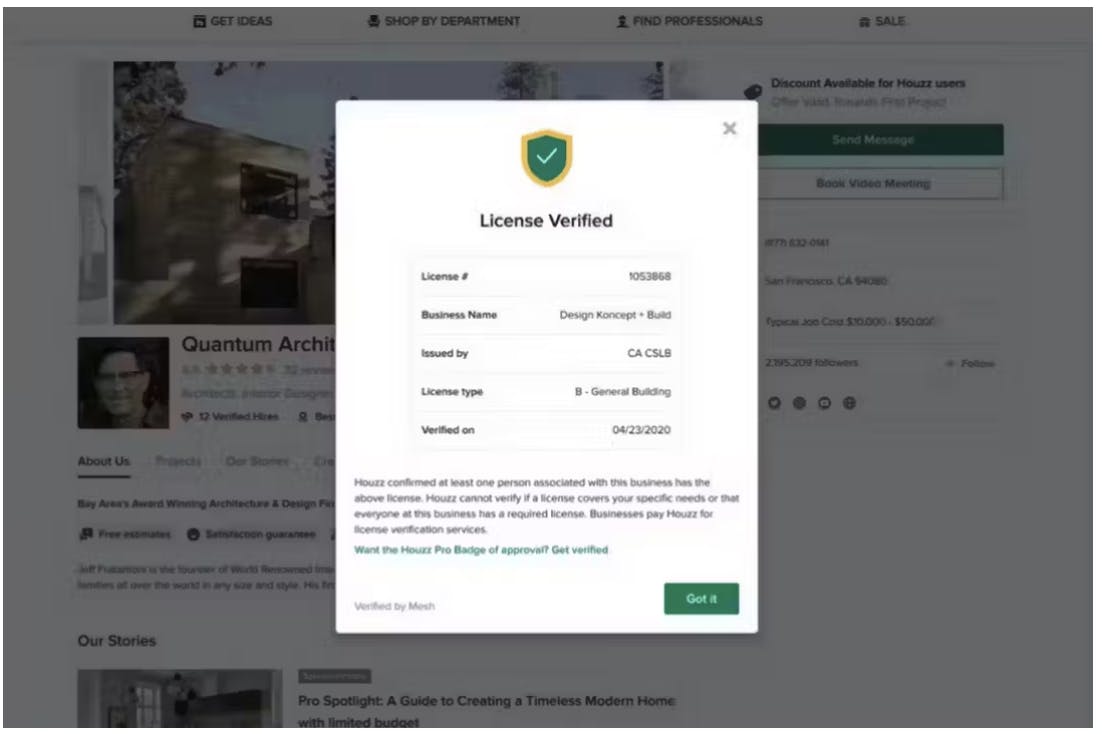
Leveraging your license on Houzz
Now that you know the Massachusetts general contractor license requirements, it’s time to start thinking about how you can promote your license to potential clients. Everyone who’s anyone knows the value of a blue checkmark on social media. That’s what the green Verified License Badge is for businesses on Houzz Pro. With one glance, this Badge helps you:
- Let homeowners know that your business is licensed by state industry experts.
- Stand out from the competition while homeowners consider who to hire
- Add credibility to your company name, providing peace of mind to future clients
Here are the steps you can take to add a verified license to your Houzz profile. If you haven’t created a free profile on Houzz, sign up today and get ready to make a bigger impact with your business’ online presence.


Want advice delivered to your inbox?
Unlock industry insights and updates for contractors and design pros
By signing up, I agree to the Houzz Terms of Use and Privacy Policy and that Houzz may use my information to contact me about relevant content, products, and services.