2025 Delaware General Contractor License Requirements
Find the Delaware general contractor licensing requirements for 2025 and let Houzz Pro help you navigate the confusing waters of becoming a general contractor.

Are you a Delaware general contractor looking to understand the licensing requirements for 2025? If so, you've come to the right place! In this blog post, we will walk you through the Delaware general contractors license requirements for 2025. This information will help you understand the steps required to obtain and maintain your license. Read on to learn more about these important requirements and get started on the path to becoming a licensed Delaware general contractor!
Who Issues Delaware General Contractor Licenses?
Anyone intending to undertake construction tasks must obtain a license sanctioned by the state of Delaware. Furthermore, Delaware administers separate licensing procedures through the Division of Professional Regulation for distinct categories, including:
- Electricians
- Plumbers
- HVAC professionals
- Water Drillers
- Pump Installers
More information about specialty trades licensing and applications can be found here.

Different Types Of Delaware General Contractors Licenses
Within Delaware, there are two distinct licenses available for registration and application. Although the application procedures share similarities, it's crucial to determine whether you'll be pursuing a:
- Resident Contractor License: This designation applies to individuals or businesses that engage in contractor work and maintain a consistent place of business within Delaware.
- Non-Resident Contractor License: If you or your business lack a regular business location in Delaware, your application process will resemble that of a resident contractor. However, you'll need to secure a surety bond.

How to Get Your Delaware General Contractor's License
1. Meet the basic requirements
- Before applying to get your general contractor's license in Delaware, there are several prerequisites you need to fulfill, including:
- Register your business with the Delaware Division of Revenue.
- Provide proof of workers’ compensation and unemployment insurance coverage.
- Obtain general liability insurance.
- Non-Resident Contractor License applicants will need to acquire a surety bond.
Once you’ve met the necessary requirements, you're all set to kick off the application/ registration procedure.
2. Apply and register
Whether you're going for a resident or non-resident license, you'll need to complete the Combined Registration Application (CRA) on the Delaware Department of Revenue website. Then you can start the application process by submitting an application to the Delaware Division of Professional Regulation and pay the required fees. Next, you'll need to provide supporting documentation such as a financial statement, reference letters, and proof of liability insurance and worker's compensation coverage. Once you have submitted your application and documentation, it will be reviewed by the licensing board. If your application is approved, you will receive notification and be eligible to proceed to the next step.

Do You Have to Take a Contractor License Exam?
Obtaining a resident or non-resident license in Delaware doesn't necessitate an exam or documented experience. Nevertheless, licenses are granted for roles such as electricians, plumbers, HVACR experts, water drillers, and pump installers, which require either an exam or evidence of experience to secure licensure or certification. You can find all the details regarding exam scheduling, fees, and locations for these specialized trades on Delaware's Division of Professional Regulation website.
How Much Does Licensing Cost in Delaware?
Your entire process of registration, application, and obtaining a license will be managed by the Delaware Division of Revenue. The associated fees are as follows:
- Business Registration: $15 for each location
- Annual Licensing Fee: $75
- Checks should be payable to: DIVISION OF REVENUE
STATE OF DELAWARE P.O. BOX 8750 WILMINGTON, DE 19899-8750

Penalties for Unlicensed Contractors in Delaware
Under Chapter 36 of the Delaware Contractor Registration Act Anyone knowingly performing contracting work without a license will result in a civil penalty ranging from $5,000 to $85,000 for each violation. For violations that lack intentionality, civil penalties of up to $1,000 per violation may apply.
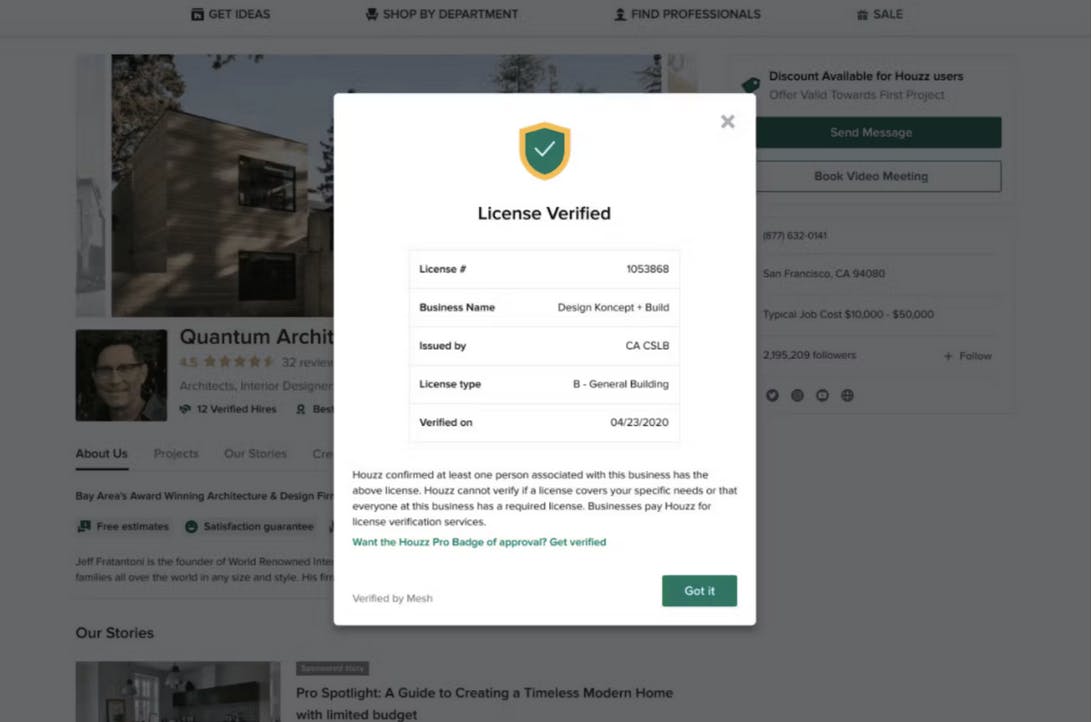
Leveraging your license on Houzz
Now that you know the Delaware general contractor license requirements it’s time to start thinking about how you can promote your license to potential clients. Everyone who’s anyone knows the value of a blue checkmark on social media. That’s what the green Verified License Badge is for businesses on Houzz Pro. With one glance, this Badge helps you:
Let homeowners know that your business is licensed by state industry experts. Stand out from the competition while homeowners consider who to hire. Add credibility to your company name, providing peace of mind to future clients
Here are the steps you can take to add a verified license to your Houzz profile. If you haven’t created a free profile on Houzz, sign up today and get ready to make a bigger impact with your business’ online presence.


Want advice delivered to your inbox?
Unlock industry insights and updates for contractors and design pros
By signing up, I agree to the Houzz Terms of Use and Privacy Policy and that Houzz may use my information to contact me about relevant content, products, and services.