How to Prevent Disagreements With Clients About Projects
Pros share communication tips for making sure homeowners stay as happy as possible while projects proceed

In a dream world, every design, remodeling and outdoor project would run on time with no surprises, and clients would be nothing but patient throughout the process. But the fact is that homeowners often find remodeling and outdoor projects stressful, especially when problems arise. This can lead to conflict with you, their designer or remodeling pro.
We recently spoke with experienced professionals to get their wisdom on handling client disagreements. Their biggest collective takeaway: Do everything you can to avoid discord in the first place. Here’s how to do that.

Communicate About Your Process
Communication with clients about a design, remodeling or outdoor project begins well ahead of demolition or groundbreaking. It’s critical that you outline from the get-go what clients should expect during each project phase.
“We don’t have a lot of disagreements with clients, we really don’t,” says Cheryl Kees Clendenon of In Detail Interiors in Pensacola, Florida. “The reason is we do such a good job of preparing the client for how we work.”
Clendenon lays out her firm’s process five times for a would-be client before she ever creates a design proposal. The process is outlined in materials she refers to as “the Client Introduction,” which explains to homeowners the benefits of working with her design firm. Clendenon emails these materials ahead of the initial discovery call. And then she continues to repeat the information.
“We go over it on the phone in the initial discovery call,” she says. Clients hear about the process again in a follow-up email Clendenon sends after the call. She reviews the process once more during the initial consultation, which is when she visits the home to diagnose the problems leading the homeowners to want to remodel or decorate. Finally, information about her firm’s process is also on the company website as an FAQ.
Repetition is a great way to make the design or remodeling process clear to homeowners. Remember, the way you do things may be a well-oiled machine. But many homeowners may be embarking upon a remodel for the first time.
Right now, due to the pandemic’s impact on the supply chain, some parts of the process may be more out of your control than is typical. “One of the things that we, as designers, find can be a bit of a challenge right now is lead times,” says Maegan Swabb of M. Swabb Decor + Style in San Diego. For instance, she might order an in-stock sofa, only to hear from a vendor two weeks later that the item has been discontinued. So Swabb is preparing clients to understand that with every project — and especially now — some bumps may occur.
“I think if you set those expectations from the beginning and they understand that we’re human,” that’s going to help set you up for success, she says.

Communicate on Price, Schedule and Look
This may sound basic, but it’s true: A good way to avoid conflicts with clients regarding a project is to communicate about everything.
“There’s three things clients want communicated: price, schedule and finish, meaning how it’s going to look,” says B.J. Barone, a general contractor at 41 West in Naples, Florida. “Most builders fail because they don’t communicate in all three of those. They’ll send a bill out too late in the game, and the customer will say, ‘Oh I thought that was included.’ ”
Homeowners don’t naturally know how unexpected issues or changes they’d like to make midproject will affect the timeline or the bottom line, especially if they haven’t hired a pro before. So when a client brings up a possible change to the project, Barone or his employees immediately address the three key points: price, schedule and finish (or look).
His company also quickly sends out change orders that detail how the change will affect price, timeline and look. The client must sign off before workers proceed.
Another good communication practice is to document everything that’s discussed. “I preach to my guys that every conversation should be followed up with an email recap” that summarizes the conversation, Barone says.
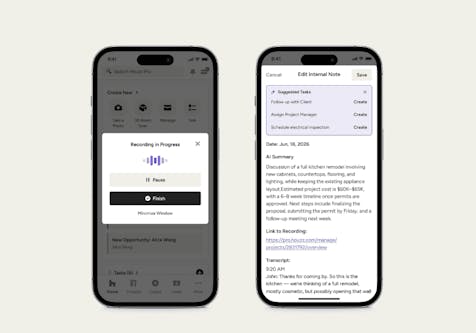
Project management software like Houzz Pro can help you track communication with clients so that you each have a central record of what’s been agreed to. Designers and other pros can use Houzz Pro to manage their client emails, direct messages and phone calls. They can share photos and files with clients, and send proposals, mood boards and more.

Be Upfront About Your Project Backlog
Another critical thing to communicate is the lead time before you can take on a new project, or get started in the design phase for a potential new client. This might include sharing with potential clients how the COVID-19 pandemic has affected your backlog of work.
For instance, landscape designer Jim Drzewiecki of Ginkgo Leaf Studio in Cedarburg, Wisconsin, found that while project inquiries slowed for only a couple of weeks, his typical work process was thrown off for much longer. Normally, Drzewiecki works in an office with fellow designer Hannah Paulson, and they are quite collaborative.
When the pandemic hit, the designers worked from their respective homes, texting and touching base daily. This continued for three months. In May, Drzewiecki’s father died. All of this lowered productivity for their two-person team.
Now the designers are back in the office and project inquiries are higher than ever, but Drzewiecki and Paulson are still digging themselves out of the hole caused by the shift in their work process — plus the general stress of the pandemic and the loss of a loved one for Drzewiecki. As a result, their turnaround times to produce a new design are longer.
“We tell people six, eight, 10 or 12 weeks” before a project can start, “depending how busy we are. And some people are contacting us when it’s only been four weeks,” Drzewiecki says. “We live in [a world with] an Amazon mentality.”
Drzewiecki is telling clients about the lengthier turnaround times when they call, so that if they do decide they want to work with him, a conflict doesn’t arise later over the length of time they’ll need to wait for his services.

Handling a Conflict With a Client When It Does Occur
If you’ve communicated throughout the project and documented all the client’s decisions, there should be little opportunity for conflict. But occasionally disagreements can’t be avoided. And in those cases, you have to keep in mind what matters most to you: being right or keeping your client happy.
“There is a cost of doing business,” Clendenon says. “If you know that they signed off on the yellow knob and all of a sudden they want the red knob, you just get the red knob.”
Also, differences of opinion about a project’s direction might occur with a client you’ve already agreed to work with. “I come back to ‘the client is always right,’ ” says Jimmy Crisp of Crisp Architects in Millbrook, New York. “Unless it’s something that is going against code or could be dangerous, I tell clients … ‘If you want a purple tower connected to your house, I will do the best purple tower that can be done.’
“I will say, ‘I don’t think it goes with the architecture’ or ‘It’s not a good color for the neighborhood,’ but it is their house.”

Want advice delivered to your inbox?
Unlock industry insights and updates for contractors and design pros
By signing up, I agree to the Houzz Terms of Use and Privacy Policy and that Houzz may use my information to contact me about relevant content, products, and services.